

Asset acquisition, in the context of online auction marketplaces, means purchasing physical goods or property through competitive bidding on a platform that connects buyers with pre-owned luxury items, collectibles, estate lots, and real estate. The industry term for this process is consignment auction, and understanding how it works before you register or list saves you money, time, and headaches.
Buyers: before the lot closes
- Pull the condition report and provenance documentation from the listing page.
- Calculate your true maximum: hammer price + buyer’s premium + shipping + applicable sales tax.
- Register with a valid payment method and government-issued ID before bidding opens.
Sellers: before you consign
- Get a professional appraisal to set a realistic reserve price.
- Gather all provenance records, original receipts, certificates of authenticity, and service history.
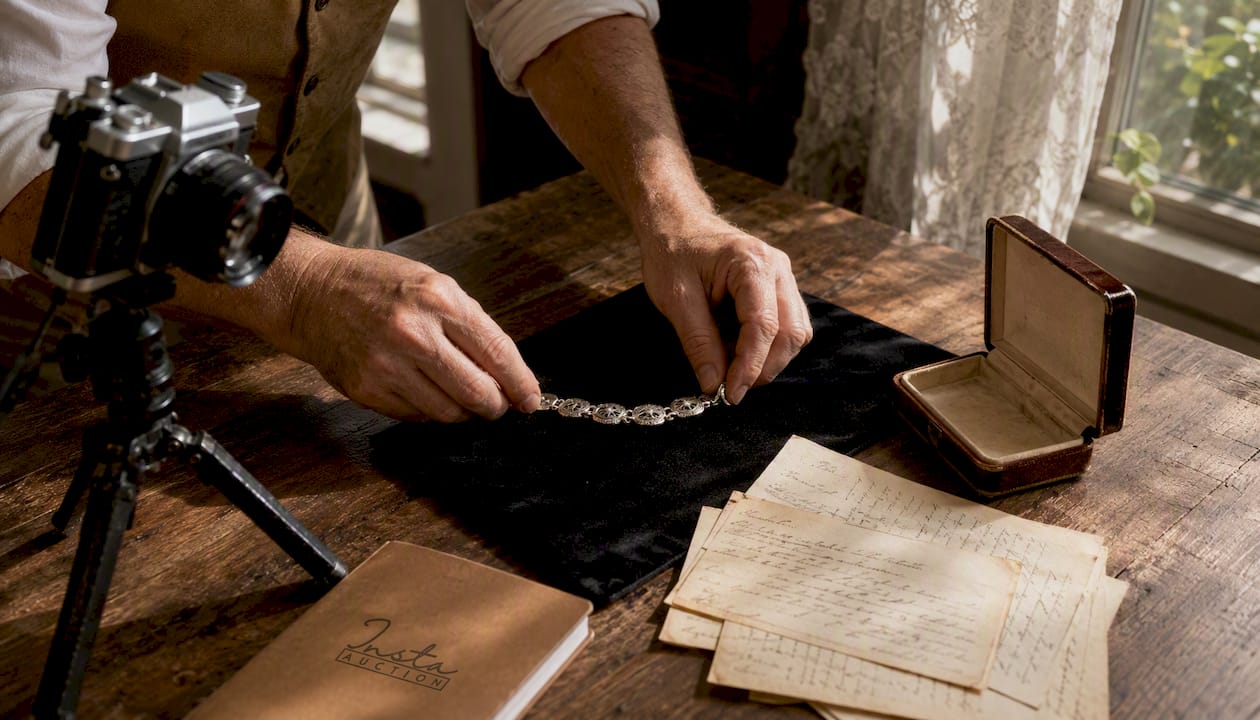
- Photograph every angle in high resolution before dropping items off or scheduling pickup.
Table of Contents
- How does the online auction asset acquisition process work?
- What should buyers check before an auction closes?
- How sellers prepare assets to maximize value and reduce buyer friction
- What are the biggest risks and red flags in auction listings?
- What fees and timelines should buyers and sellers budget for?
- Insta-auction makes asset acquisition straightforward for buyers and sellers
- Key Takeaways
- Why provenance and appraisal quality determine auction outcomes
- Useful sources for verification and authentication
- FAQ
How does the online auction asset acquisition process work?
Online estate auctions list items as individual lots and sell them through competitive bidding over a defined window. Here is the sequence from first listing to final transfer:
- Lotting and listing. The auction house photographs, describes, and assigns a lot number to each item. Condition notes, provenance, and starting bid are published.
- Buyer registration. Bidders create an account, verify identity, and provide a payment method before the auction opens.
- Bidding window. Buyers place bids manually or set a maximum auto-bid. The platform automatically outbids competitors up to that ceiling.
- Anti-sniping close. When a bid arrives in the final minutes, the lot timer extends automatically, giving every bidder a fair chance to respond. This soft-close protection also tends to push final prices higher.
- Invoice and fees. The winning bidder receives an invoice showing hammer price plus buyer’s premium, applicable sales tax, and shipping or handling charges.
- Payment deadline. Most platforms require payment within 24–72 hours of auction close.
- Pickup or shipping. Buyers coordinate pickup during a scheduled window or arrange carrier shipping. Tracking is provided.
- Title or ownership transfer. For personal property, a receipt serves as proof of purchase. For real estate lots, escrow opens, title search is completed, and the deed transfers at closing.
Online marketplaces reach a far wider pool of bidders than in-person estate sales, which typically increases realized prices for collectible and high-value items. That reach is one of the primary reasons executors, downsizing homeowners, businesses, and charities choose the online auction format.
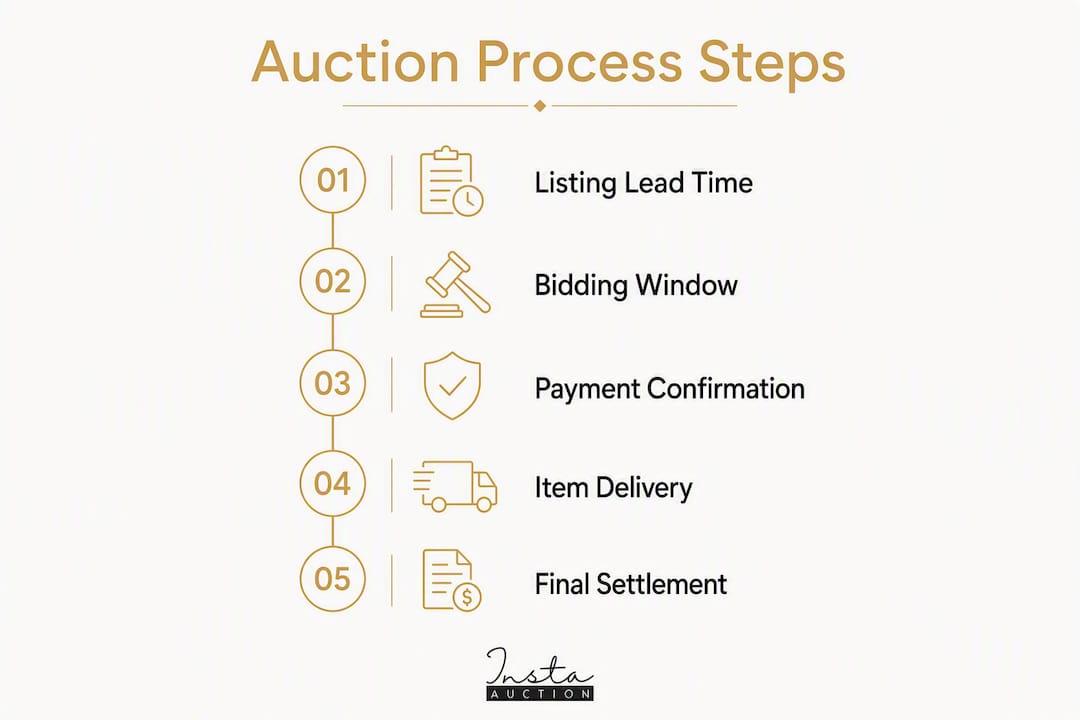
Typical timeline at a glance: Listing lead time: 1–2 weeks. Auction window: 5–14 days. Payment deadline: 24–72 hours post-close. Pickup or shipping: 3–10 business days. Real estate closing: 30–60 days.
What should buyers check before an auction closes?
Experts advise requesting high-resolution photos, detailed condition reports, and provenance documentation before any lot closes. Here is how to work through that checklist efficiently.
Inspect the photos first. Zoom into every high-resolution image for chips, cracks, replaced hardware, or inconsistent patina. If the listing shows fewer than six angles, request more before bidding.
Read the condition report carefully. A solid condition report covers the fields below:
| Field | What it shows | Why it matters |
|---|---|---|
| Overall grade | General state (excellent, good, fair, poor) | Sets baseline expectation |
| Specific damage notes | Chips, scratches, repairs, missing parts | Reveals hidden cost of restoration |
| Provenance statement | Ownership history, original receipts | Confirms legitimacy and origin |
| Authentication reference | Certificate, hallmark, serial number | Supports independent verification |
| Restoration disclosure | Prior repairs or refinishing | Affects collector value significantly |
Verify authenticity independently. Auction-house opinions on authenticity are scholarly views, not guarantees. For watches, jewelry, art, or designer goods, check stolen-property registries such as the Art Loss Register and run manufacturer serial-number checks where available. When an item’s value justifies the cost, pay for third-party authentication or a specialist lab analysis.
Calculate your true cost before you bid. A worked example: hammer price of $2,000 + 20% buyer’s premium ($400) + $150 shipping + $195 sales tax (at 7.5% on $2,600 subtotal) = $2,745 total out of pocket. That gap between hammer price and final cost surprises first-time buyers constantly.
Pro Tip: Submit all questions about condition, provenance, or missing documentation before the lot closes. Save every email or platform message as evidence. If a dispute arises later, that paper trail is your strongest asset.
For a deeper bidding checklist, the expert tips for winning online luxury auctions cover timing, auto-bid strategy, and how to read a lot description for red flags.
How sellers prepare assets to maximize value and reduce buyer friction
Professional cataloging and appraisal directly increase realized prices. Inhouse appraisal, professional photography, and clear condition reporting help items reach competitive bids, particularly when high-value pieces are involved.
Seller preparation checklist:
- Write accurate, specific descriptions: brand, model, year, dimensions, materials, and known history.
- Photograph every angle in natural light, plus close-ups of hallmarks, serial numbers, and any damage.
- Attach all provenance documents: original receipts, certificates of authenticity, appraisal letters, and service records.
- Decide on lotting strategy: single high-value items attract focused bidders; grouped lots work for lower-value collections.
- Set a realistic reserve based on recent comparable sales, not sentimental value.
Consignment terms: what to expect
- Submit items for appraisal and receive a valuation estimate.
- Sign a consignment agreement specifying the reserve price, seller commission rate, and auction timing.
- The platform catalogs, photographs, and markets the lot across digital channels.
- After the auction closes and payment clears, the seller receives the hammer price minus the agreed commission.
Estate auctions are used by executors, downsizing homeowners, businesses, and charities to convert belongings to cash on a predictable schedule. Insta-auction’s appraisal and marketing services support both valuation accuracy and bidder reach, which matters most when the collection includes luxury goods, sports memorabilia, or real estate.
For sellers preparing a collection, the auction-ready luxury items guide shows exactly what documentation and photography standards move items from “listed” to “sold at top price.”
What are the biggest risks and red flags in auction listings?
The most common problems are incomplete provenance, inconsistent serial numbers, undisclosed restoration, missing titles or liens, and estimates that seem suspiciously low relative to market value.
Red flags to watch:
- Provenance that stops abruptly or cannot be traced past one owner.
- Serial numbers that are scratched, re-stamped, or absent entirely.
- Restoration work described vaguely as “professionally cleaned” with no specifics.
- Real estate lots with no title search, active liens, or missing inspection reports.
- Starting bids far below market value with no reserve, which can signal a rushed liquidation or misrepresented item.
If you suspect a problem, act before the lot closes:
- Document everything: screenshot the listing, save all photos, and note the lot number and auction date.
- Contact the auction house directly and ask for clarification in writing.
- For suspected stolen goods, cross-reference the Art Loss Register, Interpol’s stolen works database, and manufacturer databases for watches or specialty vehicles.
- If you win a lot and discover misrepresentation after the fact, file a dispute with the platform immediately and contact your payment provider about a chargeback within their stated window.
For real estate lots specifically, always order a title search before bidding and confirm whether title insurance is available. Liens, easements, or unresolved ownership claims do not disappear at the gavel. Consult a licensed title company or real estate attorney before placing a bid on any property lot. This article provides general information, not legal advice; confirm current rules with a qualified professional or the relevant state authority.
What fees and timelines should buyers and sellers budget for?
The buyer’s premium is a percentage added to the hammer price to reach the total amount due at checkout. It is advertised in advance and must be factored into every maximum bid calculation. A buyer bidding $1,000 on a lot with a 25% buyer’s premium owes $1,250 before tax and shipping…
Fee components:
| Fee | Paid by | Typical range |
|---|---|---|
| Buyer’s premium | Buyer | 15% to 25% |
| Seller commission | Seller | 20% to 40% |
| Payment processing | Buyer | 2%–4% of total |
| Shipping and handling | Buyer | Varies; flat-rate options available |
| Shipping insurance | Buyer | 1%–2% of declared value |
| State/local sales tax | Buyer | Varies by state |
Timeline reference:
| Stage | Typical window |
|---|---|
| Listing lead time | 1–2 weeks |
| Auction bidding window | 5–14 days |
| Payment deadline | 24–72 hours post-close |
| Pickup or shipping | 3–10 business days |
| Real estate escrow and closing | 30–60 days |
Escrow protects both parties on high-value transactions: funds are held by a neutral third party until the item or property is confirmed received and matches its description. For real estate, review the terms and conditions before bidding to understand exactly what the closing process requires.
Insta-auction makes asset acquisition straightforward for buyers and sellers
Most online auction platforms leave buyers to figure out provenance and fees on their own. Insta-auction takes a different approach: trained appraisers evaluate every item before it lists, condition reports are built into each lot, and the fee schedule is published upfront so there are no surprises at checkout.
For sellers, the platform handles appraisal, professional photography, digital marketing across multiple channels, and logistics coordination, including nationwide flat-rate shipping. Executors managing estate liquidations, families downsizing, and charities converting donated goods to cash all use Insta-auction because the consignment process is handled end to end. Insta-auction also donates a portion of every completed sale to a selected charity, so sellers can opt in and direct that contribution to a cause they care about.
Getting started takes three steps:
- Sellers: Submit your items through the consignment form for an expert appraisal and reserve recommendation.
- Buyers: Register on the platform, browse active lots in luxury goods or real estate auctions, and set your maximum bid before the window closes.
- Both: Review the fee schedule and timeline for your lot category before committing.
Browse current listings or submit your collection at insta-auction.com.
Key Takeaways
Buying or selling physical assets through an online auction requires verified provenance, a clear fee calculation, and a completed due-diligence checklist before the lot closes.
| Point | Details |
|---|---|
| Calculate total cost before bidding | Add buyer’s premium (typically 15%–25%), sales tax, and shipping to the hammer price before setting your maximum. |
| Request provenance and condition reports | Always ask for documentation before a lot closes; auction-house attributions are opinions, not guarantees. |
| Sellers benefit from professional cataloging | Appraisal, high-resolution photography, and clear condition notes increase realized prices on high-value items. |
| Real estate requires extra steps | Order a title search, confirm no liens exist, and review escrow terms before bidding on any property lot. |
| Insta-auction covers both sides | Expert appraisal, transparent fees, nationwide shipping, and a charitable donation component support buyers and sellers on every transaction. |
Why provenance and appraisal quality determine auction outcomes
The conventional wisdom is that price drives auction results. It does not. Provenance and catalog quality do. A well-documented item with a clean ownership history, a professional condition report, and sharp photography consistently outperforms a comparable item listed with a vague description and two blurry photos, even when the underlying objects are identical in quality.
The reason is simple: buyers bid on confidence, not just on objects. When documentation is thin, serious collectors either skip the lot or bid conservatively to price in the uncertainty. That uncertainty discount is real money left on the table for sellers, and it is the primary source of post-auction disputes for buyers who discover the item was not what the listing implied.
The practical takeaway for anyone using any platform: never skip the condition report request, never accept “as-is” without understanding what that means for your specific lot, and always carry shipping insurance on anything you cannot afford to lose. Those three habits eliminate the majority of problems before they start.
Useful sources for verification and authentication
Trusted U.S.-focused resources for buyers and sellers conducting due diligence:
- Art Loss Register (artloss.com): Search database for stolen or missing art, antiques, and collectibles before purchasing.
- Interpol Works of Art unit (interpol.int): International stolen-art database; useful for high-value fine art and cultural property.
- National Insurance Crime Bureau (nicb.org): VIN and serial-number checks for vehicles and specialty equipment.
- American Society of Appraisers (appraisers.org): Find accredited appraisers for jewelry, fine art, antiques, and real estate.
- USPAP (Uniform Standards of Professional Appraisal Practice): The governing standard for U.S. appraisers; confirm your appraiser follows it.
- Title companies and county recorder offices: For real estate lots, order a title search directly or through a licensed title company before bidding.
- Insta-auction’s hidden value guide: The expert guide to identifying hidden value walks through how trained appraisers evaluate luxury goods for authenticity and market positioning.
For authentication of watches, jewelry, or designer goods, contact the manufacturer’s official authentication service or a certified gemological laboratory (GIA for diamonds and colored stones; WOSTEP-certified watchmakers for timepieces) when the item’s value makes the cost worthwhile.
FAQ
What is a buyer’s premium and how does it affect my bid?
A buyer’s premium is a percentage added to the hammer price to reach the total amount you owe. For example, a buyer bidding $1,000 on a lot with a 25% buyer’s premium owes $1,250 before tax and shipping., so always factor it into your maximum bid.
How do I verify an item’s authenticity before bidding online?
Request the condition report, provenance documentation, and serial number from the auction house, then cross-reference against the Art Loss Register and the manufacturer’s own database. For high-value items, pay for independent third-party authentication before the lot closes.
What happens if a won item does not match its listing description?
Document the discrepancy immediately with photos, contact the auction platform in writing, and file a dispute. If the platform does not resolve it, contact your payment provider about a chargeback within their stated window.
How does Insta-auction support sellers preparing estate items?
Insta-auction provides expert appraisal, professional photography, condition reporting, and digital marketing for each consigned lot, plus nationwide flat-rate shipping coordination and a charitable donation on every completed sale.
Do I need title insurance when buying real estate at auction?
Title insurance protects against undisclosed liens, ownership disputes, and recording errors that a title search may miss. For any real estate lot, consult a licensed title company or real estate attorney before bidding.