

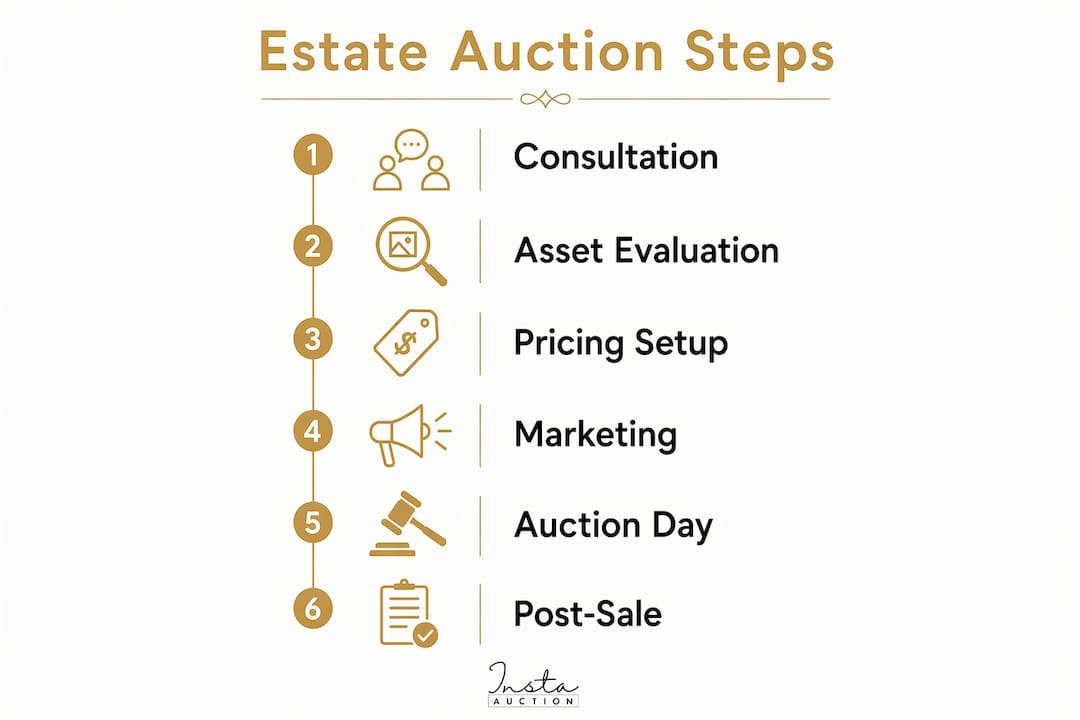
A well-run estate auction follows a clear sequence: confirm legal authority, evaluate assets, set pricing, market the sale, execute auction day, and wrap up post-sale. Skip or rush any phase and you risk delays, disputes, or leaving money on the table. The full process typically spans several weeks from initial consultation to final settlement.
How the estate auction timeline works from start to finish
Every estate auction moves through six core phases. Here is a practical overview with approximate timeframes:
| Phase | Key Tasks | Timeframe |
|---|---|---|
| Initial consultation and asset evaluation | Client meeting, walkthrough, inventory, legal authority check | Week 1 |
| Planning, pricing, and setup | Commission model selection, cataloging, contract drafting | Weeks 1–3 |
| Marketing | Photos, listings, email, signage, ads | Weeks 2–4 |
| Auction day execution | Bidder registration, live/online bidding, payment collection | Sale day(s) |
| Post-sale wrap-up | Payment settlement, proceeds distribution, unsold item disposal | Week after sale |
| Estate clean-out | Hauling, donations, final property handover | 1–2 weeks post-sale |
Legal authority comes first. Before any cataloging or marketing begins, the executor, trustee, or personal representative must confirm written authority to sell, whether from a will, trust document, or court order. Proceeding without it can halt the auction mid-process.
- Confirm letters of appointment, a trust document, or a court order before scheduling anything
- Consult an estate attorney on probate requirements and tax treatment
- Order a title search if real property is involved
- Identify all heirs or interested parties early to prevent last-minute objections
Step 1: How to start the initial consultation and asset evaluation
The first week sets the tone for everything that follows. A thorough walkthrough prevents pricing surprises and protects your labor investment later.
- Schedule an initial client call to understand the estate’s scope, timeline pressures, and family dynamics
- Walk every room and outbuilding; photograph broadly before touching anything
- Build a rough inventory grouped by category: tools, jewelry, furniture, collectibles, household goods
- Verify legal authority to sell before committing to a contract
- Flag emotionally significant items early; families often need time before releasing certain pieces
- Identify high-value categories that warrant specialist attention: jewelry, coins, vintage tools, vehicles
Pro Tip: Focus your expert appraisal time on the top tier of items. According to Gavelist’s 2026 lot data study covering 24,436 cataloged lots, the top 10% of lots generate 53% of total revenue. Spending equal time on every item is how cataloging labor bleeds profit.
Tools, jewelry, coins, and vehicles consistently perform well at auction. Oversized or worn furniture tends to sell poorly, so factor that into your walkthrough assessment when estimating gross.
Step 2: Planning, pricing strategies, and auction setup
Pricing model selection is where most new organizers make costly mistakes. The right model depends on what you found during the walkthrough.
Three models dominate the industry:
- Commission only (30–50% of gross): Works well for high-value, well-curated estates. Auction commission rates typically range 30–50%, with tiered sliding scales that reduce the rate beyond $50,000 in sales. The risk is absorbing 80–100 hours of labor on a low-value estate for a payout that may not cover your effective hourly rate.
- Hourly or flat fee ($30–$100/hr or a flat project fee): Protects your labor on cluttered or low-value estates. A large home being cleared over one to two months might warrant a flat fee of $2,000–$4,000 if the goods are uncertain in value.
- Hybrid (20–25% commission plus a $500–$1,000 setup fee): The setup fee covers cataloging, photography, and listing labor before any sale happens. Professional auction firms increasingly adopt hybrid models to balance labor costs against revenue upside. On a 250-lot estate grossing $15,000, a hybrid of 20% plus $750 setup pays $3,750 with downside protection built in.
Cataloging strategy matters as much as pricing. Concentrate detailed descriptions and photography on the high-revenue tier. Standard and box lots still need to be listed, but near-zero marginal time per lot keeps the economics workable.
Pro Tip: Always include a minimum payout clause to avoid working below baseline compensation. A straight commission on a $2,000 gross sale may represent 40 hours of work. Your contract should also specify commission structure, cleanout responsibility with a dollar cap, unsold-item disposition, a cancellation fee, and payment timeline.

| Pricing Model | Best For | Key Risk |
|---|---|---|
| Commission only (30–50%) | High-value, curated estates | Labor loss on low-value sales |
| Hourly/flat fee ($30–$100/hr) | Cluttered or uncertain estates | Caps your upside on strong estates |
| Hybrid (20–25% + setup fee) | Most estates after initial experience | Requires clear contract language |
Step 3: How to market the estate auction effectively
Marketing typically runs 1–2 weeks before the auction date. Starting too late shrinks your bidder pool; starting too early without confirmed lot photos wastes the window.
- Professional photos are non-negotiable. Blurry or poorly lit images suppress bids, especially for jewelry and collectibles
- Write detailed lot descriptions that include condition notes, measurements, and maker marks where relevant
- Publish listings on online auction platforms with full terms: buyer’s premium percentage, deposit requirements, and pickup or shipping policies
- Run targeted email campaigns to your existing bidder list; repeat buyers convert at higher rates than cold traffic
- Place local newspaper ads and roadside signage for on-site sales; signage alone drives walk-in traffic that online listings miss
- Estate auction marketing budgets typically range $300–$1,000, covering multi-channel ads, signage, and email campaigns
- State buyer’s premiums clearly in every marketing piece. Surprises at checkout kill repeat business
For selling items at auction in specialty categories like watches or fine jewelry, targeted collector forums and specialist newsletters outperform general advertising.
Step 4: What to manage on auction day
Auction day execution is where preparation either pays off or falls apart. Registration, payment, and contingency protocols need to be locked in before the first bid.
- Open bidder registration at least 30 minutes before the auction starts; verify ID and collect deposit or credit card authorization upfront
- Brief all staff on their roles: clerking, cashiering, floor management, and online bid monitoring if running a simulcast
- For live and sealed-bid formats, confirm all bids are recorded in real time with bidder numbers attached
- Collect payment immediately after the auction closes; accepted methods and deadlines should match what was published in marketing
- Deposits for real property auctions are typically nonrefundable and paid on auction day; confirm the amount and form of payment in advance
- Have a contingency plan for platform outages if running online bidding: a phone-bid backup or a brief pause protocol keeps the sale moving
- Keep a running log of sold lots, buyer numbers, and hammer prices for post-sale settlement accuracy
For families new to the process, Insta-auction’s guide to online auction bidding explains registration and payment steps in plain language.
Step 5: Post-sale wrap-up and estate clean-out
Settlement and clean-out are where disputes most often arise. Clear contract language written in Step 2 is what prevents them here.
- Reconcile all hammer prices against bidder records before releasing any items
- Collect outstanding payments within the timeline stated in your contract; follow up on unpaid lots immediately
- Distribute proceeds to the seller after deducting your commission, buyer’s premium retained amounts, and any pre-approved pass-through costs
- Send the seller a detailed settlement report showing gross sales, fees, and net proceeds
- Unsold items are the seller’s responsibility unless your contract specifies otherwise; confirm disposition in writing before the sale
- Coordinate estate clean-out logistics: hauling, dumpster rental ($500–$600 is a common range), and donation drop-offs
- If the estate is part of a broader move, align the clean-out schedule with the family’s moving timeline to avoid double-handling
Families managing estate liquidation after a loss often underestimate how long clean-out takes. Build a buffer of at least one week between auction day and property handover.
Legal authority, commission trends, and contract protections
Legal authority is the single most common source of auction delays. Formal documentation such as letters of appointment or court orders must be in hand before any sale is scheduled. If authority is unclear or contested, court confirmation may be required, which can add weeks to the timeline.
Commission snapshot: Seller commissions typically run 15–35% of hammer price, while buyer’s premiums for estate and personal property sales commonly fall in the 10–15% range. High-value estates may qualify for reduced commission thresholds beyond $50,000 in total sales.
The industry is moving away from flat commission-only structures. Hybrid pricing, which combines a fixed setup fee with a reduced commission rate, has become the preferred model among experienced operators because it protects labor costs on unpredictable estates while preserving upside on strong ones.
Contractual protections every auctioneer should include:
- Commission or fee structure with a clear calculation method
- Minimum payout clause to prevent free labor on low-value sales
- Cleanout responsibility with clear limits on hauling costs
- Unsold-item disposition terms addressing donation, haul-away, or client buyout
- Cancellation or kill fee for pre-sale labor compensation if the client withdraws
- Payment timeline and accepted methods
High-value jewelry and coins sometimes yield better net returns through specialist channels, since auction fees can erode margins on items where the spread between hammer price and retail value is narrow. Worth discussing with the client during Step 1.
How Insta-auction supports estate auction organizers

Insta-auction works with estate organizers who need expert appraisal, targeted marketing, and a platform built for pre-loved luxury items and collectibles. Trained specialists handle lot assessment and multi-channel promotion, and a portion of every sale goes to a selected charity. If you are managing an estate with auction-ready luxury items or high-value collectibles, Insta-auction’s approach tends to produce stronger hammer prices than general liquidation channels. Start with a consultation to see which lots belong in a specialist auction versus a general estate sale.
Key Takeaways
A successful estate auction requires confirmed legal authority, a pricing model matched to the estate’s value, and a marketing window of at least 1–2 weeks before sale day.
| Point | Details |
|---|---|
| Legal authority first | Confirm letters of appointment or a court order before scheduling any auction activity. |
| Match pricing to the estate | Use hybrid or hourly models for uncertain estates; commission-only works best for high-value, curated goods. |
| Concentrate cataloging effort | The top 10% of lots generate 53% of revenue; focus detailed labor there, not across every lot equally. |
| Market 1–2 weeks out | Professional photos, online listings, email, and signage together drive the bidder turnout that determines hammer prices. |
| Contract clauses prevent disputes | Include minimum payout, cleanout responsibility, unsold-item disposition, and a cancellation fee in every agreement. |
FAQ
How long does an estate auction typically take to organize?
Most estate auctions require several weeks from initial consultation to auction day, with pre-auction preparation covering legal authority confirmation, cataloging, and marketing. Post-sale settlement and clean-out add additional time.
What percentage does an auctioneer usually take from an estate sale?
Seller commissions typically vary and often use tiered sliding scales that reduce the rate on higher-grossing estates. Buyer’s premiums for estate sales commonly add a percentage on top of the winning bid.
What sells well at estate auctions?
Tools, jewelry, coins, and vehicles consistently perform well. Jewelry leads on a per-lot basis, while tools often generate the highest total revenue across a sale.
What doesn’t sell well at an estate sale?
Oversized or worn furniture tends to sell poorly, as do dated housewares and mass-market items with low resale demand. Identifying these early helps set realistic gross revenue expectations during the planning phase.
What should you avoid doing at an auction?
Bidders should never bid without reading the posted terms, particularly buyer’s premium percentages and deposit requirements. Organizers should never proceed without confirmed legal authority to sell, as it can void the entire sale.