

For most time-pressed executors handling estates with high-value luxury items and collectibles, an estate buyout is the fastest, lowest-risk path to cash and a broom-clean property. A single company purchases the contents outright, removes everything, and typically wraps up within a few days — compared to the several weeks an estate sale requires from setup through final day. Meanwhile, estate sale commissions take a significant percentage of gross sales, a cut that quietly erodes net proceeds before heirs see a dollar.
Accept a buyout when:
- The estate needs to close fast (probate deadlines, property sale pending, or family lives out of state)
- Privacy matters and a public tag sale feels intrusive
- The collection is mixed — high-value pieces alongside everyday household goods that would otherwise sit unsold
Consider auction or consignment instead when:
- The estate holds rare, highly collectible items with an active national bidder pool
- You have 60–90 days and the marketing reach to attract specialist buyers
- A handful of pieces are likely to generate competitive bidding that pushes prices well above wholesale
Table of Contents
- How do estate buyouts actually work, step by step?
- What does a buyout typically include, and what should the contract say?
- Pros and cons of estate buyouts for luxury items and collectibles
- What do buyout offers look like, and how long does everything take?
- How do you vet a buyout offer? The exact questions to ask
- When are alternatives better than a buyout?
- Quick preparation tips that protect estate value before any sale
- How Insta-auction approaches estate liquidations
- Key Takeaways
- What most executors get wrong about estate buyouts
- Insta-auction makes estate liquidation less complicated
- FAQ
How do estate buyouts actually work, step by step?
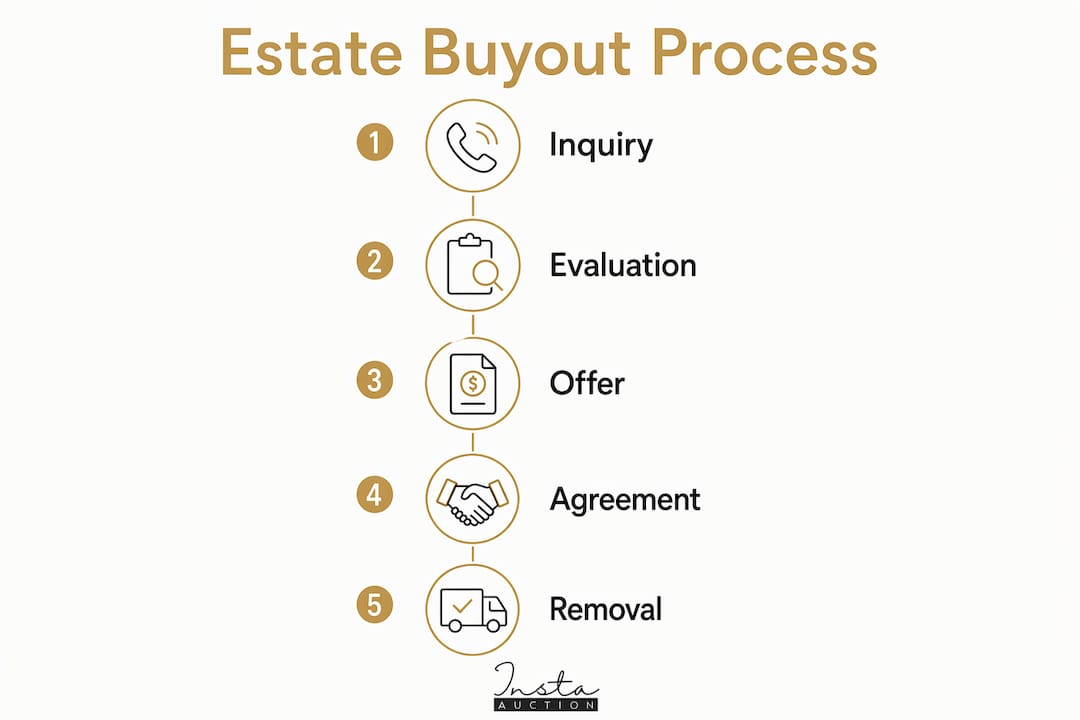
The process is more structured than most executors expect. Here is the sequence:
- Initial inquiry. You contact a buyout company or platform, describe the estate’s contents, and schedule a walkthrough. Many companies now offer virtual appraisals via video call or photo submission, which speeds things up considerably.
- On-site or virtual inventory and appraisal. A trained appraiser reviews the contents. Look for credentials from recognized bodies such as the American Society of Appraisers (ASA) or the International Society of Appraisers (ISA). Specialists in jewelry, fine art, or vintage collectibles should have category-specific experience, not just general estate knowledge.
- Written offer. The company presents a single lump-sum or itemized offer. Reputable buyers put this in writing before you commit to anything.
- Contract review and signing. The contract covers payment timing, removal schedule, liability during removal, and what happens to items the buyer does not want. Read this carefully — more on that below.
- Removal and cleanout. The buyer’s team clears the property, typically within 1–3 days of signing. A broom-clean guarantee means they handle disposal of unsalable items too.
- Payment and final accounting. Most buyouts settle by check, wire transfer, or escrow. Get an itemized receipt documenting what was purchased and at what agreed value.
Probate timelines frequently run six months to over a year, so executors have fiduciary duties to document every decision. A written offer and signed contract are not optional niceties — they are your paper trail.
What does a buyout typically include, and what should the contract say?
An estate buyout covers the full purchase of estate contents for an upfront cash offer, with removal included. Standard inclusions from reputable buyers:
- Full or partial contents purchase (some buyers will do partial buyouts for specific categories)
- Broom-clean guarantee covering disposal of unsalable items
- Insured removal with liability coverage during the clearance
- Itemized inventory or a documented lump-sum offer
Key contract terms to verify before signing:
- Payment timing. Is payment on signing, on removal completion, or on a delayed schedule?
- Cancellation rights. Can you withdraw within a set window if a better offer arrives?
- Liability and insurance. Who is responsible if a wall gets damaged during removal?
- Tax reporting. Who provides documentation for estate accounting and IRS reporting?
Pro Tip: Insist on a short written addendum listing any high-value items heirs want to retain or that are exempted from the buyout. Verbal agreements about grandmother’s jewelry or a specific painting disappear fast once the removal crew arrives.
After an estate sale, 30–50% of items typically remain unsold, and junk removal runs $500–$3,000. A buyout’s cleanout guarantee eliminates that hidden cost entirely.
Pros and cons of estate buyouts for luxury items and collectibles
Advantages:
- No commission — the offer is the net amount
- Fast cash, often within days of signing
- Privacy: no strangers walking through the home over a weekend
- Cleanout included, eliminating post-sale disposal costs
- Lower theft and damage risk than a public sale with dozens of visitors
Disadvantages:
- Total proceeds are usually lower than a well-marketed specialist auction during periods of strong demand
- Rare or highly collectible items may be undervalued in a lump-sum offer
- Some buyers cherry-pick desirable lots and leave the rest — confirm the full-cleanout commitment in writing
What do buyout offers look like, and how long does everything take?
Buyout companies anchor their offers to dealer wholesale comps, recent auction realized prices, and live spot prices for gold and silver. Their starting point is often a substantial discount to retail, varying by category and market conditions.
| Route | Typical Commission / Cost | Timeline to Cash | Cleanout Included? |
|---|---|---|---|
| Estate buyout | None (offer is net) | 1–3 days | Yes |
| Estate sale | 35–40% of gross | 2–4 weeks | No (30–50% items remain) |
| Auction house | 15% seller commission | 60–90 days | No |
| Online auction platform | Varies by platform | Days to weeks | No |

Payment methods vary: check and wire transfer are standard; escrow is available for larger estates. Always request an itemized invoice and a signed receipt — both matter for estate accounting and any IRS reporting.
How do you vet a buyout offer? The exact questions to ask
Before signing anything, run through this checklist:
- Written, itemized offer (not a verbal number)
- Proof of liability insurance covering removal
- References or documented client testimonials from recent estate jobs
- Clear removal timeline with a start and completion date
- Explicit disposal responsibilities for unsalable items
- Payment terms spelled out (amount, method, timing)
- Appraiser credentials (ASA, ISA, or category-specific certification)
| Question to Ask | Why It Matters | Acceptable Answer |
|---|---|---|
| “Can I see your proof of insurance?” | Protects you if property is damaged during removal | Current certificate of insurance, named on policy |
| “Will you provide an itemized offer?” | Lets you spot undervalued high-value pieces | Yes, in writing before signing |
| “Can you provide references from recent estate jobs?” | Confirms track record | At least 2–3 verifiable contacts |
| “What is your removal timeline?” | Avoids open-ended commitments | Specific start and end dates |
| “Who handles items you don’t purchase?” | Confirms broom-clean guarantee | Buyer disposes at no cost to estate |
Red flags: verbal-only offers, refusal to provide references, vague payment timing, and any pressure to sign on the spot.
Pro Tip: Get at least two buyout offers before signing. The spread between offers on a mixed luxury estate can be surprisingly wide — and a second offer often prompts the first buyer to sharpen their number.
When are alternatives better than a buyout?
Private buyers are best when speed, privacy, or minimal disruption are priorities. Estate sales work better when you have time and the inventory suits retail buyers. Auctions — especially online platforms — outperform buyouts when items are rare, collectible, and likely to attract competitive bidding.
- Estate sale: Best for mixed household contents with broad retail appeal; expect 2–4 weeks and a 35–40% commission
- Consignment: Best for individual high-value pieces (fine jewelry, art, designer goods); slower but often higher net
- Online auction: Best for collectibles with national or global buyer pools; auction prices often beat local retail for luxury finds
- Buyout: Best for speed, privacy, and full-cleanout when the estate is mixed or time is short
The smartest approach for many estates: sell the top 10–15 pieces via auction or consignment, then accept a buyout for everything else. You capture upside on the items most likely to generate competitive bids while still getting a fast, clean exit on the remainder.
Quick preparation tips that protect estate value before any sale
A few hours of preparation can meaningfully shift what a buyout company offers — or whether certain pieces belong in auction instead.
- Secure all documentation: receipts, certificates of authenticity, appraisals, and provenance records. A jewelry piece with documentation on a specialist platform can command significantly more than an undocumented equivalent.
- Photograph high-value items before anyone enters the property. Good photos also enable virtual appraisals, which can get you a preliminary offer faster.
- Segregate family keepsakes and items heirs want to retain before the appraiser arrives.
- Obtain independent appraisals for jewelry, art, and collectibles above a meaningful threshold — $500 is a reasonable floor, lower for items you suspect are undervalued.
- Remove perishables and personal documents; they complicate removal and create liability.
Pro Tip: Small, low-cost repairs and professional cleaning on furniture and textiles can materially increase realized values. A $50 upholstery cleaning on a mid-century chair can shift it from “buyout filler” to “auction candidate.”
How Insta-auction approaches estate liquidations
Insta-auction’s platform is built specifically for luxury pre-owned items and collectibles, with trained experts who appraise and market pieces across multiple digital channels. For sellers weighing a buyout against a platform sale, that distinction matters: a buyout locks in a wholesale number, while online bidding opens the item to a national pool of motivated collectors.
Key features relevant to estate sellers:
- Trained appraisers who assess items before listing, reducing the guesswork on valuation
- Multi-channel marketing that reaches buyers beyond a single local market
- Documented seller protections and transparent terms
- A social responsibility program that donates a portion of every sale to selected charities
For estates with a mix of everyday goods and genuine collectibles, Insta-auction’s estate sales resources support a hybrid approach: platform-sell the high-value pieces, coordinate a buyout or cleanout for the rest. That combination tends to outperform a single-route decision on either end.
Key Takeaways
An estate buyout is the right call when speed, privacy, and a clean exit matter more than squeezing maximum proceeds — but rare collectibles almost always deserve a specialist auction first.
| Point | Details |
|---|---|
| Buyout speed advantage | Removal completes in 1–3 days versus 2–4 weeks for an estate sale. |
| Commission comparison | Estate sales cost 35–40% of gross; a buyout has no commission — the offer is the net. |
| Hidden cost of estate sales | 30–50% of items typically go unsold, with cleanout running $500–$3,000. |
| Hybrid strategy | Auction or consign the top collectibles; accept a buyout for the remaining contents. |
| Insta-auction option | Insta-auction’s trained appraisers and multi-channel platform support both platform sales and estate liquidation coordination. |
What most executors get wrong about estate buyouts
The biggest mistake is treating a buyout as a single, take-it-or-leave-it transaction. It is not. The offer is a starting point, and the contract terms — payment timing, cleanout scope, liability — are negotiable. Executors who skip the written offer and accept a verbal number often discover the final payment is lower than what was discussed, or that the “full cleanout” excluded a garage full of tools.
The second mistake is applying a buyout to everything. An estate with a signed first-edition collection, a few pieces of estate jewelry, and a garage of mid-century furniture is not a single-category problem. The books and jewelry likely belong in specialist channels; the furniture is a reasonable buyout candidate. Treating the whole estate as one transaction leaves money on the table on the pieces most likely to attract competitive bids.
The practical fix: get two buyout offers, obtain at least one independent appraisal on any item you are uncertain about, and read the contract’s cleanout and liability clauses before you sign anything.
Insta-auction makes estate liquidation less complicated
When an estate holds luxury pre-owned items and collectibles, the difference between a fast buyout and a platform sale can be thousands of dollars on a single lot. Insta-auction gives sellers both options without forcing a choice upfront. Trained appraisers evaluate your items, high-value pieces go to a national bidder pool through auction-ready luxury listings, and the remainder can be handled through coordinated liquidation.

There is no obligation to list everything, and no long-term commitment required. If you are managing an estate and want a clear picture of what your items are worth before accepting any offer, request a no-obligation appraisal through Insta-auction’s estate sales page and get a real number to work from.
FAQ
What is an estate buyout?
An estate buyout is when a company purchases the contents of an estate for a single upfront cash offer and removes everything, typically leaving the property broom clean.
How long does an estate buyout take?
Most buyouts complete removal within 1–3 days of signing, compared to 2–4 weeks for a traditional estate sale from setup through final day.
Do estate buyouts include cleanout?
Yes. Reputable buyout companies include a broom-clean guarantee, disposing of unsalable items at no additional cost to the estate.
When should I choose auction over a buyout?
Choose auction or consignment when the estate holds rare, highly collectible items with an active national bidder pool and you have 60–90 days before needing to close. Insta-auction’s platform is designed for exactly this scenario.
Are estate buyout proceeds taxable?
Generally, proceeds from selling inherited personal property are subject to capital gains tax, with the tax basis typically set at fair market value at the date of death. Consult a tax professional for your specific situation — rules vary by estate size, item type, and holding period.