

For valuable estate collections, a curated online auction or specialist consignment service is almost always the highest-return path. The exceptions are narrow: if you need cash within days, a dealer buyout is faster (though you’ll leave money on the table); if the estate is mostly common household goods, an in-person estate sale is the more practical choice.
The three main routes at a glance:
- Curated online auction or specialist consignment — best for fine art, jewelry, vintage watches, rare collectibles, and designer furniture; wider buyer pool, competitive bidding, higher realized prices, but settlement takes 30–90 days
- In-person estate sale — best for mixed households with mid-value antiques and general goods; local traffic, fast turnover, commissions typically 25%–50% of gross sales
- Dealer buyout — fastest option, same-day cash, but dealers typically offer 40%–60% of retail value; only use this when speed is the overriding priority
TL;DR: If you have even one high-value item in the estate, request a qualified appraisal before committing to any route. That single step protects both your return and your tax position.
Table of Contents
- What services actually handle estate collections?
- How does the selling process actually work, step by step?
- Which estate items fetch strong returns, and which don’t?
- What fees and timelines should you expect by selling route?
- How do you choose the right estate-sale or auction provider?
- How should you prepare items before the sale?
- How a curated online auction can raise estate returns
- Key Takeaways
- What executors get wrong about estate collection sales
- Insta-auction makes the curated online auction path straightforward
- Useful resources for U.S. estate sellers and buyers
- FAQ
What services actually handle estate collections?
Estate sales are a professional liquidation of personal property, typically run by a company that stages the home, prices every item, advertises to buyers, and manages the event from setup through cleanup. They work best when the collection is broad and geographically accessible — think a full household of mid-range antiques, furniture, and decorative goods where local foot traffic can move volume quickly.
Consignment through a specialist dealer or retail gallery suits single high-value pieces or tightly defined categories. You leave the item with the dealer; they sell it at their price and split the proceeds. The upside is their existing collector clientele. The downside is that timelines are unpredictable and you give up pricing control.
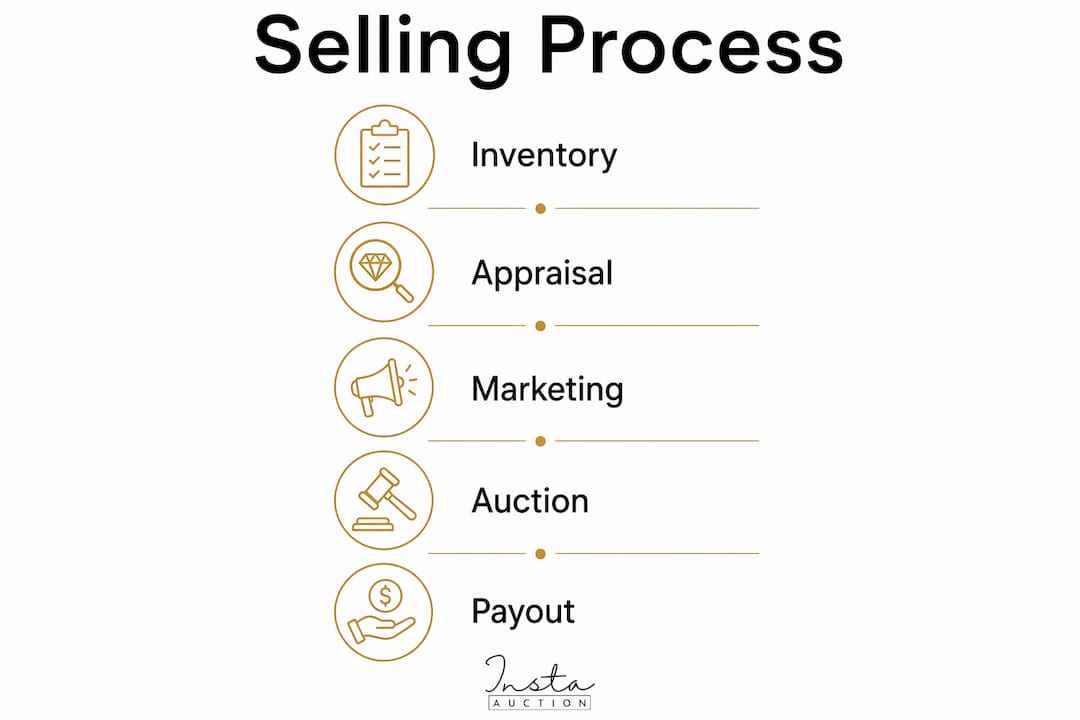
Online auctions and hybrid models are where the market has moved for specialty collectibles. Many estate-sale companies now run hybrid sales — on-site merchandising combined with online listings — to reach buyers far beyond the local market. For niche categories like designer furniture, fine art, or vintage watches, that wider reach consistently produces stronger prices than a local event alone.

| Route | Typical seller fee | Timeline to payout | Best for | Geographic reach |
|---|---|---|---|---|
| In-person estate sale | 25%–50% commission | Days to 2 weeks | Mixed households, general goods | Local / regional |
| Consignment | 30%–50% split | Weeks to months | Single high-value pieces, defined categories | Dealer’s client base |
| Online auction / hybrid | Varies; buyer’s premium 20%–25% | 30–90 days | Fine art, jewelry, rare collectibles, watches | National / international |
| Dealer buyout | No fee; net 40%–60% of retail value | Same day | Urgent cash-out, low-value lots | Local |
When to pick each route:
- A single high-value painting with documented provenance → curated online auction or specialist consignment
- A mixed household of mid-value antiques and furniture → in-person estate sale, possibly with online listings for standout pieces
- Urgent cash-out under time pressure → dealer buyout, with the understanding that you’re trading return for speed
How does the selling process actually work, step by step?
The process from inherited collection to settled payout has seven distinct stages, and skipping any one of them tends to cost money.
- Initial inventory — Walk every room and photograph everything before moving a single item. Note maker marks, serial numbers, and any paperwork you find. This takes a day or two for a typical household but is the foundation for every decision that follows.
- Appraisal and condition reporting — Hire a qualified appraiser for any item you suspect has significant value. For large estates that may approach federal estate tax thresholds, a qualified appraisal is not optional — it protects heirs from avoidable capital gains or tax consequences. Allow one to two weeks for a thorough appraisal.
- Route decision — Once you have appraisal values, match each category of items to the route that fits it. High-value pieces go to auction or consignment; general goods go to an estate sale or donation.
- Staging and photography — Professional photography and detailed condition reports materially raise buyer confidence and final prices. This step typically takes two to five days.
- Listing and marketing — A reputable provider will market across email databases, collector networks, targeted ads, and auction platforms. Ask specifically how they plan to reach buyers for your item categories.
- Sale or event — Estate sale events typically run a few days, with peak traffic in the morning hours and price reductions in the afternoon to move remaining inventory. Online auctions run on a set bidding window, usually one to two weeks.
- Settlement and payout — After the sale closes, the provider deducts their fees and remits the net proceeds. Get the payout timeline in writing before you sign anything.
For executors managing multiple properties or asset types, coordinating multiple estate auctions simultaneously requires clear documentation of executor authority at each step — probate court letters, sales tax permits where required, and written authorization to sell titled or registered property.
Pro Tip: Don’t send everything to auction at once. Flooding a single auction window with too many items from the same estate suppresses prices. Stagger high-value pieces across two or three auction cycles, and route lower-value items to the estate sale or donation.
Statistic callout: Dealer buyouts commonly return 40%–60% of retail value, while curated online auctions with competitive bidding can produce materially higher realized prices — the difference is most pronounced for fine art, jewelry, and rare collectibles.
Which estate items fetch strong returns, and which don’t?
Not everything in an estate deserves the same attention. Knowing where to focus your appraisal budget saves time and avoids paying auction fees on items that won’t cover them.
High-return categories:
- Fine art — especially works with documented provenance; institutional collections like Hillwood Estate Museum & Gardens demonstrate how curation and provenance documentation drive premium prices for Russian imperial art and French decorative pieces
- Vintage and luxury watches — proper servicing records and documentation preserve and often increase resale value; a watch with full service history consistently outperforms an identical model without it
- Fine jewelry with provenance — pieces from named houses (Cartier, Van Cleef & Arpels, Harry Winston) with original paperwork command a significant premium
- Rare coins and stamps — condition and certification (PCGS, NGC for coins; PSE for stamps) are the primary value drivers
- Designer furniture and decorative arts — mid-century modern, Arts & Crafts, and 18th-century French pieces perform well at auction for unique estate collectibles
- Signed or limited-edition collectibles — authentication documentation is everything
Low-yield items (donate, sell locally, or price to move at the estate sale):
- Mass-produced furniture and decor from the last 30 years
- Common dishware and glassware without maker marks
- Standard electronics and appliances
- Books without first-edition or signed status
For a practical look at what commonly found household items are worth auctioning, the category matters less than condition and documentation. A mid-century lamp with its original shade and a known designer attribution can outperform a piece of fine art with no provenance.
What fees and timelines should you expect by selling route?
| Route | Seller fee | Buyer’s premium | Payout timeline | Who pays incidentals |
|---|---|---|---|---|
| In-person estate sale | 25%–50% of gross sales | None | Days to 2 weeks post-event | Company (deducted from proceeds) |
| Consignment | 30%–50% split | None | Weeks to months | Negotiated; often seller |
| Online auction | Varies by platform | 20%–25% | 30–90 days post-sale | Seller (shipping, insurance) |
| Dealer buyout | No fee; net 40%–60% of retail value | Same day | Dealer |
A few costs sellers routinely underestimate:
- Shipping and insurance — for high-value items going to an online auction, insured shipping can run into hundreds of dollars per piece; confirm who absorbs this before signing
- Photography — professional photography is sometimes included in auction fees, sometimes billed separately; ask upfront
- Tax considerations — proceeds from selling inherited items may be subject to capital gains tax depending on the item’s stepped-up basis; consult a CPA before the sale closes, not after
The estate auction timeline from initial inventory to final payout typically runs 60–120 days for a curated online auction route, shorter for an in-person estate sale.
How do you choose the right estate-sale or auction provider?
The difference between a trustworthy provider and a problematic one usually shows up in the first conversation. Here’s what to look for and what to avoid.
Credentials and trust signals to verify:
- Certified appraiser on staff or a documented relationship with one
- Bonded and insured staff for handling and transport
- Clear, written fee schedule with no ambiguous line items
- Sample inventory lists or condition reports from past sales
- References from recent clients and examples of settled payouts
Questions to ask during the first call:
- What buyer channels do you use, and how do you market specialty items?
- Can you show me recent sale results for items similar to mine?
- What is your payout timeline after the sale closes, and is that in writing?
- Who handles shipping and insurance, and what are those costs?
- Do you provide a written contract before any items leave my possession?
Red flags that should end the conversation:
- No written contract offered
- Vague or verbal-only fee structure
- Pressure to accept a cash buyout before an appraisal is complete
- No documentation of past settled payouts or client references
- Unwillingness to provide proof of insurance or bonding
Reputable providers display appraiser credentials, a clear fee schedule, insurance details, and references upfront — not after you’ve already handed over the items.
How should you prepare items before the sale?
Preparation is where sellers leave the most money on the table. A well-documented item with clean, professional photos consistently outperforms an identical piece with a blurry snapshot and no paperwork.
Photography checklist:
- Full front view in natural light, no flash
- Back and underside showing maker marks, stamps, or labels
- Close-up of any damage, wear, or restoration
- Scale reference (a ruler or common object) for size context
- At least one contextual shot showing the piece in a setting
Documentation to assemble:
- Original receipts or purchase records
- Appraisal certificates (prior or current)
- Service records for watches and jewelry
- Provenance notes: previous owners, exhibition history, published references
- Serial numbers and model numbers for watches, instruments, and electronics
- Any certificates of authenticity for signed or limited-edition pieces
Pro Tip: Store high-value items in a climate-controlled space and use insured transport — not a personal vehicle — when moving them to an appraiser or auction house. One transit claim can wipe out the margin between routes.
Auction experts identify hidden value precisely through this kind of documentation. A piece that looks unremarkable in a photo can command a strong price once its maker mark is identified and its provenance is traced.

How a curated online auction can raise estate returns
The gap between a dealer buyout and a curated online auction is widest for items with a defined collector market. Here’s what that looks like in practice.
Anonymized case example:
- Starting inventory: Mixed estate including a vintage Swiss watch collection (six pieces), three signed lithographs, and a set of 18th-century French porcelain
- Route chosen: Curated online auction with hybrid marketing (email to collector networks, targeted digital ads, auction platform listing)
- Preparation: Full condition reports, professional photography, provenance documentation assembled for each piece
- Result: Realized prices materially above the dealer buyout offers received before the auction; the watch collection and the porcelain set drew competitive bidding from out-of-state buyers who would never have attended a local estate sale
The core insight: A dealer’s offer reflects what they can resell it for, minus their margin. An auction reflects what a motivated collector will actually pay — and those two numbers are rarely the same.
The hybrid online approach widens the buyer pool for niche categories and consistently produces stronger prices than a strictly local sale. For mixed collections, the most effective strategy is often to route the top 10–20% of items by value to a curated auction and handle the remainder through an in-person estate sale or donation.
Pro Tip: If the estate includes both high-value collectibles and general household goods, run them on separate timelines. Mixing a rare Fabergé piece with common kitchenware in the same listing dilutes the perceived quality of the entire sale.
Key Takeaways
Curated online auctions and specialist consignment consistently outperform dealer buyouts for valuable estate collections, but the right route depends on item type, timeline, and documentation quality.
| Point | Details |
|---|---|
| Default route for high-value items | Curated online auction or specialist consignment maximizes realized prices over dealer buyouts. |
| Dealer buyout tradeoff | Buyouts are fast but typically net only 40%–60% of retail value — use only when speed is essential. |
| Appraisal is non-negotiable | A qualified appraisal protects both sale value and tax position, especially for larger estates. |
| Documentation drives price | Provenance records, service history, and professional photos materially raise buyer confidence and final bids. |
| Insta-auction’s role | Insta-auction offers curated online auctions with trained appraisers, insured handling, and broad buyer reach for estate collections. |
What executors get wrong about estate collection sales
The conventional wisdom about estate sales is that speed is a virtue. Get it done, clear the house, move on. That instinct is understandable, especially when families are grieving and logistics are piling up. But it’s also the single most reliable way to undersell a valuable collection.
Executors who rush to a dealer buyout or a quick in-person sale are essentially making a pricing decision on behalf of every heir — without a market test. A dealer’s offer is not a market price. It’s a wholesale number designed to leave room for the dealer’s own margin. The actual market price, the one a motivated collector will pay, only emerges through competitive bidding or a properly marketed consignment.
The other thing most guides understate is the tax dimension. For estates with significant collectibles, mismanaged valuations don’t just reduce proceeds — they can create avoidable capital gains consequences for heirs that show up months later. A qualified appraisal done before the sale is far cheaper than a tax problem discovered after it.
The emotional pressure to “just get it over with” is real, and it’s worth naming directly. The best estate professionals understand this and build structured timelines that give families breathing room without sacrificing return. That’s not a luxury — it’s the difference between a settled estate and one that leaves heirs with regrets.
Insta-auction makes the curated online auction path straightforward
Sellers who want higher realized prices without managing the logistics themselves have a clear option in Insta-auction. The platform pairs trained appraisers with curated marketing across collector networks and digital channels, handling everything from condition reporting to insured transport. That means your items reach buyers who are specifically looking for what you’re selling — not just whoever shows up to a local sale.
Insta-auction donates a portion of every sale to selected charities, so the process carries a social dimension that purely transactional routes don’t. For families handling an estate after a loss, that matters. The platform’s focus on pre-loved luxury items and collectibles means your pieces are presented alongside comparable quality, which supports stronger bidding.
Ready to find out what your collection is worth? Submit a consignment inquiry or browse auction-ready luxury item examples to see the kinds of results the curated approach produces. If you’re earlier in the process, the family guide to online estate auctions walks through every step from inventory to payout.
Useful resources for U.S. estate sellers and buyers
- Hillwood Estate Museum & Gardens — A benchmark example of provenance-driven collection value; useful for understanding how documentation and curation affect perceived worth for Russian imperial art and French decorative pieces.
- LegalZoom: What Is an Estate Sale? — Plain-language overview of estate sale mechanics, commission structures, and legal considerations for U.S. sellers.
- Collectibles Authority: Estate Collectibles — Covers appraisal standards, tax implications, and valuation best practices for high-value collectible estates.
- EstateSales.org — The primary U.S. directory for finding estate-sale companies; also explains how the process works for first-time sellers.
- Insta-auction Estate Sales — Overview of Insta-auction’s curated online auction and consignment services for estate collections.
This article is general information, not legal, tax, or financial advice. Confirm current rules and thresholds with a qualified attorney, CPA, or appraiser for your specific situation.
FAQ
What is the best way to sell a valuable estate collection?
A curated online auction or specialist consignment typically produces the highest realized prices for valuable estate collections, especially for fine art, jewelry, vintage watches, and rare collectibles. Dealer buyouts are faster but usually return only 40%–60% of retail value.
How much does an estate sale company charge?
Estate-sale company commissions typically range from 25% to 50% of gross sales, with the exact rate depending on the size of the estate, the complexity of the sale, and the services included.
Do I need an appraisal before selling estate items?
A qualified appraisal is strongly recommended for any item you believe has significant value, and it’s effectively required for large estates where tax reporting is involved. It protects both your sale return and your heirs’ tax position.
How does Insta-auction handle estate collections?
Insta-auction uses trained appraisers to evaluate and market items across collector networks and digital channels, with insured handling throughout. Sellers submit a consignment inquiry, receive an appraisal, and the platform manages listing, bidding, and payout.
What types of items sell best at estate auctions?
Fine art with provenance, vintage watches with service records, jewelry from named houses, rare coins, signed collectibles, and 18th-century decorative arts consistently perform well. Mass-produced furniture and common household goods rarely justify auction fees.