

Fine art is art created primarily for aesthetic, conceptual, or intellectual purposes, intended for display and contemplation rather than practical use. That single distinction separates a Rembrandt portrait from a decorative plate, a limited-edition giclée print from a mass-produced poster, and a bronze sculpture from a functional candlestick. According to Wikipedia’s overview of the category, the boundary with decorative and applied art is fluid and often market-dependent, which is exactly why provenance, authentication, and professional appraisal matter so much when money is on the table.
This guide covers everything you need: a clear definition and history, the major media and types, how originals differ from prints, where to find and buy works in the United States, how to care for and insure what you own, and how online auctions, including Insta-auction, expand access and verify provenance for buyers and sellers alike.
Table of Contents
- What does “fine art” actually mean today?
- How the fine-art category developed over time
- What are the major types of fine art?
- Originals vs. fine art prints: what you’re actually buying
- Where can you find and buy fine art in the United States?
- How to choose, evaluate, and buy fine art with confidence
- How to care for and display fine art at home
- How to start and grow a fine art collection
- How online art auctions work, step by step
- Quick glossary of fine-art terms
- Key Takeaways
- Why verified provenance matters more than most buyers realize
- Insta-auction connects fine-art buyers and sellers to verified, expert-backed auctions
- FAQ
- Useful sources and further reading
What does “fine art” actually mean today?
The term traces back to European academic traditions, where it described art made for aesthetic or creative expression rather than utility. Today the category is broader, and the line between fine art and decorative or applied art is genuinely blurry in practice. A hand-thrown ceramic vessel by a recognized studio artist may command gallery prices and museum placement; a mass-produced ceramic bowl does not. The difference is not always the object itself. It is intention, context, and what the market has decided to do with it.
Several signals indicate that a work is being treated as fine art in the current market:
- Gallery representation: the artist shows with a recognized commercial or nonprofit gallery
- Provenance documentation: a verifiable ownership history from creation to present
- Certificate of authenticity: signed and dated documentation from the artist, estate, or recognized authority
- Limited editions (for prints and photography): numbered, signed, and accompanied by edition records
- Museum or academic citations: the work appears in institutional collections, catalogs, or scholarly publications
- Condition reports: professional assessments of physical state, often required for insurance and resale
- Professional appraisal: a formal valuation by a credentialed appraiser, typically required for auction consignment, estate settlement, or insurance
Ambiguous cases come up constantly. Ceramics, studio glass, textiles, and furniture design all occupy contested ground. When you are evaluating a piece and cannot tell whether it is fine art or decorative art, the practical question is: does it have provenance, an appraisal, and documentation that the market respects? If yes, treat it accordingly. If not, the price should reflect that uncertainty.
Pro Tip: Before paying a gallery or auction premium for any work, ask for the provenance chain in writing. A seller who cannot produce it is not necessarily hiding something, but you are taking on risk that should be reflected in the price.
How the fine-art category developed over time
The concept of fine art as a distinct, elevated category did not exist in ancient Greece or medieval Europe. It was constructed, deliberately, by institutions with economic and cultural interests in doing so.
The Italian Renaissance began the separation. Painters and sculptors argued that their work required intellectual training, not just craft skill, and that argument eventually won. By the 17th and 18th centuries, royal academies across Europe had formalized the hierarchy. The Metropolitan Museum of Art’s historical essay on the Salon and the Royal Academy documents how these institutions established curricula, controlled exhibition access, and shaped public taste through annual salon exhibitions that could make or break an artist’s career.
“Art academies functioned as corporations and cultural policy instruments, influencing the structure of the art world and the art market.” The academy model included formal training in drawing from plaster casts and live models, and the deliberate separation between fine and decorative arts was part of state-sponsored policy to elevate certain arts and artists above craft production.
The salon system dominated Western art markets well into the 19th century. Then the Impressionists organized their own exhibitions in the 1870s, bypassing the official Salon entirely. That move cracked the institutional monopoly open. By the early 20th century, avant-garde movements had multiplied, galleries had replaced academies as the primary market mechanism, and the definition of fine art had expanded to include photography, printmaking, and eventually film.
The 20th century pushed further. Performance art, video installation, conceptual art, and digital media all entered fine-art contexts, often controversially. What held the category together was not medium but market infrastructure: gallery representation, auction records, museum acquisition, and the documentation practices, provenance, condition reports, appraisals, that institutions had developed over centuries.
Research on art academies confirms that these institutional structures laid the groundwork for the modern art market. Provenance and institutional ties became trust signals precisely because academies had trained buyers to look for them.
What are the major types of fine art?
The commonly cited seven fine arts are painting, sculpture, architecture, literature, music, performance (theater and dance), and cinema. Cinema is often described as the seventh art because it integrates the other six. In collecting conversations, though, the visual arts dominate: painting, drawing, printmaking, photography, and sculpture are what most buyers encounter in galleries, art fairs, and auction catalogs.
Here is what collectors should know about each visual category:
- Painting: the most traded category in the U.S. market. Oil on canvas is the most durable and widely collected format; works on paper (watercolor, gouache, pastel) require more careful humidity and light management. Provenance records and condition reports are standard expectations for any significant work.
- Drawing: often undervalued relative to paintings by the same artist. Pencil, charcoal, ink, and chalk works on paper are sensitive to light and humidity; archival framing is non-negotiable.
- Printmaking: includes etching, lithograph, woodcut, and serigraph (silk screen). The key market question is always edition size and documentation. A hand-pulled etching in an edition of 20, signed and numbered, is treated very differently from a digital reproduction.
- Photography: printmaking and photography are media of multiplicity, and market distinction between “original” and “print” often depends on documentation more than the act of creation. A vintage silver gelatin print by a recognized photographer, properly documented, can be a significant collectible.
- Sculpture: ranges from unique bronze casts to editioned ceramic works. Condition considerations vary widely by material: bronze is durable; marble chips; mixed-media works may include fragile components.
- Architecture: rarely collected in the traditional sense, but architectural drawings, models, and photographs of significant buildings are bought and sold as fine art.
- Contemporary and interdisciplinary media: video art, installation, digital art, and NFTs all circulate in fine-art contexts. For video and installation, collectors should ask about edition size, display specifications, and what happens to the work when the technology becomes obsolete. NFTs carry their own documentation and provenance challenges that the market is still working out.
Fine art definitions are also culturally specific. Non-Western traditions may treat calligraphy, textiles, or ceramics as fine art forms with the same seriousness that European traditions reserve for oil painting. That matters when you are buying work from artists outside the Western canon.
Originals vs. fine art prints: what you’re actually buying
This is where more buyers get confused than anywhere else. “Fine art print” does not mean reproduction. It can mean an original work of art that happens to be one of many, produced through a printmaking process the artist controlled directly.
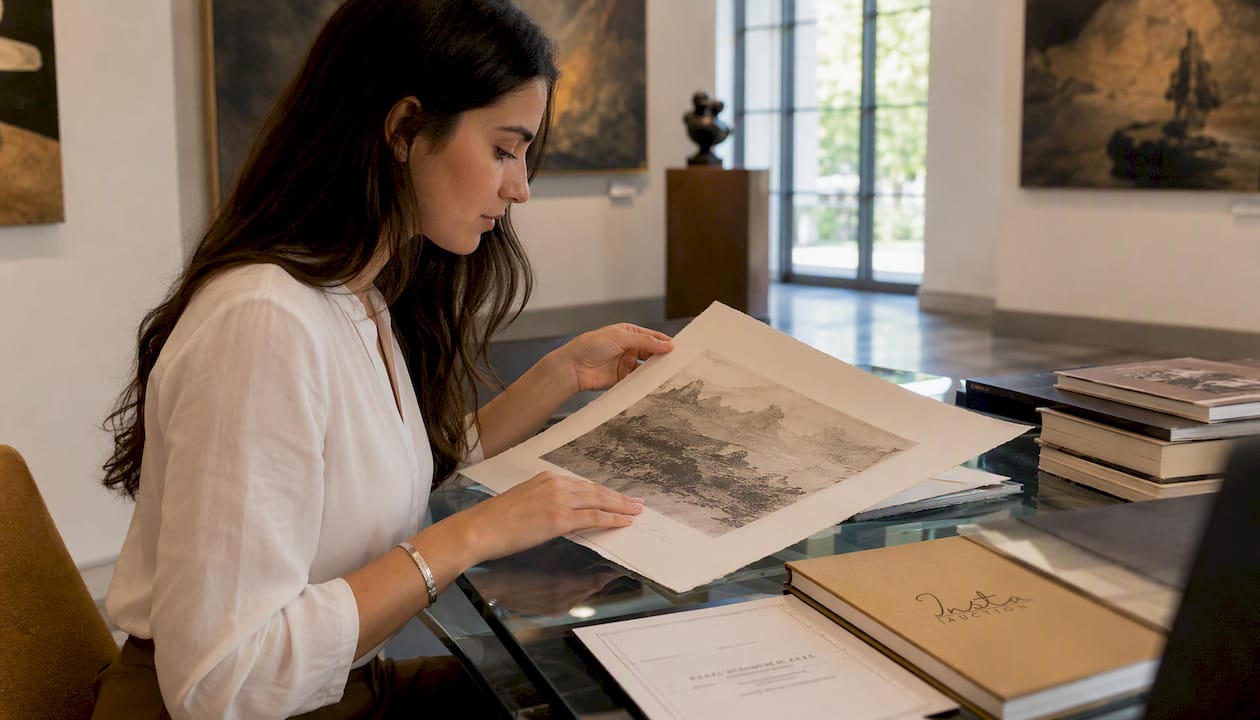
Original unique works are one-of-a-kind: a painting, a unique sculpture, a unique photograph. Original multiples are works produced in a controlled, limited edition where each copy is considered an original: hand-pulled prints, editioned photographs, editioned bronze casts. Reproductions are copies of existing works, typically produced digitally or mechanically without the artist’s direct involvement in the printing process.
The market treats these very differently, and documentation is what separates them.
Common print processes and what they mean for value:
- Giclée: a high-resolution inkjet print on archival paper or canvas. Can be an original limited edition (if the artist controls and signs the edition) or a reproduction. Ask specifically.
- Lithograph: image drawn directly on stone or metal plate, then printed. A hand-pulled lithograph signed and numbered by the artist is an original multiple.
- Serigraph (silk screen): ink pushed through a mesh screen. Andy Warhol’s signed serigraphs are originals; unsigned commercial silk screens of the same image are not.
- Etching: image incised into a metal plate, then printed. Rembrandt’s etchings are among the most collected prints in history.
- Woodcut: image carved into a wood block, then printed. One of the oldest printmaking techniques; Japanese woodblock prints are a major collecting category.
Artist proofs (APs) are prints pulled before the main edition, traditionally kept by the artist. They are typically marked “AP” or “A/P” and are often considered more desirable than numbered edition prints. Hors commerce (HC) prints are similar but designated for trade use.
Before buying any print, run through this checklist:
- Is the edition size stated? (Smaller editions generally command higher prices.)
- Is the work signed by the artist, and where? (Pencil signatures are standard; printed signatures are not the same thing.)
- Is it numbered? (e.g., 12/50 means the 12th print in an edition of 50.)
- Does it come with a certificate of authenticity from the artist, estate, or a recognized authority?
- Is there provenance documentation showing previous ownership?
- For giclée prints specifically: is this an original limited edition or a reproduction of another work?
Collectors are often surprised that printed works can be market-valuable originals when properly documented. Documentation, not medium alone, determines market treatment.
Where can you find and buy fine art in the United States?
The U.S. art market runs through several distinct channels, each with different pricing dynamics, provenance standards, and buyer protections.

| Channel | Pricing transparency | Provenance/condition docs | Buyer protections | Typical fees |
|---|---|---|---|---|
| Primary galleries | Fixed or negotiable | Artist-provided | Gallery guarantee | None to buyer; artist commission to gallery |
| Secondary market dealers | Negotiable | Varies; ask explicitly | Dealer reputation | Dealer margin built into price |
| Art fairs (e.g., Frieze, NADA) | Fixed or negotiable | Varies by gallery | Gallery guarantee | None to buyer |
| Traditional auction houses | Transparent (hammer price) | Catalog condition reports | Limited; caveat emptor | Buyer’s premium (typically 15–25%) |
| Online auction platforms | Transparent | Digital condition reports, provenance notes | Platform policies vary | Buyer’s premium; shipping fees |
| Artist websites and social channels | Fixed | Artist-provided | Direct relationship | None |
| Online marketplaces | Fixed or offer-based | Varies widely | Platform policies | Transaction fees |
Primary galleries represent living artists and set prices based on the artist’s market. You are buying directly from the source, which simplifies provenance. The downside: prices are often non-negotiable, and galleries may have waitlists for sought-after artists.
Secondary market dealers buy and resell works that have already changed hands at least once. Provenance documentation is critical here. Always ask for the full ownership history and any condition reports the dealer has.
Art fairs concentrate galleries in one place for a few days. Frieze New York, the Armory Show, and Art Basel Miami Beach are the highest-profile U.S. events, but regional fairs in cities like Chicago, Houston, and Los Angeles offer strong buying opportunities at more accessible price points.
Online auction platforms have changed access significantly. Digital cataloguing, searchable archives, and remote bidding broaden buyer pools and often surface works outside traditional dealer networks. Insta-auction’s platform, for example, provides high-quality images, condition reports, and provenance notes alongside online bidding, making it possible to evaluate and purchase works that would previously have required physical attendance at a sale.
To find local exhibitions and viewing opportunities, check gallery websites directly, museum show calendars, and art fair schedules. When you find a work you are serious about, always request a condition report and, for significant purchases, commission an independent appraisal before committing.
Pro Tip: Auction prices often beat retail for secondary-market works because multiple bidders set the price rather than a single dealer’s margin. Use auction results databases to benchmark what comparable works have actually sold for before negotiating with a dealer.
How to choose, evaluate, and buy fine art with confidence
Start with your goal, because it changes everything. Buying for decoration is different from buying for investment, and both are different from buying because a work genuinely moves you. None of these goals is wrong, but conflating them leads to bad decisions.
A practical decision framework:
- Define your goal. Decoration, investment, education, or personal connection? Be honest.
- Set a budget with a ceiling. Include buyer’s premium, shipping, framing, and insurance in your calculation, not just the hammer price or list price.
- Research the artist and market comparables. Past auction results are public record at most major houses. Use them.
- Confirm provenance and condition. No provenance documentation is a red flag, not a dealbreaker, but it should lower your price ceiling.
- Get a condition report. For any significant purchase, this is non-negotiable.
Questions to ask every seller or platform before buying:
- What is the complete provenance history of this work?
- Has the work been restored or conserved? If so, by whom and when?
- Is there a condition report available, and can I see it before purchase?
- What is the return policy if the work arrives damaged or is later found to be inauthentic?
- Who is responsible for shipping and insurance during transit?
- What documentation comes with the work (certificate of authenticity, invoices, exhibition records)?
Red flags that should make you pause:
- Missing or vague provenance (“private collection” with no further detail)
- Inconsistent signatures or numbering across an edition
- Certificates of authenticity from unknown or unverifiable sources
- Prices dramatically below market for an established artist
- Sellers who deflect or become evasive when asked direct questions about documentation
On fees: buyer’s premiums at traditional auction houses typically run 15–25% on top of the hammer price. Online platforms vary. Shipping and insurance for fine art are separate costs and can be substantial for large or fragile works. Factor all of this in before you bid.
Pro Tip: Use the art buyer checklist at Insta-auction before placing your first bid. Having a written checklist in front of you during a live auction prevents the heat of bidding from overriding your due diligence.
How to care for and display fine art at home
The single biggest threat to most artworks in a home environment is light, specifically ultraviolet radiation from both sunlight and fluorescent bulbs. UV causes irreversible fading and chemical degradation in pigments, dyes, and paper. Keep works out of direct sunlight entirely, and use UV-filtering glass or acrylic in frames for works on paper and photography.
Environmental controls to maintain:
- Humidity: aim for 45–55% relative humidity for most works. Fluctuations are more damaging than a stable level outside the ideal range. Avoid hanging works near heating vents, fireplaces, or exterior walls in cold climates.
- Temperature: 65–70°F is a reasonable target. Avoid attics, basements, and garages for long-term storage.
- Light exposure: use LED lighting with a low UV output for display. Incandescent bulbs are warmer but generate heat; fluorescent tubes emit UV. Track lighting aimed directly at a canvas can cause localized drying and cracking over time.
Framing and glazing specifics:
- Use archival (acid-free) matting for works on paper. Standard cardboard mats are acidic and will stain paper over time.
- Conservation framing uses UV-filtering glazing, archival spacers to keep the art from touching the glazing, and acid-free backing boards.
- Oil paintings on canvas are typically not glazed; they need air circulation and should not be stored face-to-face with other canvases.
Handling, transport, and storage:
- Always handle works with clean cotton gloves; skin oils transfer to surfaces.
- For transport, use acid-free tissue, bubble wrap (bubbles facing out, away from the art surface), and rigid outer packaging.
- For long-term storage, climate-controlled facilities are worth the cost for anything significant.
- Photograph every work before shipping and retain those images for insurance claims.
When to call a conservator: if you notice flaking paint, yellowing varnish, tears, foxing on paper, or any structural damage, do not attempt DIY repairs. A professional conservator’s assessment will also produce a condition report that protects your resale value and supports insurance claims.
How to start and grow a fine art collection
The collectors who build meaningful collections over time share one habit: they decide what they are collecting before they start spending. A focused collection, even a modest one, is more satisfying and more valuable than a random accumulation of things that caught someone’s eye.
Steps for building intentionally:
- Define your focus. Medium, period, geography, theme, or a specific artist’s career. Narrow is better than broad, especially early on.
- Set a short-term and long-term budget. Short-term: what you can spend in the next 12 months without financial stress. Long-term: what you want the collection to be worth in ten years, and what that implies about acquisition pace.
- Document everything from day one. Keep invoices, provenance records, condition reports, conservation records, and certificates of authenticity in a single organized system. A simple folder per work, physical or digital, is enough to start.
- Track the market. Follow auction results for artists you collect. Gallery price increases and auction hammer prices together tell you where the market is moving.
- Get appraisals at meaningful intervals. For insurance purposes, appraisals should be updated every three to five years, or after a significant market shift for the artist.
On resale: when you are ready to sell, your options are galleries (on consignment), private dealers, and auction platforms. Each takes a commission. Galleries typically charge 40–50% of the sale price; auction platforms charge sellers a consignment fee and buyers a buyer’s premium. Understanding how auction experts identify hidden value in a work can help you time and position a consignment for the best outcome.
Tax implications matter. In the U.S., fine art is classified as a collectible by the IRS, and long-term capital gains on collectibles are taxed at a maximum rate of 28%, higher than the rate on most other long-term capital assets. Charitable donations of appreciated art to qualified institutions may generate a deduction based on fair market value, subject to specific IRS rules and holding period requirements. Consult a tax advisor before making decisions based on tax strategy; the rules are specific and the stakes are real.
Art advisors are worth considering once your collection reaches a level of complexity or value that exceeds your own expertise. A good advisor brings market knowledge, dealer relationships, and negotiating experience. They typically charge either a flat fee, an hourly rate, or a percentage of purchase price. For estate sales and larger consignments, platforms like Insta-auction offer expert appraisal and consignment support that can substitute for or complement an advisor’s role.
How online art auctions work, step by step
Online art auctions follow a predictable sequence, and knowing it in advance makes the process much less stressful.
Step 1: Item discovery. Browse the platform’s catalog. Good platforms provide high-resolution images from multiple angles, detailed condition reports, provenance notes, and estimated value ranges. Read all of it before you bid.
Step 2: Condition and provenance review. The catalog entry is your primary due diligence tool. Look for: physical condition notes (any damage, restoration, or conservation history), provenance chain (previous owners, exhibition history, publication records), and any guarantees or return policies the platform offers.
Step 3: Registration and bidding. Most platforms require registration before bidding, including identity verification and, for higher-value lots, a credit card hold or deposit. Bidding methods vary: live online bidding (you bid in real time against other registered bidders), absentee bidding (you submit your maximum bid and the platform bids on your behalf up to that ceiling), and buy-now pricing for some lots.
Step 4: Winning and settlement. If you win, you receive an invoice that includes the hammer price plus the buyer’s premium. Payment terms vary by platform but are typically due within 48–72 hours of the sale.
Step 5: Packing, shipping, and delivery. Reputable platforms arrange professional art packing and shipping with insurance. Confirm coverage amounts before the work leaves the seller’s hands.
| Stage | Typical timeline |
|---|---|
| Listing lead time (from consignment to live auction) | 2 weeks |
| Bidding window (online auction) | 3–5 days |
| Payment due after winning | 48–72 hours |
| Shipping and delivery | 1–3 weeks depending on location and packing complexity |
Bidder checklist before you place a bid:
- Read the full condition report
- Confirm the provenance chain is documented
- Calculate your total cost including buyer’s premium, shipping, and insurance
- Set your maximum bid before the auction opens and do not exceed it
- Confirm the platform’s return policy for works that arrive damaged or are later found to be inauthentic
Third-party authentication feeds into this process at two points: before consignment (sellers should obtain condition reports and, for significant works, authentication from a recognized expert or foundation) and after purchase (buyers of high-value works sometimes commission post-sale authentication for additional confidence). For estate sales specifically, professional appraisal before consignment is particularly important because estate works often lack recent market comparables.
Quick glossary of fine-art terms
- Provenance: the documented ownership history of a work from creation to present. Strong provenance supports authentication and value.
- Condition report: a professional written assessment of a work’s physical state, including any damage, restoration, or conservation history.
- Certificate of authenticity (COA): documentation signed by the artist, estate, or recognized authority confirming a work’s origin and authorship.
- Edition size: the total number of copies in a limited print or sculpture run. Smaller editions generally command higher prices.
- Artist proof (AP or A/P): prints pulled before the main edition, traditionally kept by the artist. Usually marked “AP” and considered desirable by collectors.
- Hors commerce (HC): prints designated for trade use, not public sale. Similar status to APs.
- Giclée: a high-resolution inkjet print on archival substrate. Can be an original limited edition or a reproduction; documentation determines which.
- Lithograph: a print made from an image drawn on stone or metal plate. Hand-pulled, signed, and numbered lithographs are original multiples.
- Serigraph: a silk-screen print. Signed and numbered serigraphs by the artist are original multiples.
- Buyer’s premium: a percentage added to the hammer price at auction, paid by the buyer to the auction house or platform. Typically 15–25% at traditional houses.
- Consignment: the arrangement by which a seller places a work with a gallery or auction platform for sale, paying a commission on the proceeds.
- Conservator: a trained professional who assesses, stabilizes, and restores artworks. Not the same as a restorer; conservators follow ethical standards that prioritize reversibility.
- Conservation framing: framing that uses archival materials (acid-free mats, UV-filtering glazing, archival backing) to protect works on paper and photographs.
- Appraisal: a formal valuation of a work by a credentialed appraiser, typically required for insurance, estate settlement, donation, or auction consignment.
- Hammer price: the final bid accepted by the auctioneer. The buyer’s total cost is hammer price plus buyer’s premium plus applicable taxes and shipping.
Key Takeaways
Fine art’s market value depends on provenance, documentation, and condition, not medium alone; buyers who verify all three before purchase consistently make better decisions.
| Point | Details |
|---|---|
| Provenance is the foundation | Always request a documented ownership history before buying; missing provenance should lower your price ceiling. |
| Original vs. print distinction | Edition size, artist signature, numbering, and a certificate of authenticity separate a collectible limited edition from a mass reproduction. |
| Condition reports protect you | Request a professional condition report for any significant purchase; it affects resale value, insurance, and authentication. |
| Channel choice affects price and protection | Online auction platforms offer pricing transparency and broader access; primary galleries offer direct provenance but less price flexibility. |
| Insta-auction for provenance-checked auctions | Insta-auction provides expert appraisals, condition reporting, and online bidding for buyers and sellers of fine art and luxury collectibles nationwide. |
Why verified provenance matters more than most buyers realize
The conventional wisdom in art collecting is that you should “buy what you love.” That advice is not wrong, but it is incomplete in a way that costs people money.
What the advice misses is that love and documentation are not in conflict. A work you love that also has clean provenance, a condition report, and a certificate of authenticity is simply a better asset than the same work without those things. Not because the art is better, but because the market treats it better. At resale, at insurance renewal, at estate settlement, at donation, documentation is the difference between a work that moves quickly at a fair price and one that sits because no one can verify what it is.
The other thing most buyers underestimate is how much the online auction market has changed access. Works that used to circulate only through private dealer networks, visible only to people with the right relationships, now appear in searchable digital catalogs with condition reports attached. That is genuinely good for buyers. It means you can find things, compare them to market data, and make informed decisions without needing to know the right gallerist.
What it does not change is the need for due diligence. A condition report on a platform is only as good as the person who wrote it. Provenance notes are only as reliable as the documentation behind them. The tools are better than they have ever been. The judgment still has to be yours.
Insta-auction connects fine-art buyers and sellers to verified, expert-backed auctions
Insta-auction gives buyers direct access to fine art, luxury collectibles, and estate works through a platform built around expert appraisal and verified provenance. Every listing goes through trained appraisers who assess condition, document ownership history, and market items across digital channels, so you are not bidding blind. For sellers, that expertise translates to competitive prices and a wider buyer pool than most private sales or local dealer arrangements can reach.
The platform handles nationwide shipping with flat-rate fees, which removes one of the most unpredictable costs in buying art remotely. A portion of every sale goes to a selected charity, so your purchase does something beyond your walls.
Whether you are building a collection, consigning an estate, or buying your first piece, the luxury collections playbook is the right starting point. Ready to consign? Submit your items through the consignment form and let Insta-auction’s appraisers take it from there.
FAQ
What is considered a fine art?
Fine art is art created primarily for aesthetic, conceptual, or intellectual purposes, intended for display or contemplation rather than practical use. Painting, sculpture, printmaking, drawing, photography, and architecture are the most commonly recognized categories.
What are the seven fine arts?
The commonly cited seven fine arts are painting, sculpture, architecture, literature, music, performance (theater and dance), and cinema. Cinema is often called the seventh art because it integrates elements of the other six.
How do fine art prints differ from reproductions?
A fine art print is an original work produced through a controlled printmaking process in a limited edition, signed and numbered by the artist; a reproduction is a copy of an existing work, typically produced without the artist’s direct involvement. Documentation, not medium alone, determines market treatment.
How does Insta-auction support fine-art buyers and sellers?
Insta-auction provides expert appraisals, condition reporting, provenance documentation, and online bidding for fine art and luxury collectibles, with nationwide shipping and flat-rate fees. Sellers can consign directly through the platform; buyers can browse verified listings and bid remotely.
What are the three main types of fine art?
Definitions vary, but the three most commonly grouped types are visual arts (painting, drawing, sculpture, printmaking, photography), performing arts (music, theater, dance), and literary arts (poetry, fiction, drama). In collecting contexts, visual arts dominate market activity.
Useful sources and further reading
- Fine art | Wikipedia: a broad overview of the category’s definition, historical development, and relationship to decorative and applied art.
- The Salon and the Royal Academy in the Nineteenth Century | The Metropolitan Museum of Art: primary institutional history of how academies and salons shaped fine-art standards, provenance practices, and market structures.
- Fine art | EBSCO Research Starters: academic overview covering cultural specificity of fine-art definitions and non-Western perspectives.
- Defining decorative versus fine art | Invaluable blog: practical guidance on distinguishing fine art from decorative art, with notes on editioning and documentation for prints and photography.
- What are the 7 fine arts? | Rossetti Art blog: accessible overview of the traditional seven arts and how the list has evolved with modern media.
- Decorative arts | Wikipedia: useful counterpoint defining the decorative arts category and how it differs from fine art in purpose and market treatment.
- Academic art | Wikipedia: history of academicism and its influence on Western fine-art standards from the 16th century through the early 20th century.
- Art academies and cultural policy | ICCPR conference paper: academic analysis of how art academies functioned as cultural policy instruments and shaped the modern art market.
- Insta-auction platform: reference for online auction services, expert appraisal, provenance documentation, and consignment support for fine art and luxury collectibles in the United States.