

Auction closing time is the single most powerful variable shaping bidder behavior, competition intensity, and final sale prices in online auctions. The designated moment an auction ends, known as the closing time, determines how many bidders show up, how aggressively they compete, and whether last-second tactics like snipe bidding succeed or fail. Two core closing formats govern every online auction: the hard close, which ends at a fixed time with no extensions, and the soft close, which automatically extends when bids arrive near the deadline. Understanding how auction closing time affects bidding is the difference between paying too much and walking away with a win.
How does closing time affect bidder activity and final prices?
Peak bidder engagement is not random. Auctions ending between 6:30 PM and 10:30 PM produce 14.3% higher median final bid values compared to midday or off-peak closings. That gap exists because evening hours align with when most people are home, relaxed, and actively browsing online.
Off-peak closings, such as those ending at 2:00 AM or during a Tuesday lunch hour, attract far fewer active bidders. Fewer bidders mean less competition, and less competition means lower final prices. For buyers, that is an opportunity. For sellers, it is a costly mistake.
Weekend versus weekday timing also matters. Wednesday evening closings show fewer competing auctions ending simultaneously, which concentrates bidder attention and pushes average prices higher. Sunday evenings draw the largest raw bidder volume, but the sheer number of auctions closing at once dilutes attention across listings.
- Evening window (6:30 PM–10:30 PM): Highest bidder activity, strongest competition, highest final prices
- Midday (11:00 AM–2:00 PM): Moderate traffic, reduced competition, lower average bids
- Late night (after 11:00 PM): Minimal active bidders, lowest final prices on average
- Wednesday evenings: Fewer simultaneous closings, concentrated attention, above-average prices
- Sunday evenings: High raw volume but split across many listings
Pro Tip: Check your auction platform’s completed listings to identify which closing windows historically produce the highest prices for the item category you are targeting. Pattern recognition beats guesswork every time.
Hard close vs. soft close: which auction format changes your strategy?
The closing mechanism an auction uses changes everything about how you should bid. A hard close ends at a fixed, predetermined time. No extensions, no exceptions. A soft close automatically adds time, typically two to five minutes, whenever a bid arrives within the final window.

Snipe bidding, the practice of placing a bid in the final seconds to prevent competitors from responding, works well on hard-close auctions. Sniping gives bidders a 9% higher probability of winning compared to early bidders in otherwise identical competitive environments. That edge comes entirely from denying rivals the chance to counter.
Soft-close auctions are designed to neutralize sniping. The soft close mechanism extends the auction every time a late bid arrives, effectively turning a snipe attempt into the opening move of a new bidding round. The auction does not end until a full extension period passes with no new bids.
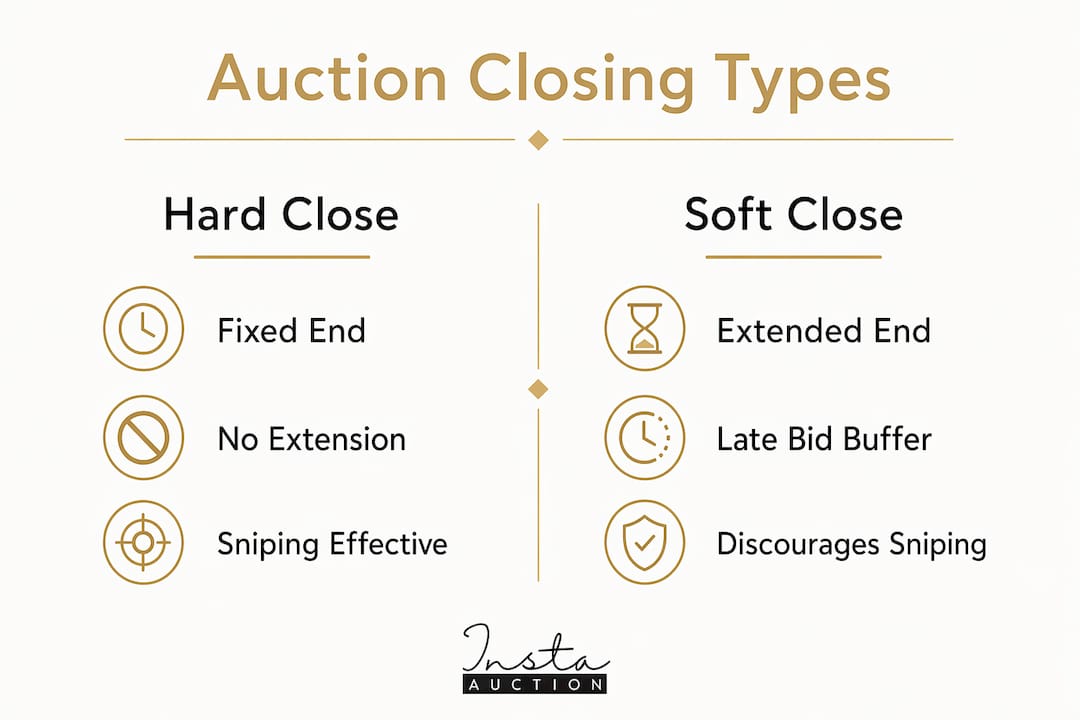
| Feature | Hard close | Soft close |
|---|---|---|
| End time | Fixed, no extension | Extends on late bids |
| Sniping effectiveness | High | Low to none |
| Best strategy | Time your bid to the final seconds | Set a firm maximum bid upfront |
| Risk of bidding war | Lower | Higher |
| Typical use case | Most fixed-time online auctions | Live and timed-extension platforms |
Auction experts confirm that the best approach on soft-close platforms is disciplined maximum bid setting rather than last-second timing. Your maximum bid should reflect the true value of the item to you, not a reactive number driven by competition pressure.
Pro Tip: Before placing a single bid, read the platform’s rules to identify whether it uses a hard or soft close. That one detail determines your entire approach.
Does network latency affect last-second bids at closing?
Technical timing is a real factor that most bidders ignore until a snipe fails. Network latency, the delay between your bid submission and the server registering it, can cause a last-second bid to arrive too late to count. This is not a rare edge case. It is a predictable problem with a predictable solution.
Platform bid validation latency drops from a median of 412 milliseconds to 197 milliseconds during the 6:30 PM to 10:30 PM window. Lower latency means your bid registers faster and more reliably. That evening window is not just better for competition reasons. It is technically safer for time-sensitive bids.
Server load is the key variable. Avoiding peak platform traffic periods where load exceeds 78% capacity reduces snipe failure rates by approximately 41%. High server load slows bid processing and increases the chance your bid arrives after the clock hits zero.
Bidding 3–5 seconds before the close reduces the risk of snipe failure caused by server lag. That small buffer accounts for propagation delays without giving competitors enough time to respond. Auction server maintenance windows and batch processing cycles can also shift effective closing times, so checking platform status before a high-stakes bid is worth the two minutes it takes.
Pro Tip: Use a wired internet connection rather than Wi-Fi for final-second bids. Wireless connections introduce variable latency that can push your bid past the deadline.
Should you bid early or wait until the final seconds?
The data favors late bidding on hard-close auctions, but the answer is not as simple as “always snipe.” A full 68% of winning bids occur in the final 90 seconds of an auction. That concentration is not coincidence. It reflects a deliberate strategy by experienced bidders who understand that early bids invite competition.
Placing a bid early signals your interest to every other bidder watching the listing. That signal can trigger competing bids and drive the price up before the auction even reaches its peak activity window. Waiting preserves your advantage and keeps rivals in the dark.
That said, early bidding has one legitimate use: setting a maximum bid on a soft-close auction where timing is irrelevant. On those platforms, your maximum bid does the work automatically, and the auction system bids on your behalf up to your ceiling.
Evening peak hours create intense bidding environments that trigger “auction fever,” a psychological state where competitive pressure causes bidders to exceed their planned limits. Recognizing this pattern before you enter a closing window is the best defense against it.
Common timing mistakes that cost bidders money:
- Bidding early on a hard-close auction and revealing your interest
- Sniping a soft-close auction without realizing the platform extends time
- Setting a maximum bid based on emotion rather than item value
- Ignoring server load and submitting a snipe bid during high-traffic periods
- Treating all auction platforms as identical when closing rules differ significantly
Pro Tip: Set your maximum bid before the auction enters its final hour. Deciding your ceiling under pressure, with a countdown clock running, leads to overspending almost every time.
For a deeper look at winning auction strategies, preparation before the closing window opens is the factor that separates consistent winners from reactive bidders.
Key Takeaways
Auction closing time directly controls bidder competition levels, final prices, and the success rate of time-sensitive bidding tactics like sniping.
| Point | Details |
|---|---|
| Evening closings yield higher prices | Auctions ending between 6:30 PM and 10:30 PM produce 14.3% higher final bid values. |
| Hard vs. soft close changes everything | Sniping works on hard-close auctions but fails on soft-close platforms that extend time on late bids. |
| Technical latency affects snipe success | Bid validation latency drops significantly in the evening window, reducing snipe failure by up to 41%. |
| Late bids win more often | 68% of winning bids occur in the final 90 seconds, favoring disciplined last-second timing on hard-close auctions. |
| Preparation beats reaction | Setting a firm maximum bid before the closing window prevents auction fever and overspending. |
What I’ve learned about timing after years of watching auctions close
The conventional advice on auction timing focuses almost entirely on when to bid. After watching hundreds of auctions close across multiple platforms, I am convinced that preparation matters far more than the precise second you submit your bid.
Bidders who win consistently do one thing differently: they decide their maximum price before the auction enters its final phase. That decision, made calmly and without a countdown clock running, is worth more than any sniping tactic. Understanding fees, buyer premiums, and auction rules before bidding is the 80% of the equation that most people skip in favor of obsessing over the 20% that is timing.
The closing time knowledge I find most underused is the hard close versus soft close distinction. New bidders regularly attempt to snipe soft-close auctions and then feel cheated when the auction extends. The platform is not broken. They simply did not read the rules. Knowing which mechanism applies lets you plan your bidding approach with clarity instead of reacting in the final moments.
Closing time also shapes your psychology in ways that are easy to underestimate. The evening peak window is genuinely exciting. Competition is real, prices move fast, and it is easy to convince yourself that one more bid is justified. The bidders who walk away with the best outcomes are the ones who set their ceiling in advance and treat it as a hard rule, not a suggestion.
— Admin
Insta-auction: auctions built for bidders who know their timing
Timing knowledge is only useful when the platform you are bidding on gives you clear, reliable closing rules. Insta-auction provides exactly that, with transparent auction formats and defined closing structures so you always know whether you are working with a fixed deadline or an extended close.

Insta-auction focuses on pre-loved luxury items and collectibles, categories where closing time strategy has the greatest impact on final prices. Trained appraisers market each item across digital channels to attract the right bidders at the right moment. Whether you are a buyer looking for a well-timed win or a seller aiming for peak competition, the luxury auction listings on Insta-auction are structured to reward preparation and smart timing.
FAQ
How does auction closing time affect the final bid price?
Auctions closing during the evening window between 6:30 PM and 10:30 PM produce 14.3% higher final bid values due to greater bidder activity and competition. Off-peak closings attract fewer bidders and consistently result in lower prices.
What is the difference between a hard close and a soft close?
A hard close ends at a fixed time with no extensions, making last-second sniping effective. A soft close automatically extends the auction when bids arrive near the deadline, neutralizing sniping and favoring a disciplined maximum bid strategy instead.
When do most winning bids get placed?
68% of winning bids occur in the final 90 seconds of an auction, reflecting the advantage of late bidding on hard-close platforms. Waiting until the closing window minimizes the time competitors have to respond.
Does network latency really affect bid success?
Yes. Platform bid validation latency drops from 412 milliseconds to 197 milliseconds during the evening off-peak window, and avoiding server loads above 78% capacity reduces snipe failure by approximately 41%. Submitting a bid 3–5 seconds before the close accounts for propagation delays.
Is sniping always the best bidding strategy at closing?
Sniping gives a 9% higher win probability on hard-close auctions but is ineffective on soft-close platforms that extend time on late bids. The best universal strategy is setting a firm maximum bid before the closing window opens, regardless of auction format.