

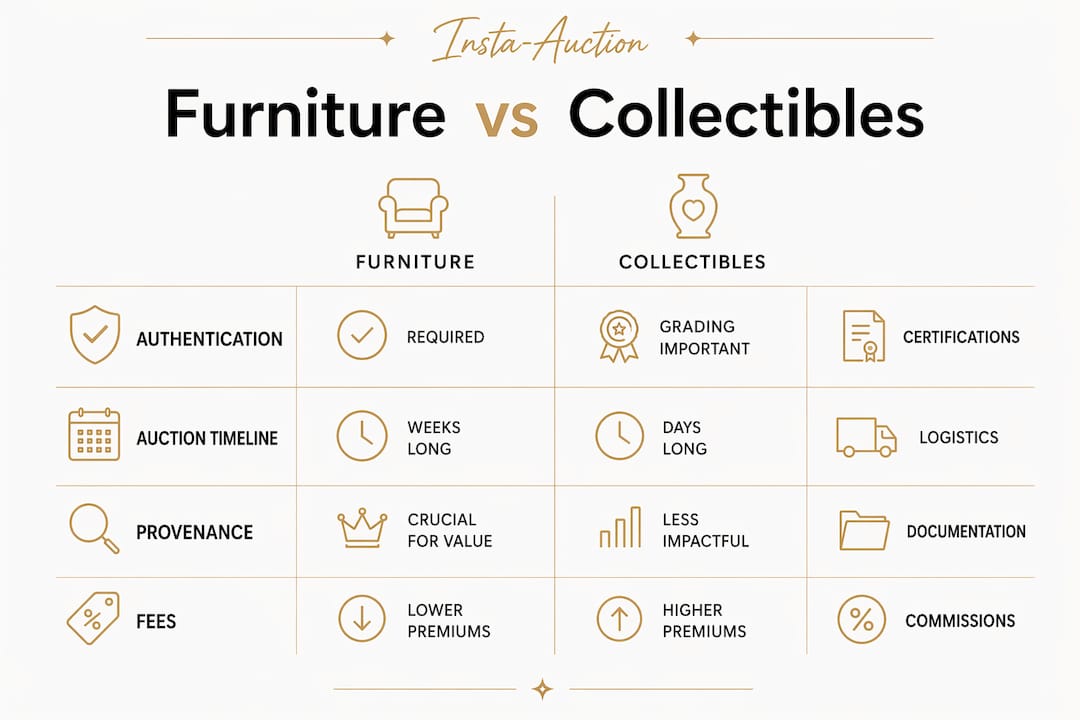
Auctioning furniture and auctioning collectibles are two distinct processes, separated by authentication requirements, buyer expectations, valuation drivers, and fee structures. Understanding how auctioning furniture differs from collectibles is the first step to getting the best price, whether you are selling a Victorian sideboard or a graded baseball card. Furniture buyers weigh condition, provenance, and utility. Collectible buyers weigh verification status above almost everything else. Auction fee structures, logistics, and timelines follow from those core differences. Knowing which rules apply to your item before you list it can mean the difference between a strong sale and a disappointing result.
How authentication and grading affect buyer access in collectibles versus furniture
Authentication acts as a binary gate for collectible buyers. A graded or certified item, such as a PSA-slabbed trading card or a CGC-graded comic book, unlocks access to institutional bidders and high-end collector pools. An unverified collectible sits in a lower tier, attracting fewer bidders and lower final prices regardless of its actual quality.
Furniture auctions operate on a different standard. No formal grading body certifies a Chippendale chair the way PSA certifies a rookie card. Buyers and auction specialists assess furniture through physical inspection, maker’s marks, construction methods, and documented history. That process is more subjective, but it is also more forgiving. A piece without a paper trail can still sell well if its condition and style are strong.

The economic logic behind certification matters for sellers. Verification economics determine whether the cost of third-party grading justifies the premium buyer pool it unlocks. For a rare collectible worth thousands, paying for PSA or Beckett grading is almost always worth it. For a mid-range item, the certification fee may eat into net proceeds without meaningfully expanding the buyer pool.
Key differences in authentication by category:
Collectibles: Third-party grading (PSA, CGC, Beckett) is the standard gateway to premium buyers.
Furniture: Maker’s marks, construction analysis, and provenance documents replace formal grading.
Unverified collectibles: Face reduced bidder interest and lower hammer prices compared to certified equivalents.
Ungraded furniture: Can still attract strong bids if condition and provenance are well presented.
Pro Tip: Before listing a collectible, get a quote from at least two grading services. The cost difference between PSA and Beckett can be significant, and each service carries more weight in different collector communities.
Does provenance matter more for furniture or collectibles?
Provenance is the documented history of an object, and it affects furniture value far more directly than it affects most collectibles. Documented provenance adds a premium over age and style alone by reducing buyer uncertainty about authenticity and origin. A plain country table with receipts linking it to a notable estate can outperform a more ornate piece with no paper trail.
For furniture, the four value drivers are age, condition, rarity, and provenance. Of these, provenance is the one sellers most often overlook. A strong provenance record can shift a piece from a local casual sale to a specialist auction, where the right buyers are willing to pay a significant premium. Auction houses like Christie’s and Sotheby’s regularly cite provenance in catalog descriptions because it directly influences bidding behavior.
Condition matters for furniture, but not always in the way sellers expect. Original finishes and hardware are typically more valuable than restored or refinished surfaces. Original finishes and provenance documentation can increase auction value more than cosmetic improvements. A seller who strips and repaints an antique chair to make it look “cleaner” often destroys value rather than adding it.
Collectibles rely on condition too, but the relationship is different. A graded collectible’s condition is locked in by the certification number. Provenance plays a smaller role unless the item has celebrity or historical ownership. A baseball signed by Babe Ruth carries provenance value. A standard graded rookie card does not.
Key provenance considerations for furniture sellers:
Gather receipts, appraisals, auction records, and photographs showing the piece in situ.
Research maker’s marks and compare them to known examples in reference catalogs.
Avoid refinishing or reupholstering before auction. Original surfaces preserve value.
Consult a specialist appraiser before setting a reserve price on any documented piece.
How do auction timelines and logistics differ for furniture versus collectibles?
Furniture auctions take longer than collectibles auctions, and the reason is physical. Furniture auctions require weeks of cataloging, photography, and logistics before a sale date, followed by settlement periods after the hammer falls. Large items need storage, transport coordination, and sometimes white-glove delivery services. That process adds time and cost.
Collectibles move faster. A graded card or coin can be photographed, listed, and sold online within days. Online auction platforms have accelerated this further by expanding buyer reach beyond local markets. Online platforms blur traditional distinctions by connecting sellers of both furniture and collectibles to national and international buyers simultaneously.
The contrast between auction and estate sale timelines is also worth understanding:
Specialist furniture auction: Cataloging takes 2–4 weeks. The sale itself runs 1–2 days. Settlement follows within 30 days. Total timeline: 6–10 weeks.
Estate sale: Moves faster, often within 1–2 weeks of setup. Prices are typically lower because buyers expect bargains.
Online collectibles auction: Listing to sale can happen in under a week. Shipping is straightforward for small items.
Live collectibles auction: Requires submission deadlines and grading lead times, but settlement is faster than furniture due to easier logistics.
| Category | Typical timeline | Logistics complexity | Buyer reach |
|---|---|---|---|
| Furniture auction | 6–10 weeks | High (transport, storage) | Regional to national |
| Collectibles auction | 1–4 weeks | Low (small, shippable) | National to global |
| Estate sale | 1–2 weeks | Medium | Local to regional |
Pro Tip: If you are selling furniture through an online auction, invest in professional photography. Buyers cannot inspect pieces in person, so image quality directly affects bidding confidence and final price.
What are the fee differences between furniture and collectibles auctions?
Auction fees are not uniform across categories, and the gap between furniture and collectibles can be substantial. Typical seller commissions at major auction houses run around 10–15% of the hammer price, with buyer’s premiums of 15–25% added on top. Collectibles carry higher fees because they require specialized marketing, certification coordination, and expert appraisal services.
Buyer’s premiums for fine art, jewelry, and collectibles at major houses can start at 27–28% of the hammer price. That figure is the buyer’s cost on top of the winning bid. It also funds the auction house’s marketing, logistics, and expert services. Sellers need to account for this when setting reserve prices, because a high buyer’s premium can suppress bidding if buyers feel the total cost is too high.
Furniture auctions at regional houses often carry lower premiums than specialist collectibles sales. The trade-off is a smaller buyer pool and less aggressive marketing. Sellers with documented, high-value furniture pieces may find that a specialist auction’s higher fees are justified by the stronger final price.
| Fee type | Furniture auction | Collectibles auction |
|---|---|---|
| Seller commission | 10–15% | 10–15% |
| Buyer’s premium | 15–20% | 20–28%+ |
| Certification cost | None required | $20–$150+ per item |
| Marketing spend | Moderate | High (specialist catalogs) |
| Net seller proceeds | Higher relative share | Lower after certification |
Pro Tip: Always ask for a full fee schedule before consigning. Some auction houses charge photography fees, insurance fees, and unsold lot fees on top of commission. These costs add up quickly on lower-value items.
How should buyers and sellers choose the right auction channel?
The right auction channel depends on what you are selling and what documentation you have. Sellers with graded or certifiable collectibles should target specialist auctions or dedicated online platforms where verified buyers are already active. Sellers with documented antique furniture should seek out auction houses with established furniture departments or estate sale expertise.
Buyers face a different set of decisions. In collectibles auctions, the verification status of an item tells you most of what you need to know about risk. In furniture auctions, you need to assess condition in person or through detailed photographs, ask about provenance documents, and factor in delivery costs before bidding.
Common mistakes to avoid:
Sellers of collectibles: Listing unverified items in premium auction slots. Without certification, you will not attract the buyers who justify those fees.
Sellers of furniture: Refinishing or repairing pieces before auction without consulting a specialist. Restoration often reduces value.
Buyers of collectibles: Bidding on ungraded items at graded prices. Verify the certification number independently before placing a bid.
Buyers of furniture: Ignoring transport costs. A $500 winning bid on a large armoire can become a $900 purchase after delivery fees.
Both categories: Skipping the reserve price conversation. A well-set reserve protects sellers without discouraging serious bidders.
Sellers preparing furniture for auction should gather all provenance documents, avoid cosmetic alterations, and get an independent appraisal before setting a reserve. Sellers preparing collectibles should weigh certification costs against expected sale price and choose a grading service with strong recognition in their specific collector community. Platforms like Insta-auction offer expert appraisal services that help sellers in both categories make that call before committing to a channel.
Key Takeaways
Furniture and collectibles auctions operate on fundamentally different rules: authentication drives collectibles value, while provenance and original condition drive furniture value.
| Point | Details |
|---|---|
| Authentication gates collectibles | Graded items unlock premium buyer pools; unverified collectibles attract fewer bidders and lower prices. |
| Provenance drives furniture value | Documented history adds a measurable premium over age and style alone for antique furniture. |
| Timelines differ significantly | Furniture auctions take 6–10 weeks; collectibles can sell online in under a week. |
| Fees are higher for collectibles | Buyer’s premiums can reach 27–28% for collectibles, versus lower rates for most furniture sales. |
| Channel choice is category-specific | Match your item to the right auction type before listing to avoid fee waste and buyer mismatch. |
What I have learned from watching both markets up close
The most common mistake I see is sellers treating furniture and collectibles as interchangeable auction categories. They are not. The furniture market rewards patience, documentation, and restraint. The collectibles market rewards verification speed and channel precision.
Authentication shapes collectibles market liquidity in a way that has no real parallel in furniture. A graded item is liquid. An ungraded item of identical physical quality is not. That gap is not about the object. It is about the buyer’s confidence in what they are purchasing. Furniture buyers accept more ambiguity because they can see and touch the piece. Collectibles buyers, especially institutional ones, do not.
Online auction platforms are genuinely changing both markets. I have watched furniture pieces that would have struggled to find regional buyers sell to international bidders through well-photographed online listings. That shift benefits sellers who invest in presentation. It does not help sellers who cut corners on documentation or photography.
The advice I give consistently: do not let logistics or certification costs push you toward the wrong channel. A documented piece of antique furniture belongs in a specialist auction, not an estate sale. A graded collectible belongs on a platform where verified buyers are already active. Matching the item to the channel is the single highest-leverage decision you make in the auction process.
— S
Insta-auction: one platform for furniture and collectibles
Selling through the wrong channel costs you money. Insta-auction works with both furniture sellers and collectibles owners to match each item to the right buyer pool, with expert appraisals and transparent fee structures built in from the start.

Insta-auction’s trained specialists appraise pre-loved luxury items, antique furniture, and graded collectibles, then market them across digital channels to reach qualified buyers. The platform’s luxury goods auction service is built for sellers who want competitive prices without navigating the complexity of traditional auction houses alone. A portion of every sale goes to charity, so your auction supports more than just your bottom line.
FAQ
How does authentication affect collectibles auction prices?
Authentication acts as a binary gate for premium buyer access. Graded or certified collectibles attract institutional bidders and higher prices; unverified items face reduced competition and lower hammer prices.
Does furniture need certification to sell at auction?
Furniture does not require formal third-party certification. Auction specialists assess pieces through maker’s marks, construction analysis, and provenance documents, making condition and documented history the primary value drivers.
What fees should sellers expect at collectibles auctions?
Seller commissions typically run 10–15%, and buyer’s premiums can start at 27–28% of the hammer price at major houses. Collectibles also carry additional certification and marketing costs that furniture sales usually do not.
How long does a furniture auction take compared to a collectibles auction?
Furniture auctions take 6–10 weeks from cataloging to settlement. Online collectibles auctions can move from listing to sale in under a week, making them significantly faster for small, shippable items.
Should I refinish antique furniture before selling it at auction?
No. Original finishes and provenance documentation typically add more value than cosmetic improvements. Refinishing often reduces auction prices by removing the original surface that collectors and specialists use to verify age and authenticity.