

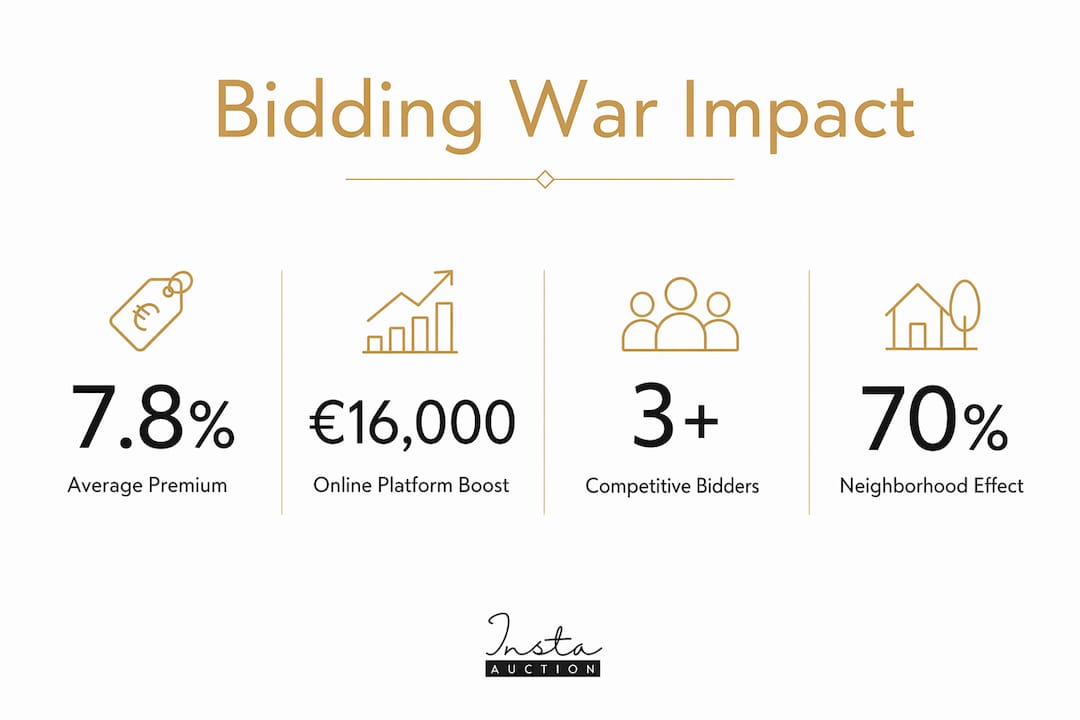
A bidding war is defined as a competitive situation where multiple buyers submit escalating offers on the same property, driving the final sale price above the original listing price. This dynamic is the single most reliable mechanism sellers in competitive markets can use to maximize what they walk away with at closing. Understanding how bidding wars increase sale price gives you a real edge, because the process is not random. It follows predictable behavioral patterns that skilled sellers can trigger and control. In high-demand Chicago neighborhoods during Q1 2026, roughly 70% of homes sold above asking price with an average premium of $60,000, or 7.8% above list.
How do bidding wars increase sale price?
Bidding wars raise final sale prices through a cycle of sequential escalation driven by buyer psychology. Each new offer signals to competing buyers that the property is worth fighting for. That signal alone pushes the next bid higher, regardless of what the home’s appraised value actually is.
The behavioral engine behind this cycle is called auction fever. Auction fever is a documented psychological state where visible competition clouds a buyer’s financial judgment, causing them to prioritize winning over rational budgeting. It is not a flaw in a few buyers. It is a predictable response that emerges whenever scarcity and competition combine.

The numbers confirm how powerful this effect is. Online bidding platforms can drive prices up by as much as €16,000 beyond baseline expectations, and 65% of online auction participants bid beyond their ideal budget. That figure means the majority of buyers in a competitive auction setting will spend more than they planned. For sellers, that gap between a buyer’s planned budget and their final bid is where the premium lives.
The bidding competition effects differ slightly by format. Estate agent-mediated bidding increases final offers by approximately €13,500 on average, while online platforms push that figure even higher. The transparency of online bidding, where every participant can see the current high offer in real time, intensifies the emotional stakes and accelerates escalation.
Pro Tip: Price your listing to attract at least three serious buyers. One buyer makes a transaction. Three buyers make a bidding war.
- Visible competing bids trigger loss aversion, making buyers fear missing out more than they fear overpaying.
- Sequential offers create social proof that the property is desirable, reinforcing each buyer’s willingness to go higher.
- Deadlines and offer windows compress decision-making, leaving buyers less time to reconsider.
- Online platforms amplify all three effects by making competition visible and immediate.
What are the risks sellers should know about bidding wars?
Bidding wars favor sellers, but they carry real risks that can erase the price premium if managed poorly. The most common threat is the appraisal gap. When a buyer’s winning bid exceeds the property’s appraised value, their lender will only finance up to the appraised amount. The buyer must then cover the difference out of pocket or walk away from the deal.
Sellers rarely make price concessions after a low appraisal because bidding wars provide backup buyers. That leverage is real and significant. If your first buyer cannot bridge the gap, you can move to the next offer in line without relisting. This is why having multiple strong offers, not just one, is the actual goal of a bidding war strategy.
The risk that sellers underestimate is what happens when a deal does collapse. A failed deal due to a low appraisal can create a “stale” stigma, making the property harder to sell later as buyers begin to wonder whether hidden problems caused the first deal to fall through. A relisted property rarely commands the same urgency as a fresh listing.
“Sellers must carefully manage expectations and contingencies to avoid the stale listing trap. The goal is not just to win a bidding war. The goal is to close the deal that follows it.”
Sellers can reduce these risks with a few deliberate steps:
- Require proof of funds or mortgage pre-approval before accepting any offer into consideration.
- Ask buyers to waive or limit appraisal contingencies in writing before the offer deadline.
- Keep backup offers active and in writing until the primary deal clears the appraisal stage.
- Work with a listing agent who has direct experience managing appraisal contingencies and gap negotiations.
Pricing strategies that trigger and leverage bidding wars
The most counterintuitive truth in real estate selling is that pricing lower can produce a higher final sale price. Professional agents call this the “ask less to get more” approach. By pricing slightly below market value, sellers attract more buyers, generate more showings, and create the conditions for competitive bidding before a single offer is submitted.
This tactic works because it bypasses rational budgeting. A buyer who sees a home priced at $50,000 below comparable sales does not think “this is a bargain.” They think “other buyers will see this too, and I need to act fast.” That urgency is the foundation of auction fever and the reason the final price often exceeds what a standard listing would have achieved.
Once offers arrive, the next lever is the offer deadline. Setting “highest and best” deadlines pushes buyers to submit their maximum offers simultaneously, which limits their ability to wait, react to each other, and negotiate incrementally. The result is a compressed, high-stakes moment where every buyer puts their best number forward at once.
Here is the sequence professional listing agents use to run this process:
- Price below comparable sales by 3–8% to generate immediate, broad interest and multiple showings within the first week.
- Set a clear offer review date at least 5–7 days after listing, giving the market time to respond and buyers time to arrange financing.
- Communicate competing interest to all buyers through your agent without disclosing specific offer amounts, which is both ethical and legal in most states.
- Request “highest and best” offers by a firm deadline, specifying that no further negotiation rounds will follow.
- Evaluate offers on total value, not just price. Fewer contingencies, flexible closing dates, and strong financing can make a slightly lower offer more valuable than the highest number.
Pro Tip: Flexible closing dates are a hidden price driver. A buyer who can match your preferred timeline will often pay more for that convenience. Ask for it explicitly in your offer instructions.
Escalation clauses, where buyers agree to automatically outbid competing offers up to a ceiling price, are worth understanding from the seller’s side. They reveal a buyer’s true maximum. Once you see that ceiling, you can use it to anchor negotiations with other buyers or simply accept the escalated figure.
How do bidding war winners fare long-term?
The seller’s gain in a bidding war comes directly from the buyer’s future loss. Research covering 14 million U.S. home sales over 20 years shows that winners of bidding wars experience 1.3 percentage points lower annual returns when reselling and carry significantly higher mortgage default rates compared to buyers who purchased outside competitive bidding situations.
Specifically, bidding war winners default at a rate of 11.42% versus 8.28% for non-bidding-war buyers. That gap reflects the financial strain of overpaying at purchase. For sellers, this data confirms that the price premium extracted in a bidding war is real money, not just a negotiating illusion.
“The winner’s curse in real estate is well-documented. Buyers who win bidding wars often pay more than the property’s long-term market value supports, which is precisely why sellers benefit so strongly in the short term.”
This dynamic has broader market implications. Buyers with fewer financial resources, who cannot absorb an appraisal gap or sustain a higher monthly payment, are effectively priced out of bidding wars. Sellers in high-demand markets benefit from this concentration of well-capitalized buyers competing for limited inventory. The real estate auction format formalizes this competition, making price discovery faster and more transparent for both sides.
The long-term market effect of repeated bidding wars is upward price pressure across entire neighborhoods. When 70% of homes in an area sell above asking, comparable sales data shifts, and future listing prices rise to reflect the new baseline. Sellers who act in a strong bidding war market lock in gains that compound over time.
Key Takeaways
Bidding wars increase final sale prices by combining behavioral pressure, competitive escalation, and deliberate seller strategy to push buyers beyond their original budgets.
| Point | Details |
|---|---|
| Bidding wars drive real premiums | Homes in competitive markets sold for an average of 7.8% above list price during Q1 2026. |
| Auction fever is the price engine | 65% of online auction participants bid beyond their planned budget due to emotional competition. |
| Appraisal gaps are manageable | Sellers with backup offers rarely need to make price concessions after a low appraisal. |
| Underpricing triggers competition | Pricing 3–8% below market value generates more offers and a higher final sale price. |
| Offer deadlines maximize bids | “Highest and best” deadlines force buyers to submit peak offers simultaneously, raising the final price. |
What I’ve learned about bidding wars after watching sellers win and lose them
Most sellers walk into a bidding war thinking the hard part is getting multiple offers. The hard part is actually what comes after. I have watched sellers accept the highest number on the table, only to see the deal collapse three weeks later because the buyer could not cover an appraisal gap and the seller had already dismissed the backup offers.
The sellers who consistently close at the highest price are not the ones who got the biggest opening bid. They are the ones who treated the offer review process like a structured negotiation, not a lottery. They kept backup offers warm. They required proof of funds before the deadline. They asked for appraisal gap coverage in writing.
The “ask less to get more” pricing strategy still surprises sellers the first time they hear it. Pricing below market feels like leaving money on the table. In practice, it puts more money on the table by bringing more buyers to it. I have seen this work in markets ranging from dense urban neighborhoods to mid-size suburban areas. The psychology does not change with the zip code.
One thing I would tell every seller: do not confuse a high offer with a strong offer. A buyer offering $50,000 over asking with a full appraisal contingency and a 60-day close is often worth less than a buyer offering $30,000 over asking with no appraisal contingency and a 30-day close. Read the full terms, not just the number at the top.
— Admin
Insta-auction and the competitive edge sellers need
Sellers who want to apply auction-style pressure to their real estate strategy have more tools available than most realize.

Insta-auction brings the mechanics of competitive bidding, transparent price discovery, and expert appraisal to sellers who want results beyond what a standard listing produces. The platform’s trained specialists understand how to position properties for maximum buyer engagement, which is the same principle behind every successful bidding war. Sellers can review the full process through Insta-auction’s seller guide and explore how auction-format selling applies directly to real estate through the real estate auction section. When competitive pricing and structured bidding work together, sellers consistently achieve stronger outcomes than traditional listing alone delivers.
FAQ
What is a bidding war in real estate?
A bidding war occurs when two or more buyers submit competing offers on the same property, driving the final sale price above the original listing price through sequential escalation.
How much can a bidding war increase the sale price?
In high-demand markets, bidding wars produced an average premium of 7.8% above list price during Q1 2026, with some homes selling $60,000 over asking in competitive Chicago neighborhoods.
What triggers a bidding war?
Low inventory, high buyer demand, and deliberate underpricing by sellers are the primary causes of bidding wars. Auction fever, a psychological response to visible competition, then drives prices higher once bidding begins.
How should sellers handle a low appraisal after a bidding war?
Sellers with backup offers rarely need to reduce their price after a low appraisal. The standard approach is to require the winning buyer to cover the appraisal gap out of pocket or move to the next offer in line.
What is the “highest and best” offer strategy?
The “highest and best” strategy sets a firm deadline by which all buyers must submit their maximum offer simultaneously. This eliminates incremental negotiation and forces buyers to put their true ceiling on the table at once, raising the final sale price.