

Expert auctioneers are the single most influential variable in charity auction fundraising, functioning as event strategists, donor psychologists, and revenue architects. The role of expert auctioneers in charity outcomes extends far beyond calling bids. A professionally trained auctioneer, particularly one holding the Benefit Auctioneer Specialist (BAS) credential, designs the entire revenue structure of a charity event, from item sequencing to paddle raise execution. Nonprofits that treat the auctioneer as a performer rather than a partner consistently leave money on the table. The evidence from real events and auction studies makes the case clearly.
What responsibilities do expert auctioneers have in charity auctions?
Expert auctioneers manage every mechanical and emotional layer of a live charity event. Their work covers far more than announcing items and accepting bids. Charity event auctioneers set bid increments, maintain momentum, and confirm bids transparently, which reduces hesitation and keeps funds flowing. Each of those functions directly shapes how much a room gives.
The specific duties a professional auctioneer handles during a charity event include:
- Item introduction and framing: Presenting each lot with a compelling narrative that connects the item to the cause, not just its value.
- Bid increment management: Setting increases at the right pace so bidders stay competitive without feeling priced out.
- Momentum pacing: Reading the room to know when to slow down, push harder, or shift to a new revenue segment.
- Fairness and transparency: Confirming every bid clearly so donors trust the process and stay engaged.
- Fundraising consultation: Advising the nonprofit before the event on item selection, run-of-show design, and revenue stream sequencing.
- Hybrid auction coordination: Managing simultaneous in-person and online bidding without losing energy in either channel.
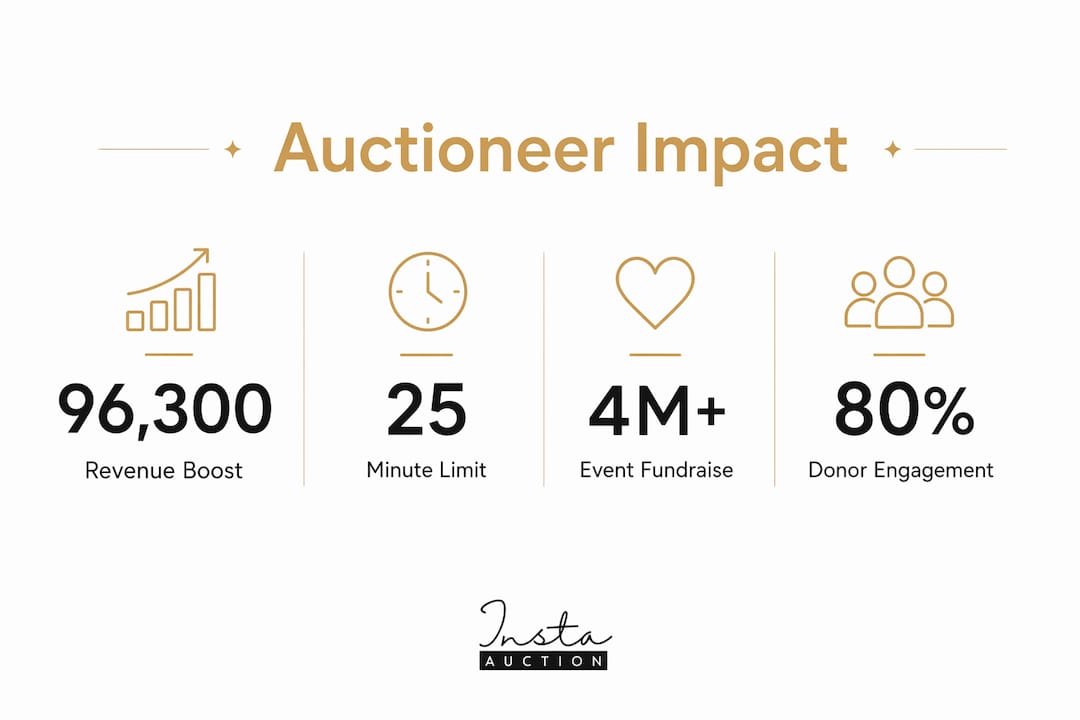
Pro Tip: Never let a live auction run longer than 20 to 25 minutes. Bidder attention drops sharply after that window. A skilled auctioneer knows exactly when to close an item and move on, keeping the room energized from first lot to last.
The consulting role is where many nonprofits underestimate the auctioneer’s value. BAS training covers run-of-show design, revenue stream development, and audience engagement well beyond what general auctioneering teaches. That preparation happens weeks before the event, not on the night itself.

How do expert auctioneers amplify fundraising revenue and donor participation?
The financial impact of a skilled auctioneer is measurable and significant. Analysis of over 4,200 nonprofit auctions shows that auctioneer execution directly influences bidding behavior, timing, and revenue growth. That is not a soft claim. It means the person at the podium controls whether a room gives generously or holds back.
Donor psychology is the core mechanism. A professional auctioneer reads the energy in the room and adjusts in real time. When competitive bidding slows, they introduce urgency. When the crowd is warm, they push bid increments higher. This live calibration is impossible to replicate with a volunteer or a static online countdown timer.
“The auctioneer’s strategic handling of bid increments and donor connection led to remarkable fundraising results.” A Manhattan charity gala of 100 guests raised $96,300 in minutes because the professional auctioneer managed room energy and created competitive bidding at the right moments.
The paddle raise, also called the fund-a-need segment, is the clearest proof of auctioneer impact. Paddle raise segments led by skilled auctioneers often raise more than the entire live auction combined. That single revenue moment, when executed well, can account for the majority of a charity event’s total take. The auctioneer’s ability to frame the ask, build emotional connection to the cause, and guide donors through giving levels determines whether that segment delivers or falls flat.
At the largest scale, EREF’s 2026 Annual Charitable Auction raised over $4 million during an industry summit. Expert auctioneer coordination of auction formats and donated items drove that result. The number shows what is possible when professional facilitation meets strong inventory and a motivated donor base.
Expert auctioneers vs. volunteers: which produces better charity results?
The difference between a professional auctioneer and a well-meaning volunteer is not a matter of personality. It is a matter of training, strategy, and measurable outcomes.
| Feature | Expert auctioneer | Volunteer or amateur |
|---|---|---|
| Credential | BAS or equivalent with continuing education | None required |
| Revenue stream design | Builds paddle raises, live lots, and fund-a-need segments | Typically follows a basic script |
| Bid increment strategy | Calibrated to room energy and donor capacity | Often fixed or guessed |
| Donor psychology | Trained to read and energize the room | Relies on personal charisma |
| Hybrid auction management | Coordinates in-person and online bidding simultaneously | Rarely equipped for dual-channel events |
| Financial impact | Consistently higher net revenue per event | Unpredictable, often lower |
The BAS credential requires a thesis and ongoing continuing education focused specifically on nonprofit fundraising strategy. That depth of training is what separates a benefit auctioneer from a general auctioneer or a celebrity emcee. Charities should evaluate candidates on their ability to design revenue streams tailored to donor motivations, not just their entertainment value.
The risk of using untrained facilitators is real. Poor pacing kills bidder momentum. Unclear bid confirmations create confusion and distrust. Missed paddle raise opportunities mean the highest-revenue segment of the night never reaches its potential. These are not minor inefficiencies. They are direct losses to the cause.
How do expert auctioneers adapt to hybrid and online charity events?
Charity auctions no longer happen in a single room. The 42nd IGFA International Auction in 2026 featured a live event alongside online bidding running from January 18 through January 25, demonstrating how modern charity auctions span multiple channels simultaneously. Expert auctioneers coordinate both tracks without losing energy in either.
Managing a hybrid event requires a specific operational approach:
- Pre-event technology setup: Confirm bidding software, paddle number assignment, and real-time data capture before the event begins. Technical failures mid-auction destroy momentum.
- Dual-channel bid tracking: Monitor in-room and online bids simultaneously, with a support team feeding updates to the auctioneer in real time.
- Pacing adjustments for virtual attendees: Online bidders cannot feel room energy the way in-person donors can. The auctioneer must verbally build that energy through narration and clear bid status updates.
- Closing coordination: Stagger lot closings so the auctioneer can give full attention to each item without overlap causing confusion.
- Fund-a-need adaptation: Structure paddle raises to include a digital giving option with a visible real-time total, so remote donors feel part of the moment.
Pro Tip: Test every piece of bidding software with a live run-through at least 48 hours before the event. Platforms like Handbid and GiveSmart each handle hybrid paddle raises differently. Knowing the system cold means the auctioneer focuses on donors, not troubleshooting.
Expert auctioneers who manage hybrid auction logistics bring a coordination skill set that goes well beyond public speaking. They serve as the real-time hub between the room, the tech team, and the remote bidding audience.
What else shapes charity auction outcomes beyond the auctioneer?
An expert auctioneer amplifies demand. The auctioneer cannot create it. Auction outcomes depend on inventory quality, marketing, pacing, and transparent process working together. When any of those elements is weak, even the best auctioneer cannot fully compensate.
The factors nonprofits must address alongside auctioneer selection include:
- Inventory quality: Items must align with what donors actually want. Donated goods that do not match the audience’s interests will underperform regardless of how well they are presented.
- Marketing and pre-event promotion: Donors who arrive already excited about specific lots bid higher and faster. Pre-event item previews and targeted outreach drive that excitement.
- Donor capacity alignment: Auction items should be priced and structured to match the giving capacity of the specific audience, not a generic donor profile.
- Event timing and structure: Silent and live auction coordination requires fixed closing times and clear transitions. Confusion about what is open or closed kills bidding energy.
- Post-event benchmarking: Using auction data to evaluate whether formats and auctioneer execution aligned with fundraising goals helps nonprofits improve each year.
The auctioneer’s consulting role extends into all of these areas. A strong benefit auctioneer will push back on poor item selection, recommend revenue stream adjustments, and help the nonprofit build a system that works, not just a single night that goes well.
Key Takeaways
Expert auctioneers drive charity auction success by combining fundraising strategy, donor psychology, and event management into a single high-impact role that no volunteer or emcee can replicate.
| Point | Details |
|---|---|
| Auctioneers are strategists | BAS-credentialed auctioneers design revenue streams and run-of-show plans before the event begins. |
| Paddle raises are the peak revenue moment | Fund-a-need segments led by skilled auctioneers often outperform the entire live auction in total dollars raised. |
| Professional vs. amateur gap is financial | Untrained facilitators miss bid increment calibration, donor psychology cues, and hybrid coordination skills. |
| Hybrid events need specialized management | Modern charity auctions span in-person and online channels, requiring real-time dual-track coordination. |
| Auctioneers amplify, not replace, good inventory | Item quality, marketing, and donor alignment must be strong for the auctioneer’s skill to reach full impact. |
Why I think nonprofits undervalue their auctioneer until it’s too late
Most nonprofits hire an auctioneer the way they hire a DJ. They want someone entertaining, available, and affordable. That framing costs them money every single year.
The auctioneers who consistently produce the best charity outcomes are the ones brought in early, given access to the donor list, and treated as a planning partner. They redesign the run-of-show. They cut weak auction items. They restructure the paddle raise to match the room’s giving capacity. None of that happens when the auctioneer shows up the night of the event with no context.
I have seen events with strong items and generous donors raise far less than they should because the auctioneer had no preparation time and no relationship with the cause. The room felt it. Donors gave politely instead of competitively. The fund-a-need segment landed flat because the emotional arc was never built.
The nonprofits that grow their auction revenue year over year treat the auctioneer as a revenue partner with a seat at the planning table. That shift in thinking, from entertainer to strategist, is the single biggest upgrade most charity events can make without spending more on items or marketing.
— Admin
Insta-auction’s approach to expert charity auction support
Charity fundraising through auctions works best when every element is handled by people who know what they are doing. Insta-auction brings trained experts who appraise, market, and present items across digital channels, giving nonprofits access to the kind of professional execution that drives real results.
Whether your event features luxury consigned items or a full hybrid format with in-person and online bidding, Insta-auction’s team supports the entire process from item selection through final bid confirmation. A portion of every sale goes directly to selected charities, so the platform’s success is tied to yours. Organizations ready to build a stronger auction program can start with Insta-auction to see how expert facilitation translates into higher net revenue for the causes that matter most.
FAQ
What does a benefit auctioneer specialist do differently?
A Benefit Auctioneer Specialist holds a credential requiring a thesis and continuing education focused on nonprofit fundraising strategy, audience psychology, and revenue stream design. That training goes well beyond general auctioneering skills.
How much can a professional auctioneer increase charity auction revenue?
Results vary by event, but a Manhattan charity gala of 100 guests raised $96,300 in a single session under professional auctioneer leadership. Large-scale events like EREF’s 2026 auction have exceeded $4 million with expert coordination.
What is a paddle raise and why does it matter?
A paddle raise, also called a fund-a-need segment, is a direct giving moment where donors raise their bidding paddle at announced giving levels. When led by a skilled auctioneer, it often raises more than the entire live auction combined.
Can an expert auctioneer manage online and in-person bidding at the same time?
Yes. Expert auctioneers trained in hybrid formats coordinate simultaneous in-person and online bidding, using real-time data feeds and support teams to track bids across both channels without losing room energy.
Should nonprofits involve the auctioneer in event planning before the night of the event?
Absolutely. Auctioneers who participate in pre-event planning help select inventory, structure revenue streams, and design the run-of-show. That preparation directly increases what the event raises.