

Online bidding is defined as a digital auction process that increases estate returns by expanding the buyer pool far beyond local geography and sustaining competitive pressure until the final close. About 60% of estate lots in 2023 were won by online bidders, a figure that signals a fundamental shift in how estate value is realized. Richer photo disclosure correlates directly with higher closing prices, not because individual buyers value items more, but because more bidders enter the auction. Families and individuals who understand these mechanics can make deliberate choices that raise final sale prices and protect net proceeds.
How online bidding increases estate returns through a larger buyer pool
The single most powerful driver of higher estate sale prices is bidder count. More competing buyers create more upward pressure on price. Online bidding removes the geographic ceiling that limits traditional in-person sales to whoever can physically attend.
A local estate sale in a mid-sized city might attract 50 to 200 walk-in buyers. The same items listed on a well-trafficked online auction platform reach buyers across the country and internationally. A vintage Rolex or a signed first-edition book finds its true market value only when the right collector can actually see it and bid. That collector may live 1,500 miles away.

Online auctions also remove scheduling friction. Buyers can participate from any device at any hour during the bidding window. That flexibility matters because organized online catalogs improve item discovery and attract qualified bidders who would never have found the item through a local listing. More discovery leads to more registered bidders, and more registered bidders leads to higher final prices.
The benefits of online bidding for estate families extend beyond price. Online estate auctions enable remote management and unified logistics, so families can handle sales without requiring onsite presence. That reduces travel costs, emotional strain, and the logistical burden of coordinating a physical event.
- Geographic reach extends to national and international buyers, not just local attendees.
- Device flexibility lets bidders participate from phones, tablets, and computers at any time.
- Online catalogs make items searchable, which brings in buyers who are actively looking for exactly what you are selling.
- Remote management means families can oversee the entire process without being physically present.
Pro Tip: List your estate items on a platform with a verified buyer base. A large pool of registered, pre-qualified bidders is worth more than any single marketing tactic.
Does listing quality affect how much bidders pay?
Listing quality is the second major lever families control. The research here is clear and counterintuitive. Richer photo disclosure attracts more bidders, which raises closing prices. The mechanism is participation, not perception. Photos do not make individual buyers value an item more. They reduce uncertainty enough that more buyers feel confident entering the auction at all.
Text descriptions matter far less than visuals. A paragraph of detailed prose about a piece of jewelry moves fewer bidders than six high-resolution photos showing the clasp, the hallmark, the stone, and the setting from multiple angles. Buyers need to see before they bid.
| Listing element | Impact on bidder count | Impact on final price |
|---|---|---|
| High-resolution photos (6+) | Strong positive effect | High, driven by participation |
| Single low-quality photo | Reduces entry | Lower final price |
| Detailed text description | Moderate effect | Modest improvement |
| Organized catalog structure | Improves searchability | Positive through discovery |
| Missing condition notes | Increases uncertainty | Reduces qualified bidders |
The table above shows that photos carry the most weight. Condition notes matter because they filter out low-intent bidders and attract serious ones. A well-organized catalog structure improves how items surface in search results within the platform, which directly affects how many buyers even see the listing.
Pro Tip: Photograph every item against a neutral background with natural light. Include at least one close-up of any maker’s mark, signature, or condition detail. This single practice raises bidder count more reliably than any other listing improvement.
How does auction timing and platform design affect final prices?
Platform design and auction timing are the mechanics that convert bidder interest into actual bids. A large pool of registered buyers means nothing if the platform loses them before the close.
Auction platforms with structured bidding windows and clear interfaces reduce bid drop-off near auction close and increase final sale prices. The design of the close matters as much as the marketing that fills the top of the funnel. Families choosing an auction platform should evaluate these structural features directly.
- Structured close-time mechanics. Platforms that extend bidding time when a bid arrives in the final minutes prevent sniping and keep multiple buyers competing. This is the single most effective structural feature for raising final prices.
- Active bidding windows. A defined start and end time creates urgency. Open-ended listings with no clear close date generate less competitive pressure than timed auctions.
- Clear bid history displays. Buyers who can see competing bids in real time are more likely to respond with a higher offer. Transparency drives competition.
- Mobile-optimized interfaces. A buyer who loses their connection or cannot navigate the platform on a phone drops out. Drop-out near the close is a direct loss of price.
- Seller responsiveness near close. Doubling response time in negotiation can increase final sale price meaningfully. The same principle applies to auction platforms where sellers can answer buyer questions. Fast answers keep hesitant bidders in the auction.
Families evaluating platforms for an online estate auction should ask specifically how the platform handles the final minutes of bidding. That window is where price is made or lost.
What do fees and commissions do to your actual net return?
Gross hammer price and net estate return are two different numbers. Families who focus only on the winning bid miss the full picture. Platform fees, buyer premiums, and commission structures all affect what actually reaches the estate.
Online-only auction platforms often achieve net margins of 12%–20% due to lower fixed overhead compared to hybrid or on-site formats. Lower overhead means more of the hammer price flows through to the seller. Physical estate sales carry costs for venue, staffing, security, and setup that online formats eliminate entirely.
Buyer premiums averaged approximately 15.5% in 2023. That premium is paid by the buyer on top of the hammer price, which means it does not reduce seller proceeds directly. However, high buyer premiums can soften bidder aggressiveness, because buyers factor the total cost into their maximum bid. A $1,000 hammer price with a 25% buyer premium costs the buyer $1,250. That math affects how high buyers are willing to go.
The practical step is to run a net-return forecast before choosing a platform. Add up the seller commission, any listing fees, shipping or logistics costs, and any platform subscription charges. Subtract that total from the expected hammer price. That number is your actual return. Families who skip this step often find that a platform advertising “higher prices” delivers lower net proceeds than a lower-profile option with a cleaner fee structure. For a deeper look at how estate sales work on different platform models, comparing fee structures side by side is the most direct way to protect your bottom line.
Key Takeaways
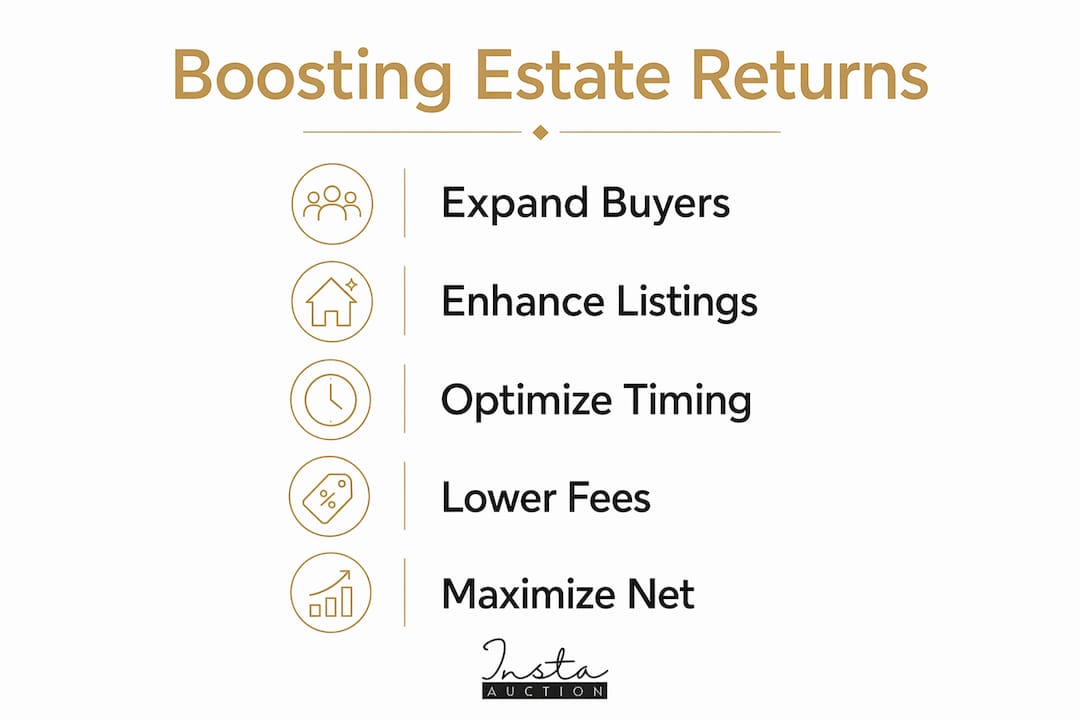
Online bidding increases estate returns primarily by expanding the bidder pool, improving listing quality, and choosing platforms with strong close-time mechanics and transparent fee structures.
| Point | Details |
|---|---|
| Bidder pool size drives price | More competing buyers create more upward price pressure than any other single factor. |
| Photos outperform text | High-resolution images attract more bidders and raise final prices through increased participation. |
| Platform design matters at close | Structured bidding windows and mobile-friendly interfaces reduce drop-off and protect final prices. |
| Net return requires fee forecasting | Subtract all commissions and fees from expected hammer price before comparing platforms. |
| Online formats reduce overhead | Online-only auctions carry lower fixed costs, which improves net margins for estate sellers. |
What I have learned from watching estate auctions play out online
The families who get the best results from online estate auctions share one habit. They treat the listing as the sale. Not the auction day. Not the marketing email. The listing itself.
I have seen estates with genuinely valuable items sell for a fraction of their worth because the photos were dark, the descriptions were vague, and the catalog was disorganized. Buyers could not tell what they were looking at, so they did not bid. The auction closed with two or three participants instead of twenty. That is not a platform problem. That is a preparation problem.
The counterintuitive truth about online bidding is that the seller’s work happens before the auction opens, not during it. Once the listing is live, the platform’s job is to sustain engagement. Your job is done. If you did it well, the bidders show up and compete. If you did it poorly, no amount of auction design saves you.
My honest advice: prioritize photo quality above everything else. Then choose a platform with a verified buyer base and a close-time extension feature. Then run your net-return numbers before you commit. Those three steps, done in that order, will produce better results than any other combination of tactics I have seen applied to estate liquidation.
The families who treat online estate auctions as a passive process, assuming the platform does all the work, consistently leave money on the table. The ones who engage with listing quality and platform selection walk away with results that surprise them.
— Admin
How Insta-auction supports your estate sale strategy
Families who want to put these principles into practice without starting from scratch have a direct path forward with Insta-auction.

Insta-auction’s platform combines expert appraisal, multi-channel digital marketing, and a verified buyer base focused on pre-loved luxury items and collectibles. Every listing goes through trained specialists who know how to present items for maximum bidder engagement. The platform’s auction design supports competitive close-time mechanics that keep bidders active until the final moment. For families ready to move forward, the expert bidding strategies and consignment guide on the Insta-auction site offer a clear starting point for turning estate assets into strong net returns.
FAQ
How does online bidding raise estate sale prices?
Online bidding raises prices by expanding the buyer pool to national and international participants, which increases competition. More competing bidders push final prices higher through the auction process.
Why do online estate auctions outperform garage sales?
Garage sales attract only local, walk-in buyers and have no competitive bidding mechanism. Online estate auctions reach thousands of qualified buyers and create price competition that garage sales cannot replicate.
How many estate lots are won by online bidders?
About 60% of estate lots in 2023 were won by online bidders, reflecting how dominant digital participation has become in estate auction outcomes.
What is the biggest factor in getting more bids on estate items?
Photo quality is the biggest controllable factor. Richer photo disclosure attracts more bidders, and more bidders directly produce higher closing prices.
Do online auction fees reduce estate profits?
Fees affect net returns, but online-only platforms typically achieve higher net margins than on-site formats because their fixed overhead is lower. Running a net-return forecast before choosing a platform protects your actual proceeds.