

A compelling auction listing is defined by three elements working together: a detailed, honest description, high-quality multi-angle photography, and buyer-focused information that removes doubt before it forms. Sellers who master this combination attract more serious bidders and consistently achieve higher hammer prices. Tools like Estimint, Gavelist, and platforms such as Whatnot have formalized these practices into repeatable workflows. This article walks you through every layer of effective auction listing creation, from the words you choose to the photos you shoot, so your luxury items and collectibles get the attention and prices they deserve.
What essential information should every auction listing include?
A five-part description structure covers item identity, key details, condition, provenance, and a factual close. Each element serves a specific purpose: identity tells buyers what they are looking at, details give them the specs to compare, condition sets honest expectations, provenance adds credibility, and the close confirms the facts without hype. Skipping any one of these parts creates a gap that cautious buyers fill with doubt.
The five-part description formula
- Item identity: State the maker, object type, and period in the first sentence. For example: “Cartier 18k yellow gold bangle, circa 1970s.” Correct attribution language matters here. Precise attribution terms such as “by,” “attributed to,” or “in the manner of” carry distinct meanings in the collectibles market. Using the wrong one invites post-sale disputes.
- Key details: Include dimensions, weight, materials, edition numbers, and any identifying marks. Buyers of luxury goods compare listings across multiple platforms before bidding. Concrete specs reduce that comparison friction.
- Condition: State flaws explicitly and reference the photos that show them. Early condition disclosure matches how buyers scan listings and reduces the chance of a return request.
- Provenance and context: Where did this piece come from? A watch from a named estate or a painting with exhibition history carries more perceived value than an identical item with no story.
- Factual close: End with confirmed facts, not sales language. “Dimensions confirmed at 7.5 inches. Ships insured within 3 business days.” That kind of close builds trust.
Beyond the five parts, your listing needs a shipping block, a returns policy, and a short FAQ drawn from real buyer questions. Returns policies should state the return window, who pays shipping, and any exclusions aligned with the platform you are using. Platforms like Mercari use a 72-hour window; Poshmark applies buyer protection only. Knowing your platform’s rules and stating them clearly prevents confusion.
Pro Tip: Pull your FAQ questions from messages you have received on past listings. If three buyers asked whether a piece is signed, add that answer to every future listing of similar items. This cuts message volume and raises buyer confidence.
Readability matters as much as completeness. Bullet points and short paragraphs help buyers skim a listing quickly among many lots. A wall of text signals effort but loses readers before they reach the bid button.
How can photography enhance your auction listings?
Photography quality and review discipline impact listing accuracy far more than clever copywriting. A buyer who cannot see a flaw in a photo will assume it does not exist, and that assumption creates returns. A buyer who can see every angle, mark, and imperfection bids with confidence.
Practical photo guidelines for luxury and collectible items
- Shoot a minimum of 3–5 angles per lot. For jewelry, that means top, side, clasp, hallmark, and any stone detail. For art, that means full front, signature, frame condition, and any damage.
- Use a neutral background, white or light gray, with consistent, diffused lighting. Shadows hide flaws and reduce perceived quality.
- Capture all maker marks, serial numbers, and signatures in dedicated close-up shots. These details justify price and confirm authenticity.
- Photograph any damage, wear, or restoration clearly. A well-lit photo of a chip is far less damaging to your sale than a buyer discovering it after delivery.
AI cataloging tools like Gavelist analyze your uploaded photos to generate draft descriptions. This speeds up the listing process significantly for high-volume sellers. However, AI-generated descriptions require manual review. Dimensions can be misread, attributions can be wrong, and context gets lost without human judgment.
Pro Tip: Spot-check 1 in 10 lots for accuracy, and review every lot priced above $500 in full before publishing. One wrong dimension on a high-value piece costs far more than the time saved by skipping the review.

What is the step-by-step process to create and publish an auction listing?
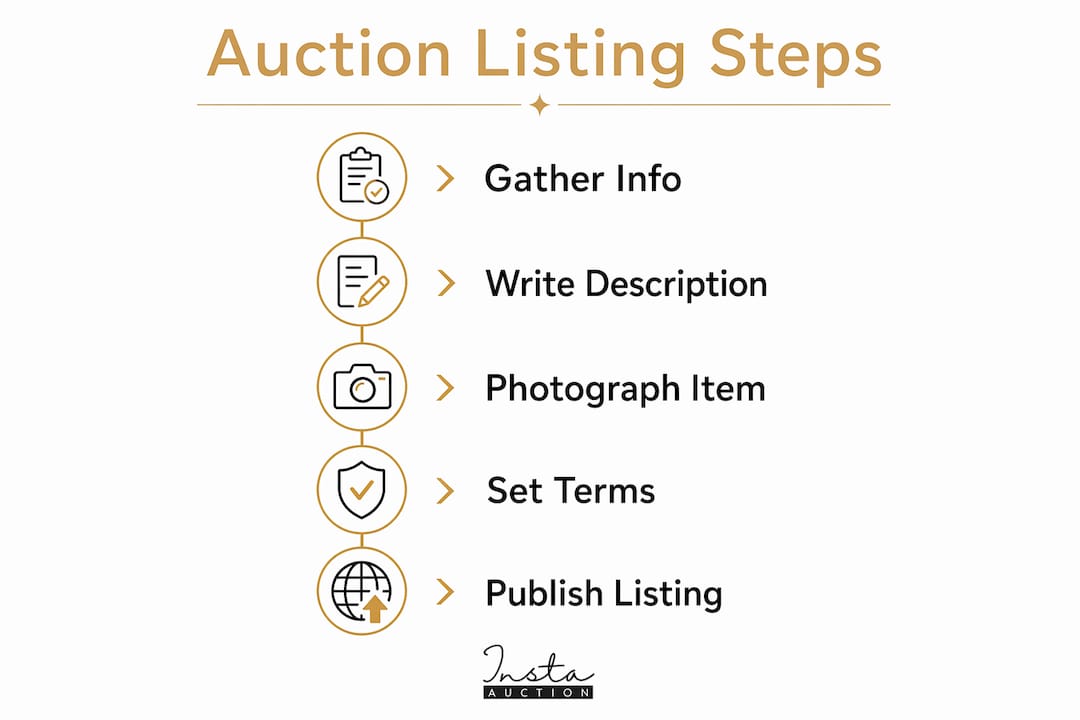
The process of creating and publishing a listing breaks into five clear stages. Following them in order prevents the most common errors.
- Gather your item details and photos first. Before you open any platform or template, have your measurements, provenance notes, condition observations, and a full photo set ready. Trying to write a description while also photographing the item produces incomplete listings.
- Draft your description using a template or AI tool. Estimint’s fill-in-the-blank template reflects the five-part structure and keeps descriptions consistent across multiple lots. Gavelist’s AI workflow integrates multi-photo upload, AI cataloging, manual review, and export formatting compatible with platforms like HiBid and LiveAuctioneers.
- Set your auction parameters. On Whatnot, listing requirements include a title, detailed description, photos, starting bid, auction type, and an accurate end time. These fields are not optional. An inaccurate end time or a missing starting bid creates confusion that costs you bidders.
- Review before publishing. Read the full listing as a buyer would. Check that every photo referenced in the description is actually uploaded. Confirm that shipping and returns information is present and accurate.
- Publish and monitor. Watch for buyer questions in the first few hours. Answers to early questions can be added to the listing FAQ to help subsequent viewers.
| Stage | Key action | Common error to avoid |
|---|---|---|
| Preparation | Gather all details and photos | Writing descriptions from memory |
| Drafting | Use a structured template or AI tool | Publishing AI output without review |
| Parameters | Set starting bid, type, and end time | Leaving duration fields at default |
| Review | Read listing as a buyer | Skipping photo-to-description cross-check |
| Publishing | Monitor early questions | Ignoring messages in the first 24 hours |
What common mistakes reduce auction listing effectiveness?
The most damaging mistake sellers make is assuming buyer trust. Professionals pre-answer uncertainty by disclosing exact flaws, referencing photo evidence, and clarifying returns. Sellers who skip this step lose bidders who move on to a listing that gives them more confidence.
- Vague or optimistic descriptions: Phrases like “good condition for its age” or “minor wear” tell buyers nothing useful. State the specific flaw, its location, and its size. “Light scratch on the base, visible in photo 4” is the standard to aim for.
- Too few photo angles: A single hero shot of a luxury handbag does not show the hardware, the interior, the date stamp, or the stitching. Buyers of high-value items expect full visual coverage before they commit.
- Missing attribution precision: Calling a piece “by” a named artist when the correct term is “attributed to” creates a legal and reputational risk. Attribution language affects serious buyer trust and reduces post-sale disputes.
- No shipping or returns information: Buyers who cannot find shipping costs or return terms before bidding either message you or leave. Both outcomes reduce your conversion rate.
Pro Tip: Before publishing, ask yourself: “What would make me hesitate to bid on this listing?” Answer that question in the description. That single habit eliminates most of the friction that kills bids.
Consistency across your listings also builds a seller reputation. Buyers who purchase from you once and receive exactly what was described become repeat bidders. That repeat behavior drives up competition on your future lots.
Key takeaways
Detailed, honest listings with multi-angle photos and clear buyer information are the single most reliable way to increase bids and reduce returns on luxury and collectible auction items.
| Point | Details |
|---|---|
| Use the five-part structure | Cover identity, specs, condition, provenance, and a factual close in every listing. |
| Photograph every angle and flaw | Shoot 3–5 or more angles per lot, including all marks, damage, and signatures. |
| Disclose condition early | State flaws explicitly and reference the photos that show them to reduce buyer doubt. |
| Include shipping and returns details | State the return window, who pays shipping, and platform-specific exclusions clearly. |
| Review AI-generated descriptions | Spot-check every lot and scrutinize all items above $500 before publishing. |
Why the story behind a listing matters as much as the specs
The listings that consistently achieve the highest prices treat the description as two things at once: structured metadata and a short story. Collectors respond to narrative as well as facts. A Rolex with documented service history at an authorized dealer tells a different story than an identical watch with no paper trail, even if the specs are the same. That story reduces perceived risk and justifies competitive bidding.
What I have seen repeatedly is that sellers underestimate how much doubt costs them. A buyer who reaches the bid page with one unanswered question often does not bid. They do not message you. They just leave. Reducing buyer doubt through detailed, honest descriptions is the biggest single factor driving auction conversion and raising hammer prices. The listing is your only sales tool when you are not in the room.
AI cataloging tools have genuinely changed the speed at which you can build a listing. But speed without accuracy is worse than slow. I always recommend using AI to generate a first draft and then reading it as a skeptical buyer would. Check the dimensions against your own measurements. Verify the attribution language. Confirm that the condition notes match what the photos actually show. The manual review step is where the real value of AI-assisted cataloging lives.
Finally, the FAQ block is underused by most private sellers. Auction houses build FAQ sections from years of buyer questions. You can do the same after just a few sales. A three-question FAQ that answers “Is this authenticated?”, “What are the shipping costs?”, and “Do you accept returns?” removes the three most common hesitations before they form. That is not extra work. That is the work.
— Admin
How Insta-auction helps sellers list luxury items with confidence
Insta-auction is built specifically for sellers of pre-loved luxury items and collectibles who want to achieve competitive prices without the complexity of traditional auction houses.
The platform gives sellers structured listing tools, expert appraisal support, and multi-channel marketing so your items reach the right buyers. Insta-auction’s trained specialists review listings to make sure descriptions are accurate and photos are complete before going live. For sellers ready to put these listing principles into practice, the luxury goods auction category is the right place to start. You can also review the full seller how-to guide for step-by-step platform guidance. A portion of every sale goes to charity, so your listing does more than generate a return.
FAQ
What makes an auction listing description effective?
An effective auction listing description follows a five-part structure covering item identity, key specs, honest condition, provenance, and a factual close. Early condition disclosure and explicit flaw references reduce buyer doubt and increase bids.
How many photos should I include in an auction listing?
Include a minimum of 3–5 photos per lot, covering all angles, maker marks, signatures, and any visible flaws. Multi-angle photo coverage is more important to listing accuracy than the quality of the written copy alone.
Should I use AI tools to write auction descriptions?
AI tools like Gavelist speed up description drafting significantly, but every AI-generated description needs manual review before publishing. Spot-check 1 in 10 lots and review every item above $500 in full to catch errors in dimensions or attribution.
What information should I include about shipping and returns?
State the return window, who pays return shipping, and any exclusions that apply on your platform. Clear shipping and returns information prevents buyer confusion and reduces post-sale disputes, especially on high-value lots.
Why does attribution language matter in luxury auction listings?
Terms like “by,” “attributed to,” and “in the manner of” carry distinct legal and market meanings in the collectibles world. Precise attribution language protects sellers from post-sale challenges and builds trust with serious buyers.