

Concurrent estate auction management is the practice of running two or more estate auctions through overlapping phases at the same time. A solo operator can manage about two estate sales per month comfortably, but a small crew with a pricing specialist can handle four to five. That gap is not luck. It is the result of documented systems, deliberate delegation, and the right technology. This guide breaks down exactly how to manage multiple estate auctions simultaneously, covering phase overlaps, team structure, and the tools that compress labor without cutting quality.
What does managing multiple estate auctions simultaneously actually involve?
Running concurrent auctions means every phase of the auction lifecycle overlaps across different estates at the same time. You might be photographing lots for Auction B while Auction A is live, and settling payments for Auction C while marketing Auction D. The complexity compounds fast. Understanding where the friction points live is the first step toward building a system that holds up.
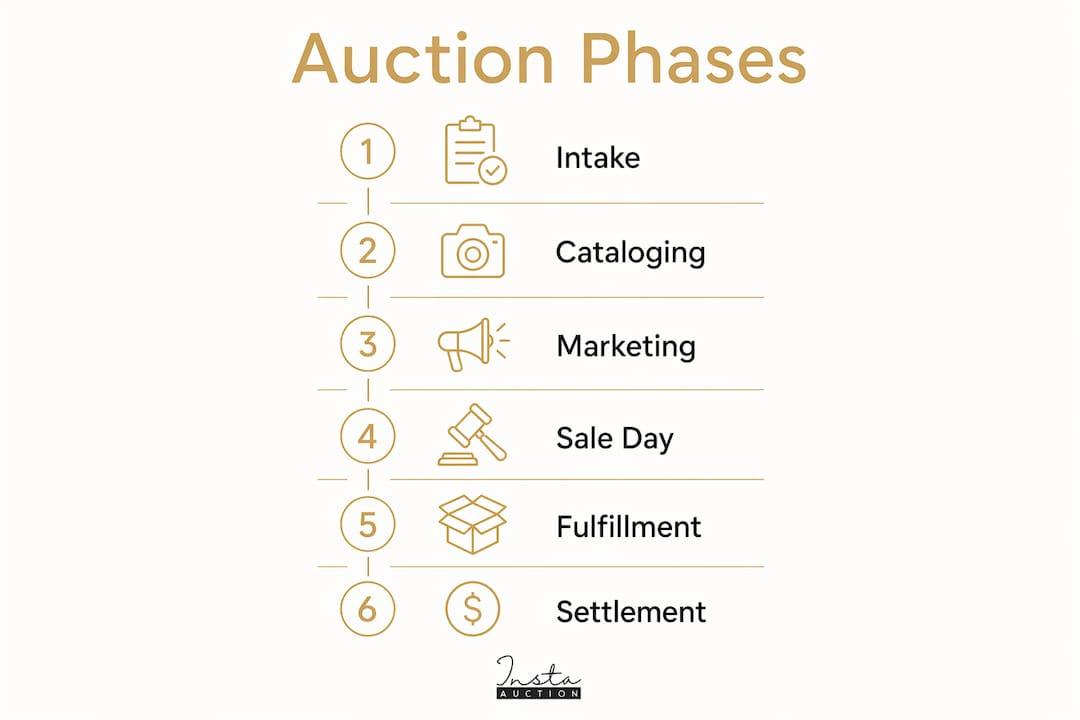
Every estate auction moves through six phases: intake, cataloging, marketing, sale day, fulfillment, and settlement. When you run one auction at a time, these phases flow in sequence. When you run three or more, they stack on top of each other. Cataloging for one auction collides with sale day for another. Fulfillment for a closed auction runs alongside marketing for the next one.

The table below shows where stress concentrates as you scale from two to six concurrent auctions.
| Phase | 2 Auctions | 4 Auctions | 6 Auctions |
|---|---|---|---|
| Intake | Manageable | Scheduling pressure | Requires dedicated intake coordinator |
| Cataloging | Primary bottleneck | Critical bottleneck | Requires AI tools or catalog team |
| Marketing | Minor overlap | Campaign fatigue risk | Segmentation required |
| Sale day | Separate days possible | Overlap likely | Strict calendar management needed |
| Fulfillment | Straightforward | Congestion begins | Staged pickup windows required |
| Settlement | Simple | Reporting complexity | Centralized software required |
Cataloging is the most consistent bottleneck. Manual cataloging takes 14 to 19 minutes per lot. At 50 lots per auction, that is over 12 hours of work per sale before you touch marketing or logistics. Multiply that across four auctions and the math breaks the operation.
Pro Tip: Map your auction calendar two months out and color-code each phase per auction. When two phases from different auctions land on the same day, that is a staffing conflict. Catch it on paper before it becomes a crisis on the floor.
What tools and systems make handling multiple auctions manageable?
Technology is not optional at scale. Software built for smaller operations struggles to manage multiple overlapping auctions. Enterprise platforms offer centralized oversight across auctions, locations, staff, and inventory. That centralization is the difference between controlled growth and operational chaos.
The most impactful single upgrade is AI cataloging. AI cataloging tools reduce photography and description time from 20-plus hours to 2 to 3 hours per sale. That frees your catalog team to process more auctions without adding headcount. The time savings alone justify the cost at three or more concurrent auctions.
Integrated software systems save over 20 staff hours per week compared to disconnected tools. That is a full half-time position recovered just by consolidating your tech stack.
| Tool Category | Core Function | Operational Benefit |
|---|---|---|
| AI cataloging software | Auto-generates lot descriptions from photos | Cuts catalog time from 20+ hours to 2–3 hours |
| Centralized auction platform | Unified dashboard for all active auctions | Eliminates fragmented reporting |
| Integrated payment processing | Invoicing and payment tied to auction records | Reduces settlement errors |
| Shipping and fulfillment tools | Label generation, carrier integration | Shipping labels within 24 hours of payment |
| CRM and email automation | Segmented bidder communication | Prevents bidder fatigue across campaigns |
Standard operating procedures, known as SOPs, are the foundation underneath all of this technology. Successful multi-auction operators formalize 10 to 12 high-impact SOPs covering every phase from intake through settlement. SOPs mean any trained team member can execute a phase correctly without asking you for direction. That is what makes scale possible.
Pro Tip: Build your SOPs before you hire. Document what you already do, then hand the document to your first hire. Training time drops significantly when the process is written down.
How do you organize team roles for running several auctions at once?
The founder bottleneck is the single most common reason estate auction businesses stall at two or three sales per month. Operator bottlenecks stem from attempting to personally handle every decision point. Spreading responsibility across reliable team members is what makes sustainable multi-auction management possible.
Formalized SOPs and a scalable structure that delegates key roles are required to scale from two to eight auctions per month without burnout. An operations manager alone removes roughly 45% of founder workload. That is not a small shift. It is the structural change that unlocks the next level of capacity.
Here are the core roles and their responsibilities for a team running four or more concurrent auctions:
- Operations manager: Coordinates phase schedules across all active auctions, manages staff assignments, and owns the master auction calendar.
- Catalog manager: Oversees lot photography, AI tool output, and description quality. Reviews final catalog before publication.
- Marketing lead: Manages email campaigns, social media scheduling, and bidder segmentation across all active auctions.
- Pricing specialist: Sets reserves and opening bids, handles authentication queries, and flags high-value lots for expert appraisal.
- Virtual assistants: Handle overflow photography editing, SEO content writing, and routine bidder communication.
Delegation patterns for scaling operators typically retain final catalog approval, reserve setting, and authentication in-house while outsourcing overflow photography, SEO content, and specialized shipping. Keep the decisions that require your expertise. Delegate the tasks that require only your time.
Pro Tip: Assign each active auction a single point of contact on your team. When a family member or probate attorney calls with a question, one person owns the answer. This prevents communication gaps and builds client trust.
Referral relationships with probate attorneys and realtors are the true competitive advantage of an estate auction business, since each client interaction is typically a one-time transaction. Your team’s ability to communicate clearly with those referral sources determines whether the next estate comes to you or goes elsewhere.
What are the step-by-step execution strategies for estate auction organization?
Execution at scale requires a calendar-first mindset. Every auction phase gets a hard deadline on the master calendar before any work begins. Overlaps are identified in advance, not discovered mid-execution.
- Build the master auction calendar. Plot all six phases for every active auction on a single shared calendar. Identify any day where two or more auctions share a phase. Those are your conflict points.
- Stage catalog production. Photography must turn around within 72 hours of intake. Assign catalog batches to specific team members with daily output targets. Never let catalog work pile up.
- Segment your marketing campaigns. Marketing segmentation and scheduling prevent bidder fatigue when multiple auctions run overlapping campaigns. Send different auction promotions to different bidder segments based on past purchase history.
- Separate sale days by at least 48 hours. Running two live auctions on the same day splits your team’s attention and your bidders’ focus. A 48-hour gap is the minimum buffer for quality execution.
- Use phased fulfillment windows. Breaking large estate sales into phased events by floor or area maintains manageable workloads and safety. Apply the same logic to pickup scheduling. Stagger pickup windows across auctions to prevent fulfillment congestion.
- Standardize settlement reporting. Generate invoices and payment records through your centralized platform. Shipping labels should be ready within 24 hours of payment confirmation.
- Review compliance and contracts per auction. Each estate has its own legal terms and conditions tied to probate timelines, family agreements, or consignment contracts. Assign a checklist review before each auction goes live.
Scaling is less about increasing the number of customers and more about compressing labor-hours per sale. Offloading tedious tasks to AI tools and specialist staff is what creates the capacity for growth without adding proportional cost or stress.
A separate contact for each estate also reduces delays in probate timelines. Separating liquidation tasks from family emotional decisions via a single accountable contact keeps the process moving when families are under stress. That accountability structure belongs in your SOPs.
Key Takeaways
Running multiple estate auctions simultaneously requires documented systems, role-based delegation, and integrated technology to maintain quality and throughput as volume grows.
| Point | Details |
|---|---|
| Catalog is the primary bottleneck | AI cataloging tools cut processing time from 20+ hours to 2–3 hours per sale. |
| SOPs unlock delegation | Formalizing 10–12 SOPs lets trained staff execute phases without founder input. |
| Team structure drives capacity | An operations manager removes roughly 45% of founder workload at scale. |
| Calendar management prevents conflicts | Mapping all auction phases on one shared calendar reveals scheduling conflicts before they happen. |
| Integrated software saves time | Centralized platforms save over 20 staff hours per week versus disconnected tools. |
Why volume without systems is just organized chaos
The operators I respect most in this industry are not the ones running the most auctions. They are the ones who built the infrastructure first and then grew into it. The common mistake is adding a third or fourth auction before the second one runs cleanly. That compounds every problem already present in the operation.
The most underrated shift in this business is treating it as a relationship operation, not a transaction operation. Families remember how you handled their parents’ belongings. Probate attorneys remember whether you returned calls. Realtors remember whether you showed up on time. None of that changes when you scale. What changes is whether your systems protect those relationships or erode them under volume pressure.
Automation genuinely transforms the workload math. When AI handles the first draft of every catalog description, your catalog manager becomes an editor, not a writer. That is a faster, less exhausting role. The same logic applies to invoicing, shipping labels, and email sequences. Every automated step is a decision your team does not have to make manually at 9:00 PM before a sale day.
The operators who burn out are almost always the ones who refused to document their process. They kept the knowledge in their heads because it felt faster. It is faster, until it is not. One sick team member, one double-booked sale day, and the whole operation stalls. Write the SOPs. Build the calendar. Hire for the roles. The business that results is one you can actually run.
— Admin
How Insta-auction supports multi-auction operators
Managing several estate auctions at once demands more than good intentions. It requires a platform built to handle the full lifecycle, from appraisal through final sale, with expert support at every stage.

Insta-auction provides trained appraisers who catalog and market estate sale items across digital channels, reducing the manual burden that stalls most small operators. The platform’s focus on pre-loved luxury goods and collectibles means your high-value lots receive the specialist attention they need, not a generic listing. Sellers consistently achieve competitive prices, and a portion of every sale goes to charity, adding real community value to each auction you run. For operators ready to scale, Insta-auction’s luxury goods auction services offer the expert infrastructure that makes concurrent auction management sustainable.
FAQ
How many estate auctions can one person manage at once?
A solo operator can comfortably manage about two estate sales per month. Adding a trained helper increases capacity to three, and a small crew with a pricing specialist supports four to five per month.
What is the biggest bottleneck in concurrent estate auction management?
Cataloging is the primary bottleneck. Manual lot description takes 14 to 19 minutes per lot, which makes AI cataloging tools the highest-impact investment for operators running multiple auctions.
Do I need specialized software to run multiple estate auctions?
Yes. Software built for single or small operations breaks down under multi-auction volume. Enterprise platforms with centralized dashboards for cataloging, invoicing, and reporting are required for consistent performance at scale.
How do I prevent bidder fatigue when running overlapping auctions?
Segment your email list by bidder purchase history and send each auction promotion to the most relevant segment. Scheduling sale days at least 48 hours apart also reduces audience overlap and maintains bidder engagement.
What roles should I hire first when scaling estate auctions?
Hire an operations manager first. This role removes roughly 45% of founder workload by owning the master calendar and staff coordination, which is the structural change that makes further scaling possible.