

Selling furniture through an online auction is the most effective way to reach a national buyer pool, generate competitive bids, and walk away with more money than a garage sale or classified listing ever delivers. The industry term for this process is “online consignment auction,” and it works by listing your piece on a digital platform where registered bidders compete in real time or over a set window. Unlike fixed-price marketplaces, auctions create urgency. That urgency drives prices up. Families clearing out a home, downsizing, or selling inherited pieces consistently report better returns through auction channels than through any other online furniture sales method.
What do you need to sell furniture through online auction?
The single biggest factor in auction success is listing quality. Listings with professional photos and video reduce sale time by 60%, with video-first platforms achieving sales within 24–48 hours compared to 7–14 days on photo-only platforms. That gap is not a coincidence. Buyers bidding on furniture they cannot touch need visual proof of condition, scale, and character.
Before you list anything, gather these essentials:
- Photos from every angle: front, back, sides, close-ups of joints, hardware, and any wear marks
- A short video walkthrough: 30–60 seconds showing the piece in natural light, opening drawers, and demonstrating any moving parts
- Accurate dimensions: always list width, depth, and height in that order (W x D x H)
- Honest condition disclosures: scratches, repairs, fading, and structural issues must be stated clearly
- Provenance and documentation: original receipts, designer tags, repair records, or certificates of authenticity
Gathering provenance documents before submitting to an auction platform speeds the appraisal process and can earn your piece premium placement in a catalog. A mid-century modern credenza with its original purchase receipt commands more attention than an identical piece with no paper trail.
Fees are the other prerequisite to understand. Auction platform commissions range from a 10% flat fee on digital-native platforms to 25–60% at traditional auction houses. You also need to clarify upfront who pays for shipping, insurance, and packing. Those costs directly affect your net profit, so calculate them before you set a reserve price.
Pro Tip: Photograph your furniture in a clean, well-lit room with a neutral background. Cluttered or dark photos cut bids before a single person reads your description.

How to price your furniture strategically for auction
Pricing is where most sellers leave money on the table, and the fix is counterintuitive. Pricing at 70–85% of retail results in four times faster sales. Items priced at 70–75% of retail sell within 3–7 days, while pricing above 90% slows sales substantially. That data point matters because a slow auction loses bidder momentum, and lost momentum means a lower final price.
The mechanics of auction pricing work like this:
- Low starting bids: A $1 or low-dollar opening bid builds bidder momentum and typically yields a higher final price than a high starting bid. More bidders enter, competition heats up, and the price climbs organically.
- Reserve prices: Set a reserve for designer, antique, or high-value pieces. The reserve is the minimum you will accept. It stays hidden from bidders but protects you from selling a $2,000 Eames chair for $80.
- Research comparable sales: Auction platforms list detailed sold data that gives you realistic price benchmarks. Sold prices at auction are more accurate than asking prices on fixed-price marketplaces, because they reflect what buyers actually paid.
The most common pricing mistake is anchoring to what you paid originally. Retail price is irrelevant at auction. What matters is what a motivated buyer will pay today, in this market, for this condition. Sold auction records answer that question directly.
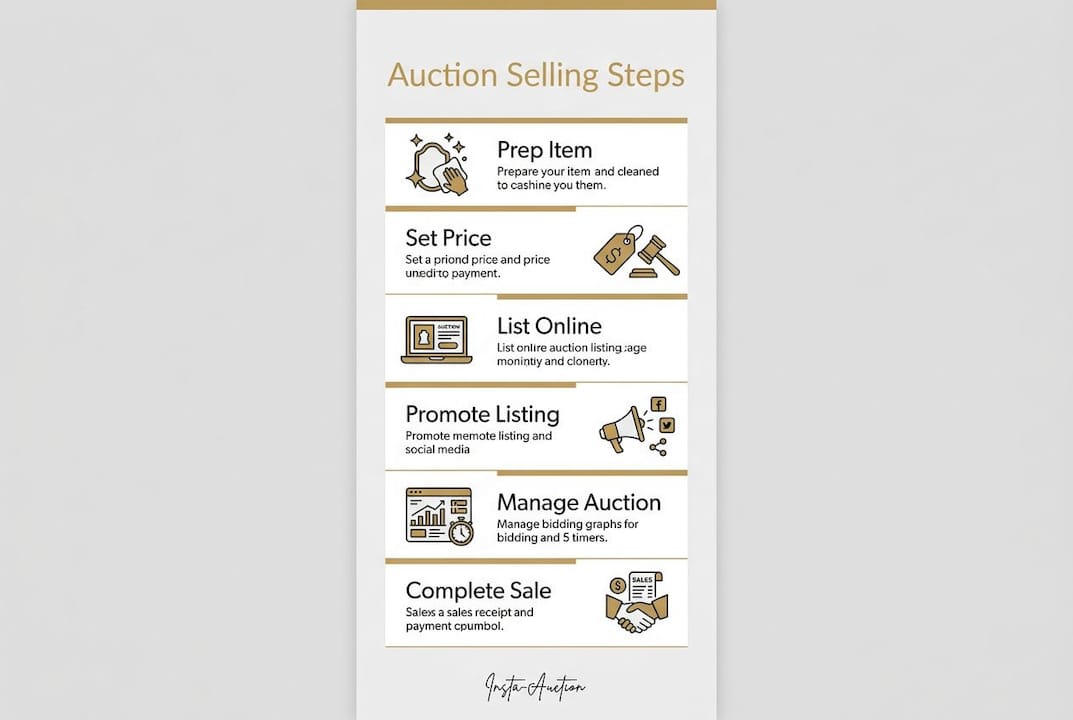
Step-by-step process for listing and running a furniture auction
A well-run auction listing follows a clear sequence. Skipping steps costs bids.
Choose the right platform for your piece. General auction platforms work for everyday furniture. Specialty platforms focused on pre-loved luxury items, like Insta-auction, attract buyers who expect quality and pay accordingly. Match the platform to the piece. A vintage Knoll sofa belongs on a platform that specializes in auction categories for design and luxury goods, not a general classifieds site.
Build your listing. Combine your best photos, your video walkthrough, and a clear written description. State the maker, materials, dimensions, age, and condition in plain language. Clear, honest descriptions reduce post-sale disputes and return requests significantly. Buyers who feel informed bid with confidence.
Set your auction window. Most online furniture auctions run for 5–10 days. Ending an auction on a Sunday evening captures the largest bidder pool, since weekend browsing peaks in the late afternoon and evening hours. Avoid ending auctions on holidays or Monday mornings.
Respond to buyer questions promptly. Bidders ask about dimensions, pickup logistics, and condition details. A fast, thorough answer keeps them engaged and often converts a question into a bid.
Manage payment and pickup. Professional auction platforms process payment before the item is released to the buyer. That structure eliminates the fraud risk common in peer-to-peer sales, where bounced checks and fake payment confirmations are real hazards. Once payment clears, schedule pickup or arrange shipping.
Disassemble before shipping. Removing legs, brackets, and hardware before shipment reduces transport damage and expands your buyer pool by making pickup easier for buyers without large vehicles. Include hardware in labeled bags taped inside the piece.
Pro Tip: List your auction to end between 7:00 PM and 9:00 PM on a Sunday. That window consistently captures the highest number of active bidders across most U.S. time zones.
For families managing an estate, the online estate auction process involves additional steps around documentation and lot organization, but the core listing mechanics are identical.
What are the most common challenges when selling furniture at auction?
Every seller hits friction at some point. Knowing the common problems in advance puts you ahead of them.
Weak bidding or no sale. If an auction closes with few bids, the cause is almost always one of three things: poor photos, an overpriced starting bid, or the wrong platform for that category of furniture. Relist with better images, a lower opening bid, and confirm you are on a platform where buyers actually search for that type of piece.
Buyer questions that feel like negotiation. Some buyers ask detailed questions as a way to test whether you will accept a lower price outside the auction. Hold your position. The auction format exists to let the market set the price. Engaging in side negotiations undermines that process and can violate platform terms.
Shipping damage. Furniture is large, heavy, and fragile in ways that standard shipping carriers do not always handle well. Disassemble every piece you can. Wrap corners and glass with moving blankets and bubble wrap. Use double-wall boxes for smaller items. Photograph the packed piece before it leaves your hands.
“Protecting against fraud starts with choosing a platform that holds payment in escrow until the buyer confirms receipt or a set release window passes. Peer-to-peer cash transactions carry real risk. Verified platforms with secure payment processing eliminate that risk entirely.”
Fraud and scams. Stick to platforms that secure payment processing before item release. Never accept payment outside the platform, and never ship before funds clear. Scammers target sellers who bypass the platform’s payment system.
Understanding how furniture auctions differ from collectibles also helps you avoid category mismatches that result in low bids or no sale at all.
Key takeaways
Selling furniture through online auction delivers the best results when sellers combine quality listings, strategic pricing, and a platform matched to the piece’s value and category.
| Point | Details |
|---|---|
| Listing quality drives speed | Professional photos and video cut sale time by up to 60% compared to photo-only listings. |
| Low starting bids increase final price | Opening bids near $1 attract more bidders and push final prices higher through competition. |
| Price at 70–85% of retail | This range sells four times faster than pricing above 90% of retail value. |
| Platform choice matters | Match the piece to the platform. Luxury and designer furniture performs best on specialty auction sites. |
| Secure payment protects sellers | Use platforms that process payment before item release to eliminate fraud risk. |
Why I think most sellers underestimate the auction format
Most people I talk to assume auctions are for dealers and estate liquidators, not for a family selling a dining set or a couple clearing out a spare bedroom. That assumption costs them money.
The auction format is actually the most honest pricing mechanism available. It does not ask you to guess what your furniture is worth. It asks the market. And the market, when given enough bidders and a well-presented listing, almost always lands at a fair number or above it. I have watched a mid-century dresser with a $75 starting bid close at $480 because two motivated buyers wanted it at the same time.
The sellers who struggle are the ones who treat auction listings like classified ads. They post one blurry photo, write three words of description, and wonder why nobody bids. The auction format rewards effort. A thorough listing with good photos, honest condition notes, and accurate dimensions signals to buyers that the seller is credible. Credible sellers get more bids.
The other thing most sellers miss is the research value. Auction platforms as market research tools give you sold price data that no other source matches. Before you list anything, spend 20 minutes searching for comparable pieces and filtering by “sold.” That data tells you exactly where to set your reserve and how to frame your starting bid.
Timing and platform selection are the two levers most sellers never think to pull. Get both right, and the auction does the rest.
— Admin
Insta-auction makes furniture auctions work for real sellers
Sellers who want competitive prices without the complexity of traditional auction houses find a practical home at Insta-auction. The platform connects furniture sellers with an engaged buyer community that actively bids on pre-loved and luxury pieces, which means your listing reaches people who are ready to pay.

Insta-auction’s trained appraisers review submissions and market items across digital channels, so your furniture gets in front of the right buyers without you managing ad campaigns. Payment processes securely through the platform before any item changes hands. Sellers maintain control over reserve pricing, and flexible pickup and shipping options keep logistics manageable. If you are ready to list, start selling with us and see what your furniture is actually worth to a motivated bidding audience.
FAQ
What commission does an online auction platform charge?
Online auction commissions range from a 10% flat fee on digital platforms to 25–60% at traditional auction houses. Always confirm who covers shipping, insurance, and packing costs before listing.
How do I set the right starting bid for furniture?
Start low. A $1 or minimal opening bid builds bidder momentum and typically drives the final price higher than a high starting bid does. Use a reserve price to protect against selling below your minimum acceptable amount.
What types of furniture sell best at online auction?
Designer, antique, mid-century modern, and solid-wood pieces consistently attract the strongest bids. Check the types of items best suited for auction to confirm your piece fits a high-demand category before listing.
How do I protect myself from fraud when selling furniture online?
Use platforms that hold payment in escrow and release funds only after the transaction is confirmed. Secure payment processing before item release eliminates the bounced-check and fake-payment scams common in peer-to-peer sales.
Does furniture condition affect auction results significantly?
Yes. Honest condition disclosures paired with clear photos build buyer trust and reduce post-sale disputes. Clear descriptions and condition notes consistently produce higher bids than vague or incomplete listings.