

Winning online luxury item auctions is defined by three factors: disciplined preparation, informed bidding, and a clear understanding of how auction platforms operate. Platforms like LiveAuctioneers host thousands of high-value lots every month, from Hermès handbags to Patek Philippe watches, and the bidders who consistently succeed are not the ones with the deepest pockets. They are the ones who arrive prepared. This guide covers the exact strategies that separate winning bidders from frustrated underbidders, including how to read condition reports, set a fee-inclusive budget, time your bids, and avoid the emotional traps that cost most people the lot.
What are the essential preparations to win online luxury item auctions?
Preparation is the single biggest factor in auction success. Condition reports and provenance are essential legal documents that directly affect your bid decision. A watch listed as “running” with no service history is a very different risk than one with full paperwork from an authorized dealer. Study every photo, zoom into clasps and hallmarks, and request additional images if the listing feels thin.
Auction fees catch most first-time bidders off guard. The buyer’s premium alone can add 20–30% on top of the hammer price, and that figure does not include sales tax or shipping. Calculate your true all-in cost before you set a maximum bid. A $2,000 hammer price on a designer bag can easily become $2,700 once fees land.
Registering early on your chosen platform removes a major source of last-minute stress. Some platforms require identity verification or a credit card hold before you can bid. Completing that process two or three days before the auction closes means you are focused on strategy, not paperwork, when the clock counts down.
| Preparation step | What to check | Why it matters |
|---|---|---|
| Condition report | Wear, repairs, missing parts | Determines true value and bid ceiling |
| Provenance documents | Receipts, certificates, prior ownership | Confirms authenticity and resale value |
| Fee structure | Buyer’s premium, tax, shipping | Sets your real maximum spend |
| Platform rules | Hard close vs. soft close | Shapes your timing strategy |
| Registration status | ID verified, payment method on file | Prevents technical lockouts at bid time |
- Read the full lot description, not just the headline title.
- Cross-reference the estimated value against recent sold prices on comparable platforms.
- Check the platform’s dispute and return policy before committing.
- Confirm shipping logistics for fragile or oversized luxury items.
Pro Tip: Set your maximum bid as a number that includes all fees. If the lot is worth $3,000 to you all-in, work backward from that figure using the platform’s fee schedule to find your true hammer price ceiling.
How should you develop effective bidding strategies for online luxury auctions?
The most effective bidding strategy for online luxury auctions is patience combined with a pre-set ceiling. Setting a firm maximum price before bidding starts is the single most cited piece of advice from professional auctioneers. It removes the emotional variable that causes most bidders to overspend.
Timing your bids is equally critical. Bidding too early attracts attention from competing bidders and drives up the price before the auction reaches its natural peak. Waiting until the final minutes of a timed auction keeps your interest invisible and reduces the window for a bidding war to develop.

Platform format changes everything about timing. Soft-close auctions extend the clock by a short window whenever a bid lands near the end. That means a last-second bid does not guarantee a win. On a hard-close platform, the timer stops at zero with no extension, so a bid placed in the final 10 seconds is final.
Proxy bidding tools let you set your maximum and let the system bid incrementally on your behalf. This removes the need to monitor the auction in real time and prevents panic bidding. The system only bids as high as needed to stay ahead, up to your ceiling.
- Research the item and set your all-in maximum bid before the auction opens.
- Register on the platform and confirm your payment method at least 48 hours early.
- Monitor the lot casually during the early phase without placing a bid.
- Identify whether the platform uses a hard close or soft close format.
- Place your proxy bid at your true maximum with enough time to avoid technical errors.
- If bidding manually, enter your bid in the final two minutes on a hard-close platform.
- Stop at your ceiling. Do not place a single bid above your pre-set maximum.
Pro Tip: On soft-close platforms, place your maximum proxy bid rather than manually sniping. The clock extension makes last-second manual bids unreliable and often counterproductive.
What common mistakes do bidders make in online luxury auctions?
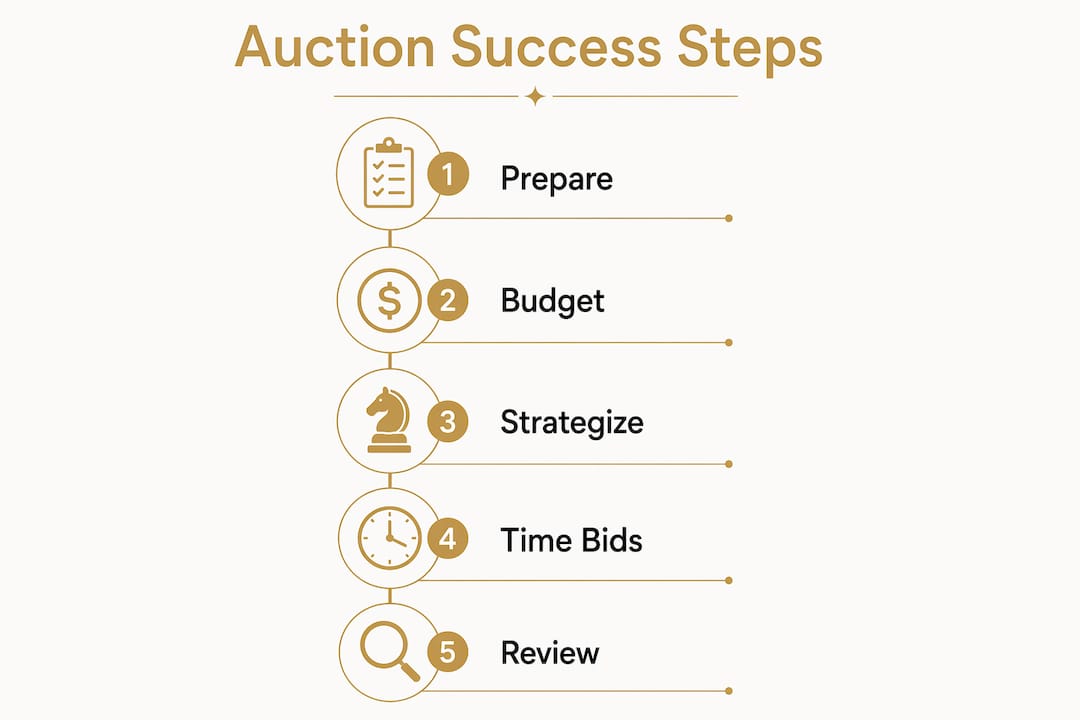
Most avoidable losses happen before the auction closes. Poor fee understanding and unclear spending limits are the two most common reasons bidders either overpay or lose lots they could have won. Fixing those two issues alone improves outcomes more than any bid timing trick.
Ignoring documentation is the second major error. When condition or provenance language is vague, such as “appears original” or “believed to be,” that uncertainty carries real financial risk. Ambiguous provenance wording should lead you to lower your maximum bid to reflect that risk, even if the item looks perfect in photos.
Emotional escalation is the most expensive mistake of all. A bidder who decides mid-auction that they “must have” a particular lot will almost always overpay. The psychology of competition triggers the same response as a retail sale: urgency overrides logic. Recognizing that feeling as a warning sign, not a green light, is what separates disciplined bidders from regretful ones.
- Review all fees and documentation at least two days before the auction closes.
- Write your maximum bid on paper before the auction opens and commit to it.
- Flag any vague condition or provenance language and adjust your ceiling downward.
- Never bid in the heat of a competitive moment without checking your pre-set limit.
- If you miss a lot, treat it as data. Note what drove the final price and apply that to your next bid.
Pro Tip: Build a simple checklist: condition report reviewed, fees calculated, maximum bid set, platform format confirmed. Run through it 48 hours before every auction. Most bidding errors are entirely preventable at that stage.
How do auction platforms and luxury categories affect your winning strategy?
Luxury auction categories each carry their own documentation standards and risk profiles. Jewelry requires gemological certificates from labs like GIA or IGI. Watches need service records and original box and papers. Handbags from brands like Hermès or Chanel require authenticity cards and date stamps. Knowing what documentation is standard for your category tells you immediately when a listing is incomplete.
Online, phone, and in-room bidding each offer different advantages. Online bidding gives you full control and a written record. Phone bidding through a specialist is useful for high-value lots where real-time guidance from an expert adds confidence. In-room bidding suits experienced buyers who read the room well, but it carries the highest emotional risk for newer bidders.
Platform mechanics vary significantly across the online luxury items for sale market. Hard-close platforms reward precise timing. Soft-close platforms reward proxy bidding and patience. Understanding which format you are working with before the auction opens is not optional. It is the foundation of your entire timing strategy.
| Platform format | How it works | Best bidding approach |
|---|---|---|
| Hard close | Timer stops at zero, no extension | Place bid in final 60–120 seconds |
| Soft close | Clock extends with each late bid | Use proxy bid at your maximum |
| Live with auctioneer | Real-time bidding, auctioneer controls pace | Bid decisively, avoid hesitation |
| Phone bidding | Specialist bids on your behalf | Pre-brief specialist on your ceiling |
- Confirm the closing format before every auction, even on platforms you have used before.
- For jewelry lots, verify the certifying lab and check its reputation independently.
- For watches, a missing original box and papers can reduce resale value by 20–40%.
- On live auctions, the winner is the highest bidder when the timer ends, so precision matters.
Key takeaways
Winning online luxury auctions requires preparation, a fee-inclusive budget, and a bidding strategy matched to the platform’s closing format.
| Point | Details |
|---|---|
| Preparation beats timing | Reviewing condition reports and fees before bidding improves outcomes more than last-second tactics. |
| Set a fee-inclusive ceiling | Calculate buyer’s premium, tax, and shipping before setting your maximum bid. |
| Match strategy to platform format | Hard-close platforms reward late bids; soft-close platforms reward proxy bidding. |
| Ambiguous documentation lowers your bid | Vague provenance or condition language signals risk and should reduce your maximum. |
| Emotional discipline is non-negotiable | Commit to your pre-set ceiling and treat any urge to exceed it as a warning sign. |
What I have learned from years of watching bidders win and lose
The bidders who consistently win luxury auctions are not the ones with the most money. They are the ones who treat every auction like a research project. I have watched people with generous budgets lose lots to bidders spending half as much, simply because the winner did their homework and the loser did not.
The most underrated skill in online bidding for luxury items is reading documentation critically. Most bidders skim condition reports. The ones who win read them word by word and ask questions when something is unclear. British Vogue quotes top auctioneers who say asking questions before bidding is one of the most reliable signs of a serious, successful buyer.
Psychological discipline is harder than it sounds. The competitive nature of auctions is designed to trigger urgency. Recognizing that the platform’s format, the countdown clock, and the visible bid history are all creating pressure is the first step to resisting it. Your maximum bid is a decision made with a clear head. Honor it every time.
My practical advice: treat every auction you participate in as a learning event, whether you win or not. Note what drove the final price, who the competing bidders appeared to be, and whether your preparation was complete. Over time, that log becomes one of the most valuable tools you have.
— S
Insta-auction: a better way to bid on luxury items online
Insta-auction is built specifically for buyers who want access to pre-loved luxury goods with transparent pricing and expert-backed listings. Every item goes through appraisal before it reaches the platform, so the condition information you read is accurate and complete.

Registration is straightforward, and the fee structure is clearly listed before you place a single bid. Insta-auction also donates a portion of every sale to charity, so your purchase supports something beyond your own collection. Browse the current luxury goods auctions to see active lots across jewelry, watches, handbags, and fashion. If you want a closer look at what is currently available, the Insta-auction gallery gives you a full view of listed items with detailed photography and condition notes.
FAQ
What is the buyer’s premium in a luxury auction?
The buyer’s premium is a fee added on top of the hammer price, typically ranging from 15% to 30%. Always calculate it into your maximum bid before the auction opens.
What is the difference between a hard close and a soft close auction?
A hard-close auction ends exactly when the timer hits zero. A soft-close auction extends the clock when a bid is placed near the end, making proxy bidding the more reliable strategy.
How do I avoid overbidding in a competitive luxury auction?
Set your maximum bid in writing before the auction opens and treat it as a fixed limit. Firm budgets and fee awareness are the most consistent predictors of disciplined, successful bidding.
Why does provenance matter so much in luxury item auctions?
Provenance confirms authenticity and affects resale value. Vague or missing provenance documentation increases your risk, and your maximum bid should reflect that uncertainty.
Should I bid by phone or online for high-value luxury lots?
Online bidding gives you full control and a written record. Phone bidding through a specialist suits very high-value lots where real-time expert guidance adds confidence, as noted by auction house specialists.