

For most U.S. heirs, a vetted online auction is the fastest path to fair market value for inherited valuables. Three reasons drive that verdict: national bidder reach drives competitive offers, transparent fee structures protect your net proceeds, and platforms like Insta-auction handle the marketing lift that private sales rarely match.
Before you list anything, do three things first: secure the items physically, document their condition and location with photos, and request a date-of-death fair market value (FMV) appraisal if the estate may owe taxes or if items appear worth more than $5,000.
Quick wins for heirs who want to act now:
- Lock items in a safe or secure storage immediately
- Photograph everything, including maker’s marks, hallmarks, and signatures
- Contact the estate executor or attorney about valuation deadlines
- Resist any quick-cash offer until you have independent comparables
Table of Contents
- What should you do in the first 72 hours?
- Why professional appraisals matter and how to hire the right one
- Which selling route gets you the best price?
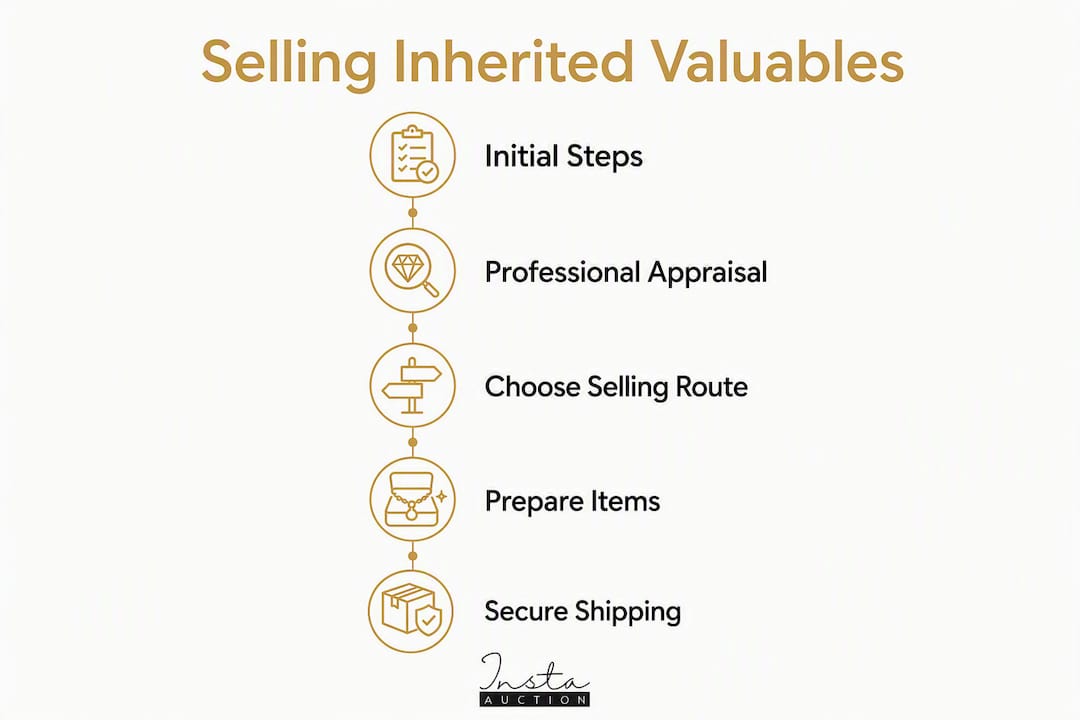
- How to sell inherited items through an online auction, step by step
- Costs, taxes, and legal basics that U.S. heirs must know
- How to prepare items to achieve top auction value
- Best practices for shipping and insuring high-value inherited items
- Common mistakes heirs make when selling inherited valuables
- How Insta-auction supports heirs selling inherited valuables
- Key Takeaways
- Useful sources and next-step contacts
- Insta-auction makes selling inherited collections straightforward
- FAQ
What should you do in the first 72 hours?
Speed matters here, but not in the direction most heirs assume. The goal is to slow down, not rush.
- Secure items physically. Move jewelry, art, and collectibles to a locked space. Document their location with timestamped photos.
- Do not sell or give anything away. Even items that look ordinary can carry significant value once properly identified.
- Search for paperwork. Receipts, certificates of authenticity, old appraisals, auction records, and family photos showing the item in use all count as provenance.
- Look for hallmarks and signatures. On jewelry, check inside bands and clasps. On silver, look for stamps on the base. On art, check the back of the canvas.
- Contact the executor or estate attorney. They may need a date-of-death valuation before the estate closes.
Pro Tip: Store digital copies of all documentation in a cloud backup or a separate safe deposit box. Physical records can be lost in the same event that damages the items themselves.
Accredited appraisers consistently warn that heirs acting under emotional pressure accept the first offer they receive, often far below market. Give yourself at least two weeks before committing to any sale.
Why professional appraisals matter and how to hire the right one
A professional appraisal does two distinct jobs: it establishes the date-of-death FMV the IRS uses to calculate your capital gains basis, and it gives you a realistic floor for sale negotiations. Skipping it on high-value items is one of the most expensive mistakes an heir can make.
The IRS ties your capital gains basis directly to the FMV at the date of death. Without a documented appraisal, you may overpay on taxes or lack the evidence to defend your basis if the return is questioned.
When you need a certified appraiser:
- The item appears worth more than $5,000
- The estate must file a federal estate tax return
- You plan to donate an item and claim a charitable deduction
- Family members dispute the item’s value
Credentials to look for: The American Society of Appraisers (ASA), International Society of Appraisers (ISA), and Appraisers Association of America (AAA) each maintain member directories and enforce ethical standards. Match the appraiser’s specialty to the item category: an art specialist is not interchangeable with a coin or jewelry appraiser.
Fee structure: Always pay a flat fee or hourly rate. A percentage-based fee is a conflict of interest and is prohibited by major appraiser societies. Request a signed written report that includes comparables, methodology, photographs, and provenance notes.

Pro Tip: Ask the appraiser upfront whether they have testified as an expert witness or worked with estate attorneys. That experience signals they understand the documentation standards the IRS and probate courts actually require.
Which selling route gets you the best price?
| Route | Typical seller net | Timeline | Best fit |
|---|---|---|---|
| Online auction | typically a majority of hammer price | 2–6 weeks | Luxury goods, collectibles, art, jewelry |
| Specialist consignment | 50–70% of fair market value (FMV) | 2–6 months | High-end furniture, fine art |
| Local dealer buyout | 50–70% of FMV | Days | Speed over price |
| Private sale | Near full FMV | Unpredictable | Established collector networks |
| Estate sale company | — | 1–4 weeks | Large mixed-content estates |
First cash offers from estate buyers frequently land well below fair market value. Online auctions sidestep that discount because competitive bidding among multiple qualified buyers pushes prices up rather than down. The wider the bidder pool, the more likely a motivated collector appears who values your specific item above the generic market rate.
For heirs managing a full estate, online auctions for estate sales can handle mixed-category lots that a single specialist consignment shop would decline.
How to sell inherited items through an online auction, step by step
- Appraisal (1–2 weeks). Get a written FMV appraisal from a credentialed specialist. This sets your reserve price and satisfies any tax reporting needs.
- Authentication and provenance assembly (1 week). Gather receipts, certificates, family records, and any prior auction results. For jewelry and watches, consider a third-party lab report.
- Photography and condition reporting (2–3 days). Shoot in natural light against a neutral background. Include scale references, detail shots of marks and flaws, and close-ups of any damage. Honest condition reporting builds buyer confidence and reduces disputes.
- Listing and marketing (1–2 weeks live). A platform like Insta-auction markets items across digital channels to reach collectors nationally. Strong listings include keyword-rich descriptions, provenance details, and multiple high-resolution images.
- Bidding period. Competitive bidding drives the final hammer price. Soft-close bidding prevents last-second sniping and encourages higher final offers.
- Settlement. The buyer pays; the platform collects the buyer’s premium and deducts the seller’s commission before remitting your net proceeds.
- Shipping and insurance. Pack items to carrier standards, insure for full replacement value, and require signature on delivery.
Typical fee touchpoints to budget for:
- Seller commission: varies by platform and item category
- Buyer’s premium: paid by the buyer, but affects perceived total cost
- Appraisal fees: flat or hourly, typically $150–$400 per item for certified reports
- Shipping and insurance: scaled to item value and fragility
For a full walkthrough of the logistics, the online estate auction step-by-step guide covers timelines and documentation in detail.
Costs, taxes, and legal basics that U.S. heirs must know
The stepped-up basis rule is the most valuable tax concept an heir can understand. When you inherit property, your cost basis resets to the FMV at the date of death, not what the original owner paid. If you sell quickly and the value hasn’t changed, you may owe little or no capital gains tax.
Collectibles carry a higher federal tax rate. Coins, stamps, art, and antiques are taxed at up to 28% on gains, compared to the standard long-term capital gains rate of 0%, 15%, or 20% for most other assets.
Six states impose an inheritance tax separate from federal rules: Iowa, Kentucky, Maryland, Nebraska, New Jersey, and Pennsylvania. Rates and exemptions vary by state and by your relationship to the decedent.
| Cost or tax item | Typical range or rate | Notes |
|---|---|---|
| Federal collectibles gains rate | Up to 28% | Applies to coins, art, antiques, stamps |
| Standard long-term capital gains | 0%, 15%, or 20% | Applies to most other inherited assets |
| State inheritance tax | Varies | Six states only; check your state |
| Certified appraisal fee | $150–$400 per item | Flat or hourly; never percentage-based |
| Seller commission | Varies by platform | Deducted from hammer price |
Sales of inherited property must be reported on Schedule D and Form 8949. Consult a tax professional or estate attorney before finalizing any significant sale. This article is general information, not tax or legal advice.
How to prepare items to achieve top auction value
Authentication, provenance, condition, and presentation each affect the final hammer price. The single highest-return action varies by category:
- Jewelry: Get a gemological lab report (GIA or equivalent) for stones above 0.5 carats. Buyers pay premiums for certified stones.
- Watches: Locate the original box, papers, and service records. A complete set can double the realized price versus a watch sold alone.
- Art: Assemble any exhibition history, gallery labels on the back of the canvas, and prior auction records. Provenance documentation materially affects buyer confidence and final price.
- Furniture: Photograph construction details: hand-cut dovetails, original hardware, maker’s labels. These authenticate age and quality.
- Coins: Never clean coins. Cleaning destroys numismatic value. Submit significant coins to PCGS or NGC for grading.
Store all documentation separately from the items themselves, using cloud backups or a safe deposit box for digital and physical copies.
Best practices for shipping and insuring high-value inherited items
Standard homeowner policies typically carry low sublimits for valuables. Before shipping anything significant, confirm coverage or purchase a scheduled personal property endorsement or standalone collectibles policy that covers full replacement value in transit.
- Choose carriers experienced with high-value shipments and require adult signature on delivery.
- Insure each item for its full appraised replacement value, not the auction estimate.
- Double-box fragile items with at least two inches of cushioning on all sides.
- Include a packing list and condition photos inside the package.
- Photograph the packed box before sealing and retain all tracking numbers and receipts.
- If damage occurs, document it immediately with photos, retain all packaging, and file a claim with both the carrier and your insurer before discarding anything.
For estate cleanouts that require on-site removal before items can be shipped, a professional estate cleanout service can handle logistics while you focus on the higher-value pieces.
Common mistakes heirs make when selling inherited valuables
Avoiding these errors is often worth more than any single optimization.
- Accepting the first offer. Estate buyers routinely offer 50–70% of fair market value to heirs who need quick cash. Get at least two independent valuations before committing.
- Using the wrong appraiser. A generalist appraiser may not know the current market for a specific category. Match specialty to item.
- Skipping provenance assembly. Missing documentation scares buyers and suppresses bids. Even partial provenance helps.
- Poor photography. Blurry or poorly lit images signal an amateur listing and attract lowball offers.
- Rushing the timeline. Appraisals, authentication, and quality photography each take time. Compressing the process costs money.
How Insta-auction supports heirs selling inherited valuables
Insta-auction coordinates the full workflow from appraisal to settlement, which is exactly what most heirs need when they are managing an estate alongside everything else.
What the platform provides:
- Expert appraisal coordination to establish FMV and set a defensible reserve
- Targeted digital marketing across multiple channels to reach qualified collectors nationally
- Secure online bidding with buyer protections that encourage competitive offers
- Nationwide shipping coordination with flat-rate fees and insurance guidance
- A portion of every sale donated to selected charities, so your sale contributes beyond the family
The platform’s process maps directly to the workflow above: appraisal, listing, bidding, settlement, shipping. Heirs who consign through Insta-auction avoid the fragmented experience of managing appraisers, photographers, and shipping carriers separately. Browse auction-ready luxury item examples to see how items are presented and what preparation looks like in practice.
Key Takeaways
Selling inherited valuables through a vetted online auction, backed by a certified appraisal and complete provenance, consistently produces higher net proceeds than quick dealer buyouts.
| Point | Details |
|---|---|
| Stepped-up basis | Your cost basis resets to FMV at date of death, which can eliminate most capital gains. |
| Collectibles tax rate | Federal gains on coins, art, and antiques are taxed at up to 28%, higher than standard rates. |
| Appraisal threshold | Get a certified appraisal for any item likely worth over $5,000 or needed for tax filings. |
| Avoid first offers | Dealer buyouts often land at 50–70% of fair market value; competitive bidding typically does better. |
| Insta-auction | Coordinates appraisal, marketing, bidding, and shipping for heirs selling inherited collections. |
The case for patience when selling family heirlooms
Heirs who slow down almost always come out ahead financially, and that is not a coincidence. The items sitting in an estate often carry decades of accumulated value that a rushed sale erases in an afternoon. A signed appraisal, a clean provenance file, and a well-photographed listing are not bureaucratic hurdles; they are the difference between a collector paying a premium and a dealer paying wholesale.
There is also something worth preserving beyond the dollar amount. Careful documentation of family heirlooms, even when the items are ultimately sold, creates a record of where they came from and who owned them. That history has value to the buyer and to the family, independent of the hammer price.
Useful sources and next-step contacts
- IRS guidance on inherited property basis: IRS Publication 551 and Publication 544 cover basis rules, stepped-up basis, and reporting requirements for inherited property sales.
- IRS reporting for sales: Gifts & Inheritances FAQ explains Schedule D and Form 8949 requirements.
- Appraiser directories: Search for credentialed specialists through the ASA (appraisers.org), ISA (isa-appraisers.org), and AAA (appraisersassociation.org).
- Appraisal guidance for collectibles: Chubb’s collectibles appraisal resource explains when and why to get a written appraisal.
- Inherited item valuation overview: Estimonia’s inherited items guide covers valuation thresholds, selling routes, and tax basics.
- Insta-auction consignor page: Start the consignment process to list inherited items with Insta-auction.
- Estate collections guidance: How sellers get top value from inherited collections via online auction.
- Tax and legal professionals: For complex estates, consult a CPA or estate attorney familiar with IRS Publication 544 and your state’s inheritance tax rules before finalizing any sale.
Insta-auction makes selling inherited collections straightforward
When you have spent weeks managing an estate, the last thing you need is to also become an expert in auction logistics, photography standards, and carrier insurance policies. Insta-auction handles that side of the process so you can focus on the decisions that actually require your judgment.

The platform specializes in pre-owned luxury goods, collectibles, sports memorabilia, and estate items, connecting sellers with a national pool of qualified bidders. Expert appraisal coordination, targeted digital marketing, and flat-rate nationwide shipping are built into the consignment process. A portion of every completed sale goes to a selected charity, which means your family’s collection contributes to something beyond the transaction itself.
Ready to see what your inherited items could achieve? Start your consignment with Insta-auction, or review auction-ready luxury examples to understand how top-performing listings are prepared.
FAQ
What is the stepped-up basis for inherited property?
The stepped-up basis resets your cost basis to the fair market value at the date of death, so you only owe capital gains tax on appreciation that occurs after you inherit the item, not on the original owner’s gain.
Do I need a professional appraisal before selling inherited items?
A certified appraisal is recommended for any item likely worth over $5,000, for items involved in estate tax filings, or for charitable donations. For lower-value items, completed auction sales and online price databases can provide informal guidance.
How are collectibles taxed when sold by an heir?
Gains on collectibles such as coins, art, antiques, and stamps are taxed at a federal rate of up to 28%, which is higher than the standard long-term capital gains rate. Your taxable gain is calculated from the stepped-up basis, not the original purchase price.
Why do online auctions often outperform dealer buyouts for inherited valuables?
Competitive bidding among multiple qualified buyers pushes prices up, while a dealer buyout is a single offer with no competition. Estate buyers frequently offer 50–70% of fair market value to heirs who accept quickly.
How does Insta-auction help heirs sell inherited collections?
Insta-auction coordinates appraisal, digital marketing, secure bidding, and nationwide shipping in one process, giving heirs access to a national buyer pool without managing each step separately.