

An online estate auction is a digital process where estate items are listed, bid on, and sold remotely through specialized auction platforms, giving sellers access to national and international bidders far beyond any local market. This guide walks you through every stage of the online estate auction step by step, from gathering your inventory to receiving your final check. Whether you are settling a loved one’s estate or clearing decades of collected items, knowing how the process works removes the guesswork and protects your returns. Sellers typically pay commissions between 15% and 40%, with payouts arriving 30–60 days after the auction closes.
What do you need before starting an online estate auction?
Preparation determines your results before a single bid is placed. Sellers who arrive at this stage organized consistently see better outcomes than those who hand over a disorganized collection and hope for the best.
Build your estate inventory first. A complete estate inventory for the auction process means listing every item you plan to sell, noting its condition, approximate age, and any provenance documents you have. Provenance, meaning proof of origin or ownership history, adds credibility and raises bids on jewelry, art, and collectibles.
Choose your platform carefully. Not every auction platform suits every estate. Consider these criteria before signing anything:
- Specialization: Does the platform focus on luxury goods, collectibles, general household items, or all three?
- Reach: Does it attract buyers nationally or only regionally?
- Fee structure: Are seller commissions and buyer premiums clearly disclosed upfront?
- Support: Does the platform assign a dedicated contact for questions during the auction?
- Bidder qualification: Reputable platforms require government-issued ID and sometimes a deposit from registered bidders, which filters out non-serious participants.
Photograph every item before submission. Photography quality directly determines auction success. Shoot items in place with good natural or artificial lighting, and number each piece to match your inventory list. Blurry or dark photos suppress bids even on genuinely valuable items.
Pro Tip: Set realistic price expectations early. General household items without a collector base often receive low bids or fail to sell online. Reserve your auction slots for pieces with collector appeal, and consider donating or selling common items through other channels.

How does the online estate auction process work, step by step?
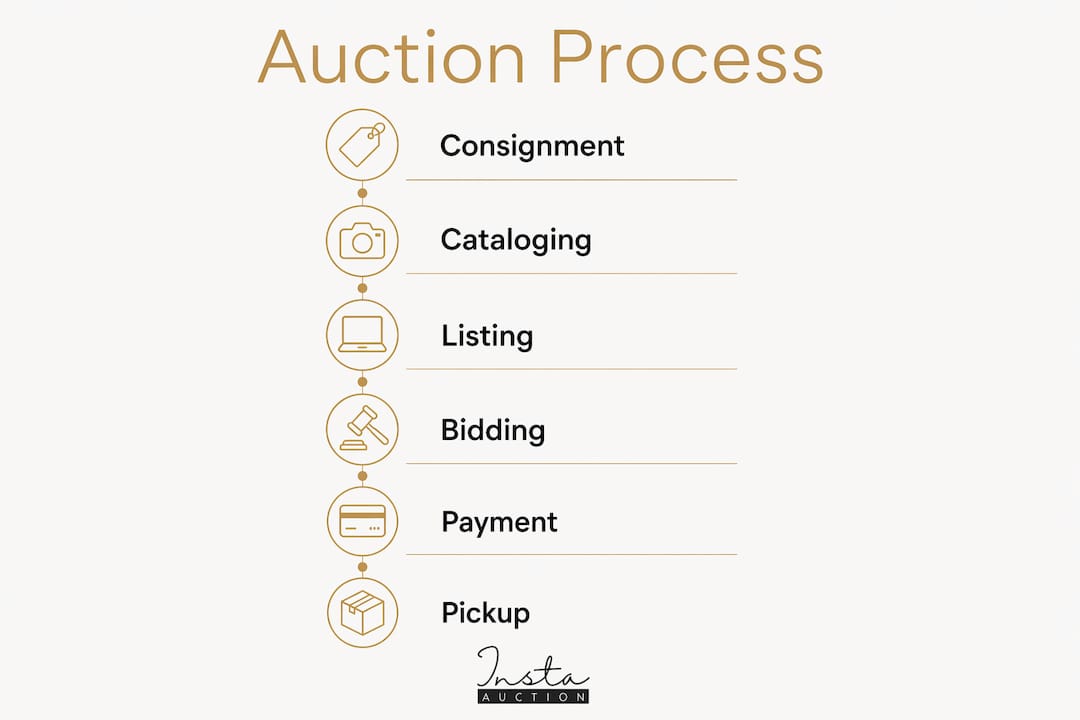
The full auction flow moves through five distinct phases. Each one builds on the last, and skipping steps creates problems that are hard to fix once bidding opens.
Sign the consignment agreement. The consignment agreement defines the commission rate, minimum bid thresholds, auction dates, and what happens to unsold items. Read every line. Seller commissions typically run 15%–40%, and some platforms also charge listing fees or photography fees on top of that.
Catalog and photograph your items. Work with the platform’s team to create accurate descriptions. Include measurements, materials, maker’s marks, and condition notes. Pair each description with clear photos from multiple angles.
Reorder your top listings strategically. This is an insider tactic most first-time sellers miss. Placing your 20 highest-value items first creates a psychological hook that draws bidders in and builds early momentum across the entire catalog. Bidders who engage early tend to stay active throughout the auction.
Launch the auction and manage the bidding phase. Most online estate auctions use a rolling close with a soft-close timer. Each lot closes shortly after the previous one. If a bid arrives in the final seconds, the timer resets, preventing last-second sniping and pushing prices higher. Monitor your platform’s dashboard during this phase and respond quickly to bidder questions.
Confirm winning bids and close the auction. Once all lots close, the platform confirms winning bids and sends payment instructions to buyers. Your job at this stage is to be available for any disputes or questions the platform escalates to you.
Pro Tip: Answer bidder questions within two hours during an active auction. Slow responses cause bidders to lose confidence and drop out, which directly lowers your final sale price.
The table below summarizes the key phases and what you control at each stage.
| Phase | Your responsibility | Platform’s responsibility |
|---|---|---|
| Consignment | Sign agreement, supply items | Set terms, assign contact |
| Cataloging | Provide descriptions and photos | Edit, publish, and organize listings |
| Auction live | Answer bidder questions | Manage bidding system and timers |
| Close | Confirm item availability | Notify winners, collect payment |
| Post-sale | Arrange pickup or shipping | Remit proceeds with itemized statement |
How do you handle payment and post-auction procedures?
The auction closing is not the finish line. What happens in the 48–72 hours after the final lot closes shapes your experience as a seller.
Payment from buyers moves fast. Buyers must pay within 24–48 hours of auction close. Platforms enforce this strictly. Non-paying bidders forfeit their deposit and may face permanent bans. This enforcement protects you as a seller, but you should still confirm with your platform how they handle non-payment before the auction starts.
Arrange item pickup or shipping promptly. Most platforms set a pickup window of two to five days after the auction closes. Coordinate access to the property during that window. For items requiring shipping, the platform or buyer typically arranges and pays for a third-party shipper, but confirm this in your consignment agreement.
Understand what happens to unsold items. Every auction has lots that do not sell. Your options usually include re-listing at a lower reserve, donating the items, or arranging private removal. Clarify this policy before signing, because abandoned items can create logistical headaches.
Your proceeds arrive with a full accounting. Auction houses remit net proceeds with an itemized breakdown showing each lot’s sale price, the commission deducted, and any additional fees. Review this statement carefully against your original inventory list. Discrepancies are rare but do occur, and catching them early is far easier than disputing them weeks later.
- Confirm the payout timeline in writing before the auction launches
- Keep a copy of your signed consignment agreement until funds clear
- Save the itemized proceeds statement for tax records
- Note which items sold below expectations for future reference
What are the most common mistakes in online estate auctions?
Most sellers make the same handful of errors. Knowing them in advance puts you ahead of the majority of first-time participants.
Listing everything without filtering. Online auctions yield inconsistent results depending on item type. A vintage Rolex will attract fierce bidding. A used blender will not. Flooding your catalog with low-demand items dilutes the overall auction and can actually suppress interest in your better pieces.
Underinvesting in photos. Poor photography is the single most common reason good items sell below value. If your platform does not photograph items for you, hire a local photographer for a few hours. The cost is minor compared to the difference in bids.
Ignoring the fee structure. Fees include both seller commissions and buyer premiums. The buyer’s premium is added on top of the winning bid, which affects how high buyers are willing to go. A 25% buyer’s premium on a $1,000 item means the buyer pays $1,250. Understanding this math helps you set realistic reserve prices. You can find more detail on auction listing strategies that account for fee structures.
Skipping the catalog order. Reordering your top 20 listings to appear first is not optional if you want strong results. It is a proven tactic that creates early bidding energy. Platforms that allow seller input on lot order give you a real advantage.
“The difference between a good auction and a great one often comes down to three things: what you list, how you photograph it, and where you put it in the catalog. Get those right, and the bidding takes care of itself.”
For sellers dealing with a loss, the estate liquidation process has additional considerations worth reviewing before you commit to a platform.
Key Takeaways
A successful online estate auction depends on preparation, strategic listing, and understanding your fees and payout timeline before the auction opens.
| Point | Details |
|---|---|
| Filter your inventory | List only items with a collector base; household basics rarely sell well online. |
| Photo quality drives bids | Shoot every item with good lighting and multiple angles before submission. |
| Catalog order matters | Place your top 20 items first to build early bidding momentum. |
| Know your fees upfront | Seller commissions run 15%–40%; buyer premiums affect how high bidders go. |
| Review your proceeds statement | Check every line of the itemized payout against your original inventory list. |
What I have learned running estate auctions online
The first time I helped a family navigate an online estate auction, they expected the platform to handle everything. They were partly right. The platform managed the bidding, the payments, and the logistics. But the results were directly tied to decisions the family made in the first 48 hours: what to include, how to photograph it, and which items to put at the front of the catalog.
The item that surprised everyone was a mid-century drafting table. It was bulky, hard to ship, and the family almost left it out. We listed it with detailed photos showing the original hardware and maker’s stamp. It sold for three times the estimated value to a buyer two states away. That outcome would not have happened at a local estate sale with foot traffic limited to one weekend.
What I tell every first-time seller now is this: the online format rewards specificity. A vague description with one photo gets ignored. A detailed description with six photos and a clear provenance note gets bids. The platform gives you the audience. Your preparation gives you the price.
The trend toward online estate auctions is not slowing down. Buyers increasingly prefer the convenience of remote bidding, and sellers benefit from that wider pool of competition. If you are on the fence about whether to go online or stick with an in-person sale, consider what you are selling. Collectibles, luxury goods, art, and specialty items belong online. Common household goods may do better at a traditional sale or through donation.
— Admin
How Insta-auction supports your estate auction from start to finish
Families navigating an estate sale for the first time rarely know what their items are worth or which platform will treat them fairly. Insta-auction addresses both problems directly.

Insta-auction’s trained appraisers evaluate your items before listing, so you enter the auction with realistic expectations and accurate descriptions. The platform markets across multiple digital channels, which means your lots reach the widest possible pool of qualified buyers. Commission structures are disclosed clearly upfront, and a portion of every sale goes to a selected charity, adding a community dimension to every transaction. For sellers with luxury goods or collectibles, the luxury auction category connects your items with buyers who are actively searching for exactly what you have. Ready to get started? Consign with Insta-auction and let the experts handle the details.
FAQ
What is an online estate auction?
An online estate auction is a digital sale where estate items are listed on a specialized platform, bid on remotely by registered buyers, and sold to the highest bidder. Sellers consign items to the platform, which manages cataloging, bidding, and payment collection.
How long does an online estate auction take from start to finish?
The full process typically spans two to six weeks, covering preparation, cataloging, the live auction period, and post-sale logistics. Sellers receive their proceeds 30–60 days after the auction closes, depending on the platform’s payment terms.
What is the difference between an estate sale and an auction?
An estate sale is typically an in-person event held at the property over one or two days, while an online auction runs digitally over a set period and attracts buyers nationally or internationally. Auctions generally produce stronger results for collectibles and luxury items, while in-person sales can move common household goods more efficiently.
How do I bid in an online estate auction?
Register on the platform with a government-issued ID and any required deposit, then place bids on individual lots during the active auction window. Most platforms use a soft-close timer that resets if a bid arrives in the final seconds, giving all bidders a fair chance to respond.
What happens to items that do not sell?
Unsold items are typically returned to the seller, re-listed at a lower reserve, or donated, depending on the terms in the consignment agreement. Confirm this policy before signing, as some platforms charge removal fees for unclaimed lots.