

Probate assets are any property titled solely in a decedent’s name at death, without a beneficiary designation or survivorship feature, that must pass through court-supervised probate before anyone can legally sell or transfer them. If you’re an executor or a collector handling an estate, the first rule is simple: secure the items, don’t sell or distribute anything, and wait until the court issues letters testamentary or letters of administration. For high-value jewelry, art, or memorabilia, contact a qualified appraiser immediately. Insta-auction specializes in selling auction-ready probate items and can coordinate appraisals, marketing, and nationwide shipping once legal authority is confirmed.
- Secure all physical property and change access codes before anything else.
- Do not sell, gift, or move items until an executor or administrator is formally appointed.
- Contact a qualified appraiser for collectibles, fine art, watches, or designer goods.
- Check whether the estate qualifies for a small-estate affidavit to bypass full probate.
- Consult a probate attorney when debts, disputes, or high-value items are present.
Table of Contents
- What counts as a probate asset for collectors and sellers?
- How do probate assets differ from non-probate assets?
- Who has legal authority to sell probate assets?
- How should you value probate items for auction?
- What are the best ways to sell probate assets?
- What legal risks should buyers and executors watch for?
- Quick checklist: what to do in the first days after a death
- When does hiring a specialist auction partner make sense?
- Key Takeaways
- What most guides get wrong about probate sales
- Insta-auction makes probate sales straightforward for executors
- Useful sources
- FAQ
What counts as a probate asset for collectors and sellers?
The plain-language rule: if the decedent owned it solely in their own name and there’s no beneficiary designation or survivorship feature attached, it’s a probate asset. That covers far more than most families expect.
For collectors and sellers, the most common examples include:
- Jewelry and watches (rings, vintage Rolex pieces, signed pieces with no named beneficiary)
- Fine art and prints (paintings, limited-edition prints, sculptures)
- Designer handbags and luxury accessories (Hermès, Chanel, Louis Vuitton)
- Sports memorabilia and collectible cards (signed jerseys, graded cards, game-used equipment)
- Vehicles without a transfer-on-death (TOD) designation
- Domain names and digital assets owned solely by the decedent
- Storage-unit contents and household goods
- Stocks and bonds held in a solely-owned account with no named beneficiary
A few special cases trip people up. Property held as tenants in common goes through probate for the decedent’s share, even though co-owners survive. Sole proprietorship inventory is a probate asset. Digital assets and cryptocurrency are probate assets when owned solely by the decedent, and lost private keys can make them practically unrecoverable even when they’re legally part of the estate.
How do probate assets differ from non-probate assets?
Confusing these two categories is one of the most common executor errors, and it can delay sales by months.
| Asset Type | Probate? | Transfer Mechanism |
|---|---|---|
| Solely-owned real estate | Yes | Court order and new deed |
| Solely-owned collectibles/jewelry | Yes | Executor sale after appointment |
| Joint tenancy with right of survivorship | No | Automatic to surviving owner |
| Life insurance (named beneficiary) | No | Direct to beneficiary |
| IRA with named beneficiary | No | Direct to beneficiary |
| TOD/POD bank or brokerage account | No | Direct to beneficiary |
| Revocable living trust assets | No | Trustee distribution |
| Tenants-in-common share | Yes | Probate for decedent’s share |
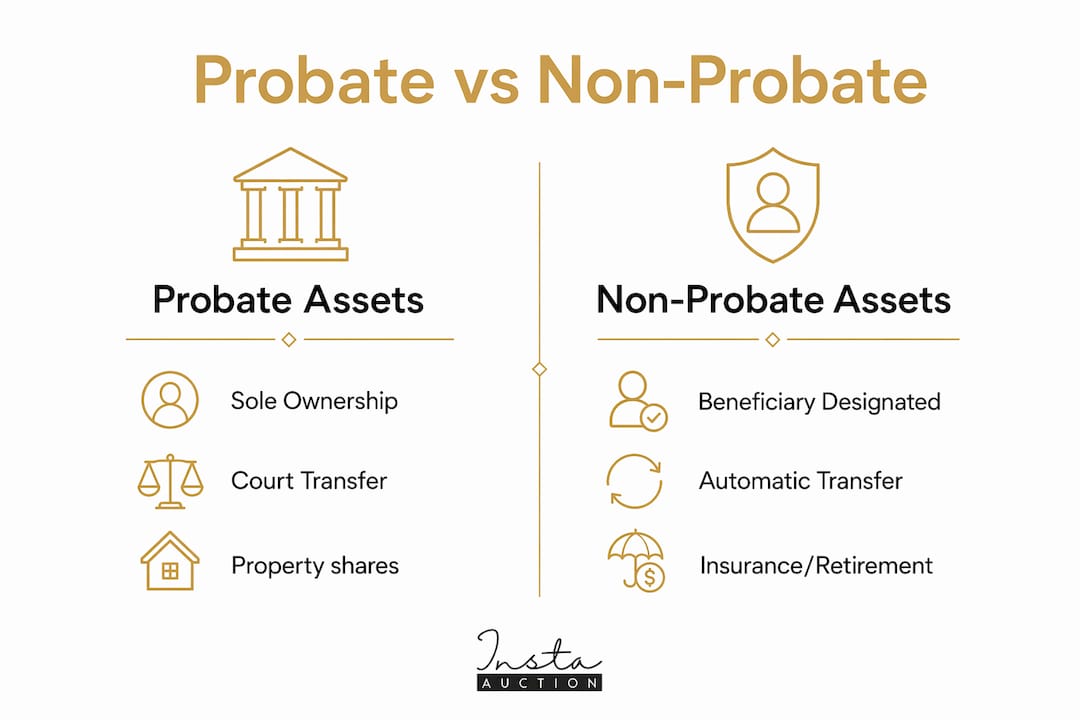
The taxable estate is broader than the probate estate. Life insurance proceeds and retirement accounts skip probate entirely but still count toward the gross estate for federal estate tax purposes. An executor who treats “non-probate” as “non-taxable” can miss significant tax obligations.
Pro Tip: When you’re unsure whether an item is probate or non-probate, don’t guess. A one-hour consultation with an estate attorney or CPA costs far less than a creditor claim or a family dispute triggered by distributing the wrong asset.
Who has legal authority to sell probate assets?
Nobody has legal authority to sell or transfer probate assets until the probate court issues letters testamentary (when there’s a will) or letters of administration (when there isn’t). Banks, title companies, and motor vehicle agencies will not process transfers without these documents. Families commonly assume they can divide personal property informally after a death. Courts and advisors consistently warn against this.

Small-estate shortcuts exist and are underused. Most states offer affidavit procedures that let heirs claim personal property without full probate when the estate’s value falls below a threshold. Thresholds commonly fall in the $50,000–$100,000 range for personal property, but they vary widely by state. Arizona, for example, has its own specific rules worth reviewing in a dedicated small-estate affidavit guide. Always check your state’s probate court website for current forms and limits.
Typical probate milestones:
- File the will and petition for appointment with the probate court.
- Court issues letters testamentary or letters of administration.
- Executor secures assets and opens an estate bank account.
- Inventory and appraisal filed with the court, commonly within 60–90 days of appointment.
- Creditor notice period runs (often 3–6 months depending on state).
- Debts, taxes, and administration costs are paid.
- Court approves distribution; assets transfer to beneficiaries.
If the decedent owned real estate in another state, ancillary probate proceedings in that state are also required.
How should you value probate items for auction?
Estate appraisals use fair market value as of the date of death, not retail replacement cost. A vintage Patek Philippe may carry a $40,000 retail tag but fetch $28,000 at fair market value on the date of death. That distinction matters for both tax reporting and realistic auction pricing.
| Item Category | Appraiser Type | Key Documentation | Tax Reporting Note |
|---|---|---|---|
| Fine art | Certified art appraiser (ASA/AAA) | Provenance, exhibition history, condition report | Qualified appraisals are required for art or collectibles over certain amounts when filing Form 706 |
| Jewelry and watches | Certified gemologist (GIA/AGS) | Original receipts, certificates, serial numbers | Same Form 706 threshold applies |
| Sports memorabilia | Specialist authenticator | LOA, grading certificates, purchase records | Include in estate inventory |
| Designer handbags | Luxury goods specialist | Authentication cards, dust bags, receipts | Include in estate inventory |
| Vehicles | Licensed vehicle appraiser | Title, service records, VIN | Title transfer required |
Pro Tip: Gather purchase invoices, restoration records, storage location logs, and serial numbers before the appraiser visits. A well-documented item typically appraises faster and commands stronger bids. For jewelry assets in estates, provenance documentation can meaningfully affect realized prices.
Executors must inventory every item, even low-value pieces, because creditors can claim against all estate assets. Skipping a box of vintage baseball cards because they look modest is the kind of oversight that creates personal liability.
What are the best ways to sell probate assets?
| Channel | Cost Structure | Time to Sale | Best For |
|---|---|---|---|
| Specialist online auction | Buyer’s premium + seller commission | 2–6 weeks post-listing | Luxury goods, collectibles, memorabilia |
| Estate sale (on-site) | — | 1–3 days | Mixed household goods, furniture |
| Consignment (gallery/dealer) | — | 3–6 months | Blue-chip art, rare watches |
| Private sale | Negotiated | Weeks to months | Single high-value items with known buyers |
Specialist online auctions consistently outperform estate sales for auction-ready luxury items because competitive bidding drives prices up, and the buyer pool is national rather than local. Auction prices often beat retail for rare or in-demand pieces.
Seller checklist before listing:
- Confirm legal authority (letters testamentary in hand).
- Complete appraisals for all items above $3,000.
- Assemble provenance files, condition reports, and original packaging.
- Photograph items professionally, including serial numbers and hallmarks.
- Confirm insurance coverage during transit and storage.
- Document chain of custody from estate to auction platform.
For large estates with mixed quality, a tiered disposition works well: specialist auction for blue-chip pieces, bulk cleanout vendors for low-value goods. Estate cleanout vendors charge fees, and sometimes their costs exceed the remaining value of items, so solicit multiple proposals before committing.
What legal risks should buyers and executors watch for?
Chain-of-custody gaps are the single biggest risk in probate sales. An item removed from the estate by a family member before the executor was appointed, or sold informally without court authority, can expose both the seller and the buyer to legal claims. Buyers should always request probate documentation — letters testamentary, the estate inventory, and any court orders authorizing the sale — before bidding on high-value lots.
Red flags that warrant immediate legal advice:
- Missing title or ownership documents for vehicles, real estate, or titled collectibles
- Undisclosed liens or loans secured against estate property
- Disputed provenance on art or memorabilia
- Items removed from the property by family members without executor authorization
- An insolvent estate where creditor claims may absorb all sale proceeds
Executors should hold all sale proceeds in a dedicated estate bank account until the court authorizes distribution. Never commingle estate funds with personal accounts.
Quick checklist: what to do in the first days after a death
Immediate steps (days 1–7):
- Secure the property physically; change locks and access codes.
- Locate title documents, deeds, vehicle titles, and ownership records.
- Notify the homeowner’s or renter’s insurer and add estate coverage.
- Start a written inventory with photos of every item, room by room.
- Identify digital accounts and locate any password files.
Short-term tasks (weeks 2–8):
- File the will and petition for executor appointment at the probate court.
- Check whether the estate qualifies for a small-estate affidavit.
- Order appraisals for jewelry, art, watches, and collectibles.
- Open a dedicated estate bank account.
- Solicit proposals from auction partners and consignment specialists.
Before listing items for sale:
- Pack and store fragile items with appropriate materials.
- Assemble provenance bundles (receipts, certificates, photos, restoration records).
- Decide on sale channel priorities based on item type and timeline.
- Confirm the estate auction timeline aligns with probate court deadlines.
When does hiring a specialist auction partner make sense?
A specialist auction partner earns their commission when the estate contains items that need more than a price tag. For probate sales, that means coordinating appraisals, producing condition reports, handling high-end photography, running multi-channel digital marketing, managing secure warehousing, and arranging nationwide shipping logistics. Insta-auction handles all of these for luxury goods and collectibles, including buyer vetting and transparent settlement reporting so executors can account for every dollar.
Before selecting a partner, ask:
- Do you have experience with fiduciary sales and probate documentation requirements?
- What is your full fee structure, including buyer’s premium and seller commission?
- What insurance coverage applies during storage and shipping?
- How do you handle buyer disputes or authenticity challenges?
- Can you show realized sale prices for comparable lots?
For estates with a mix of blue-chip art and everyday household goods, a tiered approach works best: specialist auction for the high-value pieces, bulk cleanout for the rest. A good partner will tell you honestly which items belong in which channel rather than taking everything on consignment.
Pro Tip: Request a written consignment agreement that specifies the reserve price, commission rate, marketing plan, and settlement timeline before signing anything. Verbal agreements don’t hold up when an executor needs to account to the court.
Key Takeaways
Probate assets require court-supervised transfer before any sale; executors must secure items, obtain legal authority, and complete appraisals before listing anything.
| Point | Details |
|---|---|
| Legal definition | Probate assets are solely-owned property with no beneficiary designation; they transfer only through court-supervised probate. |
| First action | Secure property and wait for letters testamentary before selling or distributing any item. |
| Small-estate option | Thresholds commonly fall within typical state-dependent limits; check your state court site early to see if full probate can be bypassed. |
| Appraisal deadline | Courts typically require inventory and appraisal within 60–90 days of executor appointment. |
| Insta-auction | Insta-auction coordinates appraisals, marketing, and nationwide shipping for probate collectibles and luxury items once legal authority is confirmed. |
What most guides get wrong about probate sales
The standard advice is to “get an appraisal and pick a channel.” That’s not wrong, but it misses the part that actually costs executors money: the gap between appointment and listing. Most estates lose value during that window, not because the items depreciate, but because no one acts on the timeline. Probate courts set deadlines. Appraisers have backlogs. Auction platforms have catalog cycles. An executor who waits until the creditor period closes to start thinking about sale channels has already missed the best listing windows for seasonal collectibles and luxury goods.
The other thing guides understate is documentation. A signed jersey with a clear chain of custody from the original owner to the estate to the auction platform sells for more than the same jersey with a gap in the story. Buyers at the level who bid on blue-chip memorabilia or fine watches are not naive. They price provenance risk into their bids. Closing that gap before listing is the single highest-return task an executor can do.
Insta-auction makes probate sales straightforward for executors
When an estate includes luxury goods, collectibles, or memorabilia, the difference between a good outcome and a great one usually comes down to who handles the sale. Insta-auction works directly with executors and consignors on estate liquidation, coordinating expert appraisals, professional photography, and multi-channel digital marketing to reach serious buyers nationwide. Flat-rate shipping and secure handling mean items move from the estate to the buyer without the executor managing logistics.

Ready to get started? Submit your items through the consignor form or request an estate valuation to see what your probate collection could realistically bring at auction.
Useful sources
For verifying state-specific rules, thresholds, and appraisal standards:
- Cornell Law School Legal Information Institute — Probate Assets: authoritative U.S. legal definition
- LegalClarity — Probate Assets: What’s Included: plain-language breakdown of what qualifies
- LegalClarity — What Is Probate Property: digital assets and practical property guidance
- Ohio State Bar Association — Law Facts: Probate: state-level procedural detail and cost guidance
- WealthManagement.com — Art and Tangible Assets in Estate Administration: specialist guidance for high-value personal property
- Commerce Trust Company — High-Net-Worth Estate Planning for Sentimental Assets: Form 706 appraisal thresholds and tax considerations
For state-specific forms and offices:
- Your county’s probate court clerk (for petition forms, fee schedules, and inventory deadlines)
- County recorder’s office (for real estate deed transfers)
- State motor vehicle agency (for vehicle title transfers)
- IRS Form 706 instructions (for federal estate tax and qualified appraisal requirements)
When major assets, creditor disputes, or family disagreements are present, consult a qualified probate attorney, CPA, or certified appraiser before taking action. This article is general information, not legal or tax advice; confirm current rules with your state’s probate court or a licensed professional for your specific situation.
FAQ
What are probate assets in simple terms?
Probate assets are property owned solely by a person who has died, with no beneficiary designation or survivorship feature, that must pass through a court process before heirs can receive or sell them.
Can an executor sell probate assets before probate closes?
Yes, in most states an executor can sell assets during probate with court authorization, but no sale is legal before letters testamentary or letters of administration are issued.
What is the small-estate affidavit threshold in the U.S.?
Thresholds vary by state but commonly fall in the $50,000–$100,000 range for personal property; check your state’s probate court website for the current figure and waiting period.
How long does probate typically take?
A straightforward estate with no federal estate tax return often closes within six months of executor appointment; estates requiring a Form 706 filing or facing creditor disputes can take a year or more.
How does Insta-auction help with probate sales?
Insta-auction coordinates appraisals, professional photography, and nationwide marketing for probate collectibles and luxury goods, handling logistics from estate to buyer once the executor has legal authority to sell.