

Soft close auction bidding is defined as a format where the auction timer resets whenever a new bid arrives in the final minutes, giving every bidder a fair chance to respond. The industry standard extension window runs 1 to 3 minutes, and that small window changes everything. Items sold under this format consistently earn 13–20% higher prices compared to hard close auctions. Whether you are a seller wanting top dollar for a luxury watch or a bidder trying to win a rare collectible, understanding how soft close works gives you a real edge.
What is soft close auction bidding and how does it differ from hard close?
Soft close bidding, also called extended bidding, resets the countdown clock each time a bid lands near the scheduled end of an auction. Hard close auctions end at a fixed time, no matter when the last bid arrives. That fixed deadline rewards speed over judgment, which is exactly the problem soft close solves.
The mechanics work like this:
- The auction nears its scheduled end. The timer counts down to, say, 30 seconds remaining.
- A bidder places a new bid. The platform detects the bid within the soft close threshold window.
- The timer resets. The clock extends by the platform’s set interval, typically 1 to 3 minutes.
- Bidding continues. Every new bid in the final window triggers another reset.
- The auction closes naturally. When no new bids arrive before the timer expires, the auction ends.
This cycle prevents sniping tactics that hard close formats reward. Sniping is the practice of placing a winning bid in the last second, leaving other bidders no time to respond. Soft close eliminates that advantage entirely.
The bidding experience also feels different. Hard close auctions create a frantic rush in the final seconds. Soft close auctions build momentum steadily, much like a live auction floor where the auctioneer waits for the room to settle before calling the item sold.

Pro Tip: Set a calendar reminder or browser alert for the original auction end time. When the soft close kicks in, you want to be at your device and ready to respond within the extension window, not scrambling to reload the page.
What are the benefits and potential drawbacks of soft close bidding?
The most direct benefit is price. Soft close formats produce 13–20% higher final prices on average compared to hard deadlines. That gap exists because every serious bidder gets a genuine opportunity to place their best offer.
Key benefits for sellers and bidders:
- Higher sale prices. Extended bidding keeps competition alive longer, pushing prices toward true market value.
- Fairer competition. Every participant gets equal time to respond, regardless of their internet speed or time zone.
- Stronger bidder confidence. Extended bidding mimics live auction rhythm, replacing arbitrary clocks with a “going once, going twice” engagement model that buyers trust.
- Reduced buyer frustration. Losing an auction by one second to a sniper is deeply discouraging. Soft close removes that experience entirely.
- Better engagement. Bidder momentum and reduced frustration support price maximization by keeping participants active through the final stages.
No format is perfect, and soft close has real drawbacks worth knowing.
“Soft close bidding is not a guaranteed price booster in every scenario. In hyper-competitive auctions, the timer can extend repeatedly, exhausting bidders who have rational spending limits. Platforms that lack safeguards risk turning a 30-minute auction into a two-hour ordeal.”
Rare cases of indefinite extension do occur without proper safeguards. Most serious platforms address this by capping the total number of extensions or setting an absolute maximum auction length. Sellers should confirm their platform has these limits before listing high-demand items. Bidders who feel pressured by repeated extensions sometimes drop out, which can actually suppress the final price if the two top bidders both walk away.
What are soft close groups and how do they work?
Soft close groups are an advanced technique that links the timers of multiple related auction lots together. When a bidder places a bid on any item within the group, the timer resets for every item in that group, not just the one being bid on.
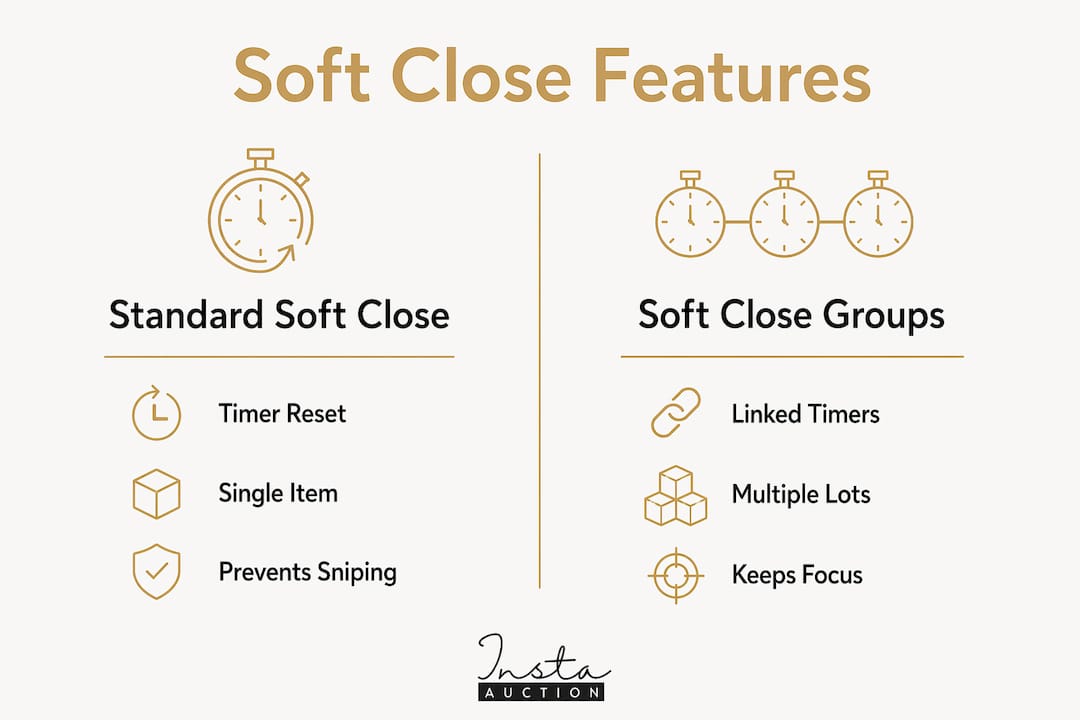
Soft close groups prevent split wins across related items. Consider a matched set of vintage dining chairs listed as six separate lots. Without grouping, one lot might close while a bidder is still active on another, breaking up the set. With a soft close group, all six lots stay open together until bidding fully stops across the entire set.
The table below shows when standard soft close and soft close groups each serve auction goals best.
| Scenario | Standard soft close | Soft close group |
|---|---|---|
| Single high-value item | Best fit | Not needed |
| Matched sets or collections | Works but risks split wins | Best fit |
| Estate sale with related lots | Adequate | Recommended |
| Unrelated individual lots | Best fit | Not applicable |
| Parcel or bundle bidding | Risky | Best fit |
Synchronized timer extensions across related lots also keep bidder attention focused. A buyer interested in a complete set of collectibles stays engaged across all lots rather than winning two and losing three. That sustained attention benefits sellers because it maintains competitive pressure across the entire group.
Pro Tip: Use soft close groups for any auction where the value of items together exceeds the sum of their parts. Jewelry sets, matched furniture, and multi-piece art collections all benefit from grouped timers.
How can bidders and sellers optimize their strategies?
Soft close bidding rewards preparation over speed. The following strategies apply directly to both sides of the auction.
For bidders:
- Know the extension interval. Confirm whether the platform uses a 1-minute or 3-minute reset. That window determines how quickly you need to respond.
- Set your maximum price before the auction starts. Soft close creates psychological pressure to keep bidding. Decide your ceiling in advance and stick to it.
- Use proxy bids wisely. A proxy bid automatically places the minimum required bid on your behalf up to your set maximum. Under soft close rules, proxy bids can trigger extensions without you being present, which protects your position.
- Do not assume the auction ends on time. Sniping tools lose effectiveness under soft close, so any strategy built around last-second automation will fail. Focus on valuation instead.
- Stay present near the original close time. Extensions can stack quickly. Being active during the first extension often determines the outcome.
You can find more expert bidding tips that apply directly to soft close environments, including how to read bidding momentum and time your responses.
For sellers:
- Set your extension interval to match your audience. A 1-minute window suits tech-savvy bidders who check their phones constantly. A 3-minute window works better for older audiences or complex items that require thought.
- Pair soft close with a strong reserve price. The format drives prices up, but a well-set reserve protects you if bidding stalls early.
- Use soft close groups for related inventory. Keeping matched lots open together prevents the frustration of broken sets and encourages higher total bids.
- Communicate the rules clearly in your listing. Bidders who understand soft close rules bid more confidently. Confusion about end times leads to drop-offs.
Understanding how bidding wars increase sale price gives sellers a fuller picture of why soft close is worth configuring carefully rather than leaving at default settings.
Key Takeaways
Soft close auction bidding consistently produces higher final prices and fairer competition by resetting the timer whenever a bid arrives near the auction’s end.
| Point | Details |
|---|---|
| Core mechanic | Timer resets by 1–3 minutes each time a bid lands near the scheduled close. |
| Price impact | Soft close formats produce 13–20% higher average prices than hard close auctions. |
| Sniping eliminated | Last-second bidding tools lose their advantage because every bid extends the clock. |
| Soft close groups | Linked timers across related lots prevent split wins and keep bidders engaged. |
| Strategy shift | Both bidders and sellers benefit most by focusing on valuation, not speed. |
Why soft close is the format serious auction participants should demand
I have watched bidders lose items they genuinely wanted because a hard close auction ended while their page was still loading. That outcome has nothing to do with who valued the item most. It rewards whoever had the fastest connection at the right second. Soft close fixes that, and the 13–20% price premium it generates is not a coincidence. It is what happens when every serious bidder actually gets to bid.
What surprises most people is how much the format changes bidder psychology. Under hard close rules, participants hold back and snipe. Under soft close, they engage earlier and bid more honestly because they know a response is always possible. That shift from speed-based tactics to valuation-based thinking is the real value of the format.
The one thing I would caution sellers about is over-relying on extensions to do the work. Soft close is a fair-competition tool, not a magic price inflator. If your item is mispriced, poorly described, or poorly photographed, no timer reset will save it. The format rewards good listings by giving competitive bidders room to compete. It does not create competition where none exists.
Platforms that handle estate liquidation auctions have shown me that soft close matters most when emotional and financial stakes are both high. Families selling inherited collections deserve a format that gives every buyer a real shot. That is exactly what extended bidding delivers.
— Admin
Insta-auction and soft close bidding for high-value items
Insta-auction applies soft close bidding across its luxury goods and real estate auctions, giving sellers the competitive environment their items deserve.

Every auction on the platform benefits from expert appraisal, targeted marketing across digital channels, and a bidding format designed to reach true market value. Sellers consigning pre-loved luxury items, collectibles, or real estate get the full advantage of extended bidding without managing the technical setup themselves. A portion of every sale also goes to a selected charity, so winning bids do more than close deals.
Browse current luxury goods auctions to see soft close bidding in action, or read the consignment auction guide to understand how to list your items for maximum return.
FAQ
What is soft close auction bidding?
Soft close auction bidding is a format where the auction timer resets by a set interval, typically 1 to 3 minutes, whenever a new bid arrives near the scheduled end. This prevents last-second sniping and gives all bidders a fair chance to respond.
How does soft close differ from hard close auctions?
Hard close auctions end at a fixed time regardless of when the last bid was placed, which rewards speed over valuation. Soft close auctions extend the timer with each late bid, so the auction closes only when no one bids within the final window.
Do soft close auctions actually produce higher prices?
Research shows soft close formats produce 13–20% higher prices on average compared to hard close auctions. The price increase comes from sustained competition rather than one bidder winning by timing alone.
What are soft close groups?
Soft close groups link the timers of multiple related auction lots so that a bid on any one item extends the clock for all items in the group. This prevents split wins on matched sets, collections, or bundled inventory.
Can soft close auctions run indefinitely?
Without safeguards, repeated extensions could theoretically extend an auction for hours. Most platforms cap the total number of extensions or set an absolute maximum auction length to prevent this from happening.