

What is trust liquidation and why does it matter in bankruptcy?
Trust liquidation is the process of establishing and administering a specialized legal entity, called a liquidation trust, to convert a debtor’s assets into cash and distribute the proceeds to creditors following bankruptcy or corporate dissolution. It is not a generic estate-planning concept. In the U.S. bankruptcy context, it is a precisely defined mechanism governed by Treasury Regulation § 301.7701-4(d), IRS Revenue Procedure 94-45, and IRS Publication 1635.
The core purpose is orderly wind-down. A liquidation trust exists for one reason: to monetize assets, resolve creditor claims, and distribute proceeds in a timely manner consistent with the bankruptcy plan. It does not operate a business, generate new revenue, or hold assets indefinitely. That strict limitation is what earns it favorable tax treatment under federal law.
Key functions of a liquidation trust include:
- Asset monetization: Converting real estate, equipment, receivables, intellectual property, and other holdings into distributable cash.
- Claims resolution: Reconciling disputed creditor claims before final distributions are made.
- Orderly distribution: Paying creditors and beneficiaries according to the confirmed bankruptcy plan.
- Regulatory compliance: Filing required tax returns, maintaining court oversight, and adhering to IRS grantor trust rules.
- Isolation of long-tail liabilities: Removing contested litigation and contingent claims from the reorganized debtor so the business can emerge from bankruptcy without delay.
The trustee, appointed under the confirmed plan, holds fiduciary authority over all trust assets. Beneficiaries, typically the creditors of the bankrupt estate, hold beneficial interests and ultimately receive distributions. Both IRS Publication 1635 and Revenue Procedure 94-45 set the regulatory framework that governs how the trust is formed, taxed, and eventually terminated.
How a liquidation trust is legally formed and funded
Formation happens inside the bankruptcy proceeding itself. A liquidation trust does not arise from a private agreement between parties. It is created pursuant to a confirmed Chapter 11 plan of reorganization or liquidation, approved by the U.S. Bankruptcy Court with jurisdiction over the case. That court approval is not a formality. It is the legal foundation that gives the trust its authority to hold assets, resolve claims, and make distributions.
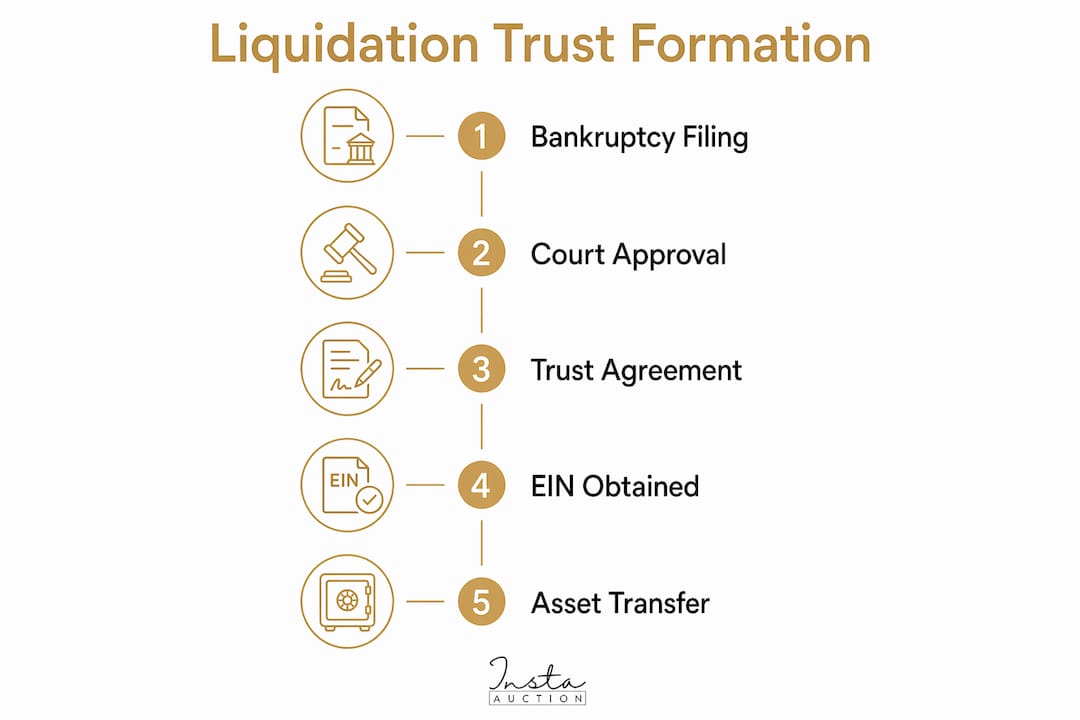
The trust agreement is the governing document. It must specify the trust’s purpose, the identity and powers of the trustee, the rights of beneficiaries, the initial term, and the conditions under which the term may be extended. Under IRS Revenue Procedure 94-45, the agreement must also contain a fixed or determinable termination date, generally not exceeding five years from the date of creation, and must require court approval for any extension within six months of the beginning of the extended term.
Funding occurs through the transfer of the debtor’s assets to the trust. Those assets can include:
- Cash and bank accounts
- Accounts receivable and litigation claims
- Real property and personal property
- Intellectual property and licenses
- Equity interests in subsidiaries
“Trust was created for the purpose of liquidating, converting assets to cash, and distributing the assets of Trust in accordance with § 301.7701-4(d), with no objective to continue or engage in the conduct of a trade or business.” — IRS Private Letter Ruling, 2022
One of the first administrative steps after formation is obtaining a separate Employer Identification Number. Per IRS Publication 1635, a liquidation trust established for a corporation in bankruptcy must obtain its own EIN, distinct from the debtor corporation’s EIN. This is required under Treasury Reg. § 301.7701-4(d) and applies even when the underlying business already had an EIN. The trust is a new legal entity for tax purposes, and the IRS treats it as such from day one.
The trust agreement must also address cash management. Funds not immediately available for distribution must be held in demand deposits, short-term certificates of deposit, or Treasury bills. The trust cannot accumulate cash beyond what is reasonably necessary to cover pending claims, reserves, and administrative costs.
What powers and duties does the liquidation trustee hold?
The liquidation trustee is the operational center of the entire process. Appointed under the confirmed bankruptcy plan, the trustee holds broad fiduciary authority but operates within strict boundaries set by the trust agreement and the bankruptcy court.
Core duties include:
- Asset liquidation: Selling or otherwise converting trust assets to cash through negotiated sales, auctions, or other disposition methods.
- Claims reconciliation: Reviewing, objecting to, and resolving creditor claims before distributions are calculated.
- Distribution management: Making periodic distributions of net income and sale proceeds to beneficiaries, at least annually under most trust agreements.
- Court reporting: Filing regular status reports with the bankruptcy court and maintaining transparency with beneficiaries.
- Tax compliance: Overseeing the preparation and filing of Form 1041 and grantor trust letters, and coordinating with tax advisors on income reporting.
The fiduciary duty runs to the beneficiaries, not to the former debtor or any other party. Every decision the trustee makes, from accepting a sale price to contesting a claim, must serve the beneficiaries’ collective interest in maximizing recovery.
Asset valuation at the time of trust formation is one of the most consequential early decisions. Trustees must properly value assets upon trust formation to avoid tax and distribution complications. Incorrect initial valuations can create adverse tax consequences if cash received from asset sales later exceeds the opening book value recorded at formation.
Assembling the right advisory team is not optional. Trustees typically retain bankruptcy attorneys, tax advisors with grantor trust experience, and valuation specialists. For complex estates with real estate, specialty equipment, or illiquid trust assets, professional auctioneers and appraisers often join the team to maximize recovery on hard-to-value holdings.

Pro Tip: Engage a tax advisor with specific liquidating trust experience before the trust agreement is finalized. The tax structure decisions made at formation, including how assets are valued and how the grantor trust election is documented, are extremely difficult to unwind later.
How are liquidation trusts taxed under U.S. federal law?
The tax treatment of a liquidation trust flows directly from its classification as a grantor trust under IRC § 671. This structure is intentional. It avoids double taxation at the entity level by treating the beneficiaries as the owners of the trust for tax purposes. The trust itself does not pay federal income tax on its income. Instead, each beneficiary reports their proportionate share of trust income, gains, deductions, and losses on their own individual or entity tax return.

The transfer of assets from the debtor to the trust is treated as a taxable exchange under Revenue Procedure 94-45. Beneficiaries recognize gain or loss based on the difference between the consideration they are deemed to receive and their tax basis in the claims they held against the debtor. This two-step deemed transaction, from transferor to beneficiary and then from beneficiary to trust, can affect who is treated as the grantor for tax purposes. Obtaining a private letter ruling from the IRS under Rev. Proc. 94-45 provides certainty that the trust qualifies and will not lose favorable tax status.
Key tax compliance requirements include:
- Form 1041: The trust must file a U.S. Fiduciary Income Tax Return. Filing Form 1041 initiates the IRS statute of limitations and supports required fiduciary reporting to beneficiaries and courts. Even trusts with minimal income often file strategically to maintain transparency and compliance.
- Grantor trust letters: The trustee must provide each beneficiary with a statement showing their share of trust income, deductions, and credits so they can report correctly on their own returns.
- Beneficiary reporting: Beneficiaries must report trust income on their own tax returns, often creating significant administrative burdens, particularly when there are many creditor-beneficiaries with small fractional interests.
Statistic callout: Filing Form 1041 for a liquidating trust initiates the IRS statute of limitations on assessment, making it a strategic compliance step even when the trust has minimal taxable income in a given year.
The consequences of getting the tax structure wrong are severe. If the trust engages in active business operations rather than pure liquidation, it risks losing grantor trust status, which would expose the trust itself to entity-level taxation. That outcome eliminates the primary tax advantage of the structure and can significantly reduce distributions to beneficiaries.
What is the 5-year rule and how do trust termination rules work?
The five-year limit is the most misunderstood timing rule in liquidation trust administration. Under Section 3.06 of IRS Revenue Procedure 94-45, the trust instrument must contain a fixed or determinable termination date that is generally not more than five years from the date of trust creation. That five-year period is not a default. It is a ceiling, and the trust agreement must state it explicitly.
Extensions are available but not automatic. The trust instrument must provide for extensions, and each extension requires:
- A finding by the bankruptcy court that the extension is necessary to accomplish the liquidating purpose of the trust.
- Court approval obtained within six months of the beginning of the extended term.
- Continuing evidence that the trust is actively working to liquidate, not simply holding assets.
The IRS has issued multiple private letter rulings confirming that court-approved extensions do not disqualify a trust from liquidating trust status, provided the trust continues to operate consistent with Rev. Proc. 94-45. In one ruling, a trust that had received multiple extensions due to unresolved litigation was confirmed to retain its classification as a liquidating trust under § 301.7701-4(d), because the trustee demonstrated ongoing efforts to dispose of assets and made timely distributions.
The risk of losing trust status is real. If the liquidation is unreasonably prolonged, or if business activities become so prominent that the liquidation purpose appears abandoned, the IRS can reclassify the entity. That reclassification has tax consequences that flow back to beneficiaries and can complicate distributions significantly.
Procedural steps for termination include:
- Resolving all remaining claims and contingent liabilities.
- Making final distributions of net proceeds to beneficiaries.
- Filing a final Form 1041 for the trust’s last tax year.
- Obtaining a court order closing the trust and discharging the trustee.
- Notifying the IRS of the trust’s termination and closing the EIN.
Common misconceptions and practical challenges in trust administration
The single most damaging misconception is treating a liquidation trust as a continuing business entity. It is not. Treasury Reg. § 301.7701-4(d) is explicit: the trust must be organized for the primary purpose of liquidating and distributing assets, with activities that are all reasonably necessary to and consistent with that purpose. The moment a trust begins generating new revenue, entering contracts for ongoing services, or operating a business in any meaningful sense, it risks losing its classification entirely.
Practical challenges that arise frequently include:
- Complex beneficiary tax reporting: When a trust has hundreds or thousands of creditor-beneficiaries, distributing grantor trust letters and ensuring each party reports correctly is a logistical challenge that requires dedicated administrative infrastructure.
- Asset valuation disputes: Disagreements over the fair market value of assets at trust formation can create downstream tax problems. If the IRS later determines that opening values were understated, beneficiaries may face unexpected gain recognition.
- Timing of distributions: Trusts must distribute net income and sale proceeds at least annually under most trust agreements. Delays in distributions can create tension with beneficiaries and attract court scrutiny.
- Prolonged litigation: Unresolved adversary proceedings or contested claims are the most common reason trusts require term extensions. Each extension requires court approval and IRS compliance, adding administrative cost.
- Record-keeping failures: Inadequate documentation of asset dispositions, claim resolutions, and distribution calculations creates exposure in court reporting and IRS audits.
Pro Tip: Maintain a detailed transaction log from the first day of trust operation. Every asset sale, claim settlement, and distribution should be documented with dates, amounts, and the legal basis for the action. This record becomes the backbone of every court report and tax filing the trust will ever produce.
For trustees managing estate liquidation assets that include collectibles, luxury goods, or specialty property, the valuation challenge is particularly acute. Standard appraisal methods may not capture the true market value of unique items, and undervaluation at formation directly reduces what beneficiaries ultimately receive.
FAQ
What happens when a trust is liquidated?
When a liquidation trust completes its work, the trustee resolves all remaining claims, makes final distributions of net proceeds to beneficiaries, files a final Form 1041, and obtains a court order closing the trust and discharging the trustee. The trust’s EIN is then closed with the IRS.
How long does it take to liquidate a trust?
The standard maximum term is five years under IRS Revenue Procedure 94-45, though court-approved extensions are available when unresolved litigation or other circumstances make full liquidation within that period impossible. Many trusts complete liquidation well before the five-year limit, depending on asset complexity and the number of disputed claims.
What is the 5-year rule on trusts?
Under Section 3.06 of Rev. Proc. 94-45, a liquidation trust instrument must contain a termination date generally not exceeding five years from the date of trust creation. Extensions beyond five years require bankruptcy court approval, a finding that the extension serves the liquidating purpose, and IRS compliance filings within six months of the extended term’s start.
Does a liquidating trust need an EIN?
Yes. Per IRS Publication 1635, a liquidation trust established for a corporation in bankruptcy must obtain its own Employer Identification Number, separate from the debtor’s EIN, as required under Treasury Reg. § 301.7701-4(d).
How are beneficiaries taxed in a liquidation trust?
Because liquidation trusts are classified as grantor trusts under IRC § 671, beneficiaries report their proportionate share of trust income, gains, and losses on their own tax returns. The trust itself does not pay entity-level federal income tax, and the trustee provides each beneficiary with a grantor trust letter to support their individual filings.
Key Takeaways
A liquidation trust is a court-approved, IRS-regulated grantor trust with a maximum five-year term, designed solely to convert debtor assets into cash and distribute proceeds to creditors.
| Point | Details |
|---|---|
| Grantor trust classification | Beneficiaries report income on their own returns; the trust pays no entity-level federal income tax. |
| Separate EIN required | IRS Publication 1635 mandates a new EIN for every liquidation trust, distinct from the debtor’s EIN. |
| Five-year termination limit | Rev. Proc. 94-45 caps the standard term at five years; extensions require bankruptcy court approval within six months of the extended term. |
| No business activity allowed | Engaging in trade or business operations risks losing grantor trust status and triggers entity-level taxation. |
| Insta-auction for asset disposition | Trustees managing luxury goods, collectibles, or specialty property can use Insta-auction’s expert appraisal and auction platform to maximize recovery for beneficiaries. |
Why liquidation trusts deserve more credit than they get
The conventional view treats liquidation trusts as a procedural afterthought in bankruptcy, something the lawyers set up after the real restructuring work is done. That framing misses what these structures actually accomplish. A well-administered liquidation trust does something a reorganized debtor cannot: it holds contested, uncertain, and illiquid assets completely outside the reorganized business, letting that business operate without the shadow of unresolved litigation or hard-to-value property on its balance sheet.
The grantor trust structure is where the real sophistication lies. Avoiding entity-level taxation is not a minor benefit. For a trust holding tens of millions of dollars in assets, the difference between grantor trust treatment and corporate-level taxation on gains can represent a material reduction in what creditors ultimately recover. The IRS did not create this structure out of generosity. It reflects a policy judgment that creditors who already suffered losses in bankruptcy should not face a second layer of tax on whatever they eventually recover.
What practitioners often underestimate is the administrative complexity that falls on beneficiaries. When a large corporate bankruptcy produces a liquidation trust with thousands of creditor-beneficiaries, each of those parties receives a grantor trust letter and must incorporate trust income into their own tax filings. For institutional creditors with sophisticated tax departments, that is manageable. For individual creditors or smaller funds, it creates real compliance costs that can erode the value of their recovery.
The five-year rule also deserves more attention than it typically gets in plan negotiations. Attorneys focused on confirmation sometimes treat the termination date as a placeholder. In practice, it is a hard constraint with real consequences. A trust that drifts past its term without proper court approval and IRS filings risks losing its classification, and recovering from that error is expensive and uncertain. Building realistic timelines into the trust agreement from the start, accounting for the complexity of the asset portfolio and the likely duration of contested claims, is one of the most valuable things a well-prepared trustee team can do.
Insta-auction helps trust administrators get full value from specialty assets
When a liquidation trust holds luxury goods, collectibles, fine art, or high-value personal property, the difference between a rushed private sale and a properly marketed auction can be substantial. Trustees have a fiduciary duty to maximize recovery for beneficiaries, and for specialty assets, that duty points directly toward expert-led auction disposition.

Insta-auction specializes in exactly this category of asset. The platform’s trained appraisers assess auction-ready luxury items and market them across targeted digital channels to reach qualified buyers, not just the first offer that comes in. For trust administrators managing estates with pre-loved luxury goods, watches, jewelry, or collectibles, that targeted reach consistently produces better outcomes than traditional retail channels. Insta-auction also donates a portion of every sale to selected charities, which can align with the social responsibility expectations some bankruptcy courts and creditor committees bring to the disposition process. Trustees looking to fulfill their fiduciary obligations on hard-to-value assets can explore specialist auction categories to find the right disposition path for each asset class in the trust.
FAQ
Can a liquidation trust hold real estate?
Yes. Real estate is a common trust asset, and trustees may sell it through negotiated transactions or real estate auctions to maximize recovery. The proceeds must be distributed to beneficiaries in accordance with the confirmed plan.
What is the difference between a liquidation trust and a reorganization plan?
A reorganization plan restructures the debtor as a going concern, while a liquidation trust winds down the estate by converting assets to cash and distributing proceeds. The two are not mutually exclusive; many Chapter 11 plans include both a reorganized operating entity and a liquidation trust to handle residual assets and contested claims.
Who qualifies as a beneficiary of a liquidation trust?
Beneficiaries are typically the creditors of the bankrupt estate whose claims have been allowed under the confirmed plan. Their beneficial interests correspond to their allowed claim amounts and the priority rules established in the bankruptcy proceeding.