

Bulk auction listing is defined as the simultaneous creation and upload of multiple product or lot listings to an auction platform, using tools like CSV files or bulk management software to sell large inventories efficiently. The practice is standard in two distinct settings: online marketplaces, where sellers upload hundreds of individual product listings at once, and liquidation auctions, where surplus or returned goods are grouped into categorized lots. Both approaches share the same core goal. Bulk listing saves businesses dozens of hours of manual entry compared to one-by-one listing. Platforms like Insta-auction apply expert appraisal and multi-channel marketing to bulk lot sales, ensuring sellers receive competitive returns on high-value and pre-loved items.
What does bulk auction listing involve at each stage?
Bulk auction listing follows a defined workflow. Skipping any stage creates errors that reduce final sale prices or delay settlement. The industry term for the full process is “bulk lot auction selling” in liquidation contexts, and “bulk listing management” in marketplace settings. Both share the same foundational steps.
1. Inventory and data preparation

Catalog every item before touching any upload tool. Assign a condition grade (new, like new, good, fair, poor), a category, and a short description to each unit. In liquidation settings, this stage also involves deciding how to group items into lots. Effective lotting requires grading by condition and grouping by function or brand to match buyer expectations and increase sale prices. A lot of 20 matching office chairs sells faster and at a higher price than a mixed lot of 20 random furniture pieces.
2. Lot packaging and physical preparation
Liquidation lots may be packed onto wooden pallets or into mixed boxed lots. Not all lots arrive on pallets, and physical packaging directly affects buyer shipping expectations. Label each lot clearly with its lot number, condition grade, and item count. This step reduces buyer disputes after the auction closes.
3. Bulk upload using the right tool
Online marketplace sellers use CSV templates, platform bulk management dashboards, or third-party software to upload listings in batches. eBay Seller Hub, SellerChamp, and InkFrog each offer different scalability and integration features. Choose based on your catalog size and how often you need to sync inventory. Liquidation platforms typically accept structured data files with lot numbers, descriptions, photos, and starting bids.
4. Marketing and inspection window
Once listings go live, the marketing phase begins. Buyers review photos, descriptions, and condition notes. Industrial auction timelines follow six defined stages: inventory, marketing, inspection, bidding, payment, and removal. The inspection window is the period when registered bidders can physically examine lots before placing bids. Missing or shortening this window reduces buyer confidence and lowers final bids.
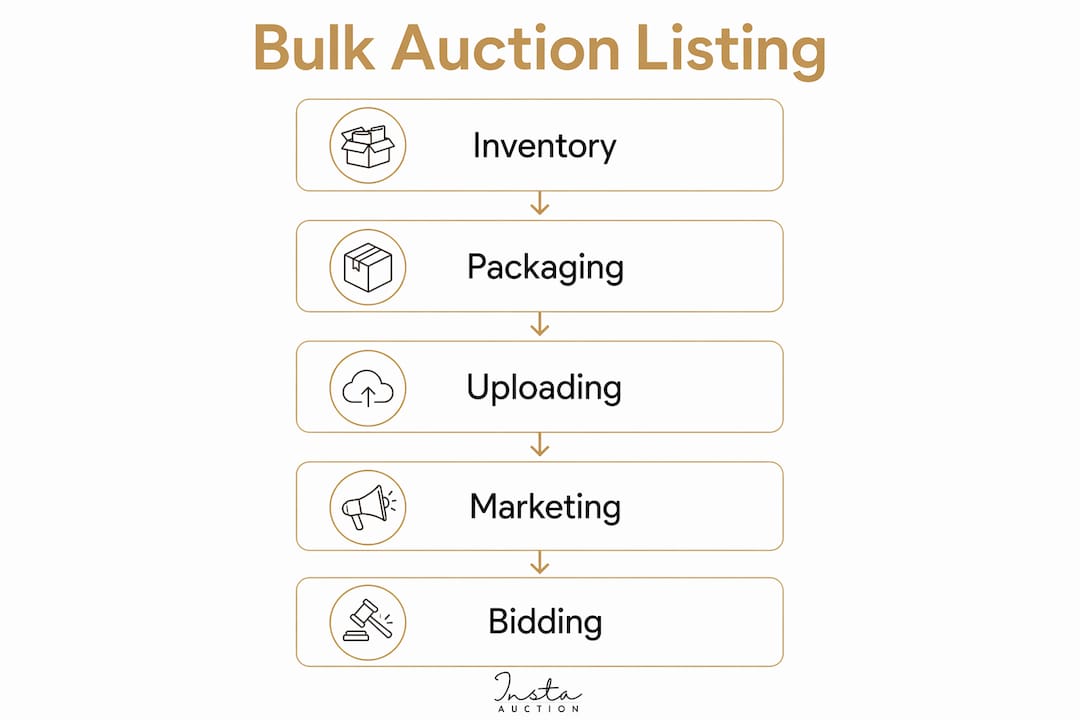
5. Bidding, payment, and removal
Online bidding opens and closes on a fixed schedule. After the auction closes, winners pay and arrange removal within a defined move-out window. Inspection and move-out periods are strictly enforced to protect facilities and keep asset removal on schedule. Sellers who communicate these deadlines clearly in their listings avoid disputes and penalties.
Pro Tip: Always include the move-out deadline and inspection dates directly in the lot description, not just in the terms and conditions. Buyers who see logistics details upfront bid with more confidence.
How does bulk listing differ between liquidation and online marketplaces?
The mechanics of bulk auction listing shift significantly depending on the selling environment. Understanding those differences helps you choose the right approach for your inventory type.
In retail liquidation, the focus is on lotting. Surplus stock, customer returns, and overstock are bundled by category and condition, then sold at 10%–30% of retail value to wholesale buyers and resellers. That discount range reflects the risk buyers accept when purchasing lots they may not fully inspect. Buyers in this channel are typically professional resellers, not individual consumers.
Online marketplaces operate differently. Sellers upload multiple individual listings or multi-quantity variations in bulk, but each listing targets a single buyer. The goal is speed of listing management, not lot bundling. Auction dynamics are also different: marketplace auctions use individual buyer bidding mechanisms, while liquidation auctions often require buyer pre-qualification and enforce strict removal windows.
The table below captures the key operational differences:
| Factor | Retail liquidation auctions | Online marketplace bulk listing |
|---|---|---|
| Primary goal | Maximize lot value for wholesale buyers | Speed up individual listing creation |
| Lot structure | Grouped by condition, category, or brand | Individual SKUs or multi-quantity variations |
| Buyer type | Professional resellers, wholesalers | General consumers, collectors |
| Pricing mechanism | Starting bid, often 10%–30% of retail | Dynamic bidding or fixed price |
| Buyer qualification | Often required | Rarely required |
| Move-out window | Strictly enforced | Not applicable |
One misconception is that “bulk” implies randomness or low quality. Organized, strategically grouped lots consistently sell better and command higher prices than random collections. Complete system lots, such as a matched set of restaurant kitchen equipment, attract targeted professional buyers who pay a premium for functional completeness.
What tools and strategies maximize bulk listing efficiency?
The right tools cut listing time dramatically. The right strategy determines whether buyers bid aggressively or pass.
Cataloging and photo processing
AI-driven cataloging tools now process images at scale. AI multi-photo cataloging can handle up to 6,000 lots per hour, auto-generating titles and condition notes from photos. That same technology reduces human cataloging time from 70–95 hours for 300 lots to minutes. For high-volume sellers, this is the single biggest time-saving tool available.
Categorization and grading criteria
Grading standards vary by industry, but the principle is consistent: buyers need to know exactly what condition they are bidding on. Use a defined grading scale (A, B, C, or new/like new/good/fair/poor) and apply it consistently across every lot. Inconsistent grading is the fastest way to lose repeat buyers.
Bulk listing best practices
- Validate your CSV file against the platform’s template before uploading. A single column mismatch can cause an entire batch to fail.
- Use variation listings for uniform products (same item in multiple sizes or colors) to consolidate inventory under one listing.
- Set starting bids low enough to attract early bidders but high enough to cover your floor price. A low starting bid with no reserve generates more bids and often a higher final price than a high starting bid.
- Sync inventory in real time if you sell across multiple channels. Overselling a lot that no longer exists damages your seller reputation.
- Write lot titles that include the brand, category, condition grade, and quantity. “10x Sony WH-1000XM5 Headphones, Grade B, Open Box” outperforms “Lot of Headphones” every time.
Pro Tip: Run a test upload of 5–10 listings before submitting your full batch. Catching a formatting error on 10 listings is far less damaging than discovering it after 500 listings fail.
What are the common pitfalls in bulk auction listing?
Bulk listing at scale amplifies both good practices and bad ones. A single error in a CSV template can fail hundreds of listings at once. Understanding where sellers go wrong is as valuable as knowing what to do right.
- CSV formatting errors are the most common cause of bulk listing failures. Mismatched column headers, special characters in description fields, and incorrect date formats all trigger upload rejections. Always download the platform’s current template before each batch upload, since templates change.
- Over-diversified lots dilute buyer interest. A lot containing electronics, clothing, and kitchenware appeals to no specific buyer segment. Buyers who specialize in one category will pass on mixed lots, reducing competition and final prices.
- Overly large lots limit bidder accessibility. A pallet of 500 mixed items may deter smaller resellers who lack the storage or capital to absorb that volume. Breaking large inventories into smaller, focused lots often generates more total revenue.
- Bidder criteria errors cut both ways. Bidding criteria must balance being restrictive enough to qualify serious bidders but not so tight that competition drops. Requiring a $10,000 deposit to bid on a $500 lot eliminates most legitimate buyers.
- Unclear lot descriptions reduce buyer confidence and final prices. Vague language like “some wear” or “untested” signals risk. Specific language like “screen has one 2mm scratch, all functions tested and working” builds trust and justifies higher bids.
- Missing timeline communication creates logistical chaos. Buyers who miss the inspection window or move-out deadline create facility problems and payment disputes. State all dates in the listing body, not only in attached terms documents.
Key Takeaways
Bulk auction listing succeeds when sellers combine precise grading, strategic lot grouping, and clean data management across every stage of the auction process.
| Point | Details |
|---|---|
| Define your lot structure first | Group items by condition and category before touching any upload tool to maximize buyer appeal. |
| Use AI cataloging for speed | AI tools can process thousands of lots per hour, cutting manual cataloging time from days to minutes. |
| Match the tool to the environment | Use CSV templates and bulk dashboards for marketplaces; use structured lot data for liquidation platforms. |
| Communicate all timeline dates | Include inspection windows and move-out deadlines in the lot description, not just in terms documents. |
| Balance bidder criteria carefully | Overly restrictive deposit requirements reduce competition; overly lenient criteria attract unqualified bidders. |
What I’ve learned from watching bulk auction sellers succeed and fail
The sellers who consistently get the best results from bulk auctions are not the ones with the most inventory. They are the ones with the most discipline in how they organize it. I have seen high-volume sellers with thousands of units generate disappointing returns because they treated “bulk” as a synonym for “dump everything and hope.” The buyers on the other end of those auctions are professionals. They know exactly what they want, and they will not overpay for a lot that forces them to sort through irrelevant items.
The arrival of AI cataloging tools has genuinely changed what is possible for smaller sellers. What used to require a team of catalogers working for days can now be done by one person with a camera and the right software. That shift levels the playing field, but it also raises buyer expectations. If your competitor’s listings have clean AI-generated titles and condition notes, your hand-typed descriptions look unprofessional by comparison.
The bidder criteria question is one that most sellers get wrong in one direction or the other. Setting criteria too loose fills your auction with window shoppers who never pay. Setting them too tight kills competition and hands the lot to the one bidder who qualified. The right answer depends on lot value, buyer pool size, and how urgently you need to move the inventory. There is no universal formula, but erring toward accessibility on lower-value lots and toward qualification on high-value ones is a reasonable starting point.
Transparency in grading is the single most underrated factor in bulk auction outcomes. Buyers who trust your condition descriptions bid higher because they feel less risk. Buyers who have been burned by vague descriptions bid lower or not at all. Building a reputation for accurate grading is a long-term asset that compounds with every auction you run.
— Admin
How Insta-auction supports your bulk listing and liquidation goals
Sellers who want expert support for bulk lot sales and asset liquidation will find that Insta-auction brings a different level of service to the process. The platform pairs trained appraisers with multi-channel digital marketing to position your lots in front of qualified buyers, not just the widest possible audience.

Insta-auction specializes in pre-loved luxury items and collectibles, making it the right fit for sellers who need accurate appraisal alongside bulk listing support. A portion of every sale goes to selected charities, so your liquidation also contributes to a broader cause. Sellers looking to get started can review the full process on the how to sell page, or explore luxury goods auctions to see how high-value lots are handled from appraisal to final bid.
FAQ
What does bulk auction listing involve at its core?
Bulk auction listing involves creating and uploading multiple product or lot listings to an auction platform simultaneously, using CSV files or bulk management software to reduce manual entry time and manage large inventories efficiently.
What is the difference between bulk lot auction selling and standard bulk listing?
Bulk lot auction selling groups multiple physical items into categorized lots sold as a single unit, typically in liquidation settings at 10%–30% of retail value. Standard bulk listing uploads many individual product listings at once without bundling items together.
How do I avoid CSV errors when bulk uploading auction listings?
Download the platform’s current CSV template before each upload, validate all column headers, and run a test batch of 5–10 listings before submitting the full file to catch formatting issues early.
Why do organized lots sell for more than random mixed lots?
Strategically grouped lots attract targeted professional buyers who specialize in specific categories. Complete, function-matched lots reduce buyer sorting effort and signal quality, which drives higher bids and faster sales.
How long does the bulk auction process typically take from listing to settlement?
The timeline varies by platform and lot type, but industrial and liquidation auctions typically follow six stages: inventory, marketing, inspection, bidding, payment, and removal. Each stage has defined windows, and the full cycle commonly runs from one to several weeks depending on lot complexity and buyer logistics.