

An absentee bid auction is a bidding method where you authorize the auction house to bid on your behalf up to a maximum amount you set before the sale begins. You never need to attend in person, stay by the phone, or watch a live stream. Absentee bids are standard and binding across major auction houses including Christie’s and Sotheby’s, making this one of the most widely used methods for participating in auctions across time zones and schedules. The auction house bids incrementally on your behalf, securing the lot at the lowest possible price within your limit.
What is an absentee bid auction and how does it work?
An absentee bid is a formal, pre-authorized instruction telling the auction house exactly how high to bid for you. The industry also calls this a “commission bid” or “order bid,” and both terms refer to the same process. Understanding the distinction matters because auction catalogs and registration forms often use these terms interchangeably.
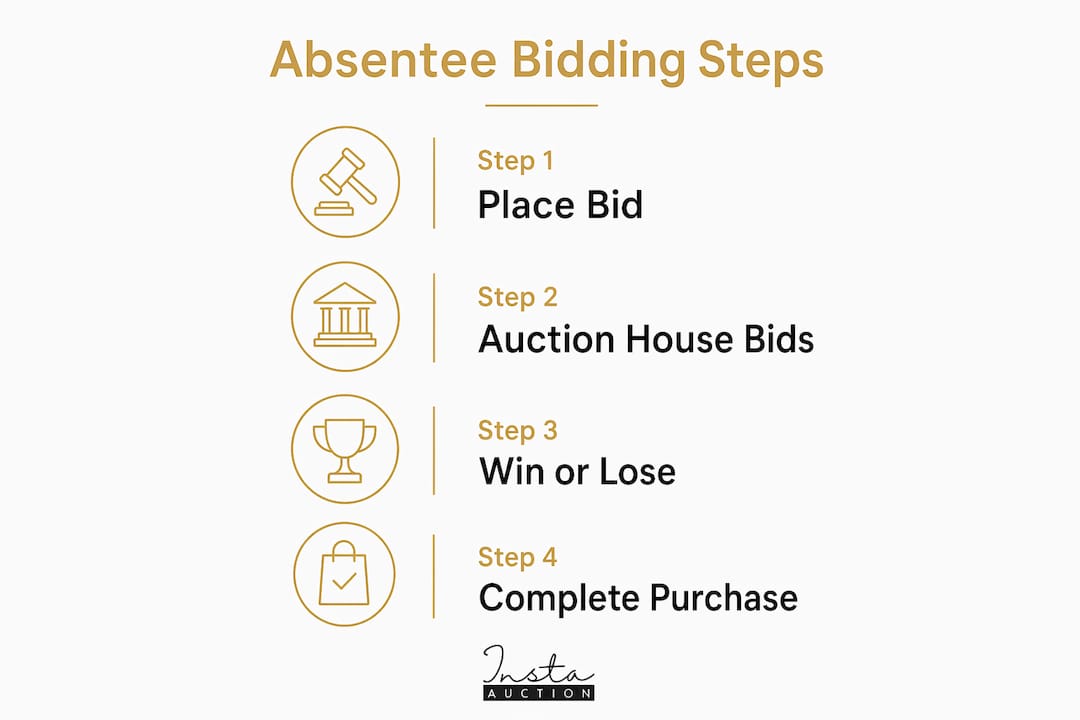
The core mechanic is incremental bidding. The auction house bids progressively to secure the lot at the lowest winning price within your limit, not by jumping straight to your maximum. If your max is $500 and the live room opens at $200, the auctioneer does not immediately call $500. Instead, they bid just enough to stay ahead of competing bids, one increment at a time.

Absentee bids remain confidential, known only to designated staff and the auctioneer. No other bidder, phone representative, or online participant can see your maximum. That confidentiality protects your negotiating position and prevents anyone from gaming the bidding against you.
The step-by-step absentee bid process
- Register with the auction house. Create an account or complete a registration form. Most houses require identity verification and a credit card on file before accepting bids.
- Review the catalog. Identify the lot number, estimate range, and any reserve price listed. Your maximum bid should reflect the lot’s realistic market value.
- Submit your maximum bid. Bidders submit their max bid online, by email, phone, or fax through the auction house’s official channel. Each method is equally valid, but online portals generate an automatic confirmation.
- Meet the deadline. Most houses require absentee bids 24 to 48 hours before the auction. Bids submitted after the cutoff are typically rejected.
- The auctioneer bids on your behalf. During the live sale, the auctioneer advances your bid incrementally against room, phone, and online competition.
- Receive the result. Win or lose, the auction house notifies you after the sale. If you win, absentee bids are legally binding and you are contractually obligated to complete the purchase.
What are the benefits of absentee bids?
Absentee bidding solves a real problem: most collectors and buyers cannot attend every auction that interests them. The benefits go beyond simple convenience.
- Time zone freedom. A buyer in Tokyo can bid on a New York estate sale without waking at 3:00 AM. The bid runs automatically during the live event.
- Budget discipline. You set your ceiling before the excitement of a live room takes over. Emotional overspending, a common problem for live bidders, becomes structurally impossible.
- No real-time commitment. Telephone bidding requires real-time availability; absentee bidding works independently once your maximum is submitted. You can be in a meeting, on a flight, or asleep.
- Multi-lot coverage. You can place absentee bids on dozens of lots in a single auction. A live or phone bidder can only focus on one lot at a time.
- Discretion. No one in the room knows you are bidding, how high you will go, or whether you are a serious collector or a first-time buyer.
Pro Tip: If you are targeting multiple lots in the same auction, absentee bidding is the only practical method. Phone lines are assigned per lot, and you cannot hold multiple lines simultaneously at most houses.
Strategic tips for placing absentee bids
Most bidders set a round number as their maximum, and that habit costs them wins. The most effective absentee bidding strategy involves a few specific techniques that most guides never mention.
- Add a “+1” or “+2” increment to your maximum. Adding +1 or +2 increments to your maximum bid authorizes the auctioneer to top identical bids by one small increment. If your max is $500 and another absentee bid also sits at $500, your +1 instruction pushes you to $510 and wins the tie.
- Submit early. Tied bids are awarded to the earliest submitted absentee bid at most major houses. Submitting the day the catalog drops gives you a structural advantage over bidders who wait until the deadline.
- Bid just above estimate midpoints. Estimates are published. Predictable bidders cluster at the low estimate. Bidding slightly above the midpoint of the estimate range puts you ahead of the crowd without reaching the high estimate.
- Confirm your bid in writing. Even if you called in your bid, follow up with an email. Written confirmation protects you if a dispute arises over the amount recorded.
- Check increment tables before setting your max. Auction houses use fixed increment schedules. A max of $950 may only beat a $900 bid by $50, while a max of $1,000 could jump you two increments ahead depending on the table.
Pro Tip: Never set your maximum at a round number like $500 or $1,000. Bid $520 or $1,050 instead. Round numbers are where ties cluster, and the +1 trick only works if you think about it before submitting.
How to place absentee bids at different auction platforms
The submission process varies by platform, but the core steps follow a consistent pattern. Here is how to navigate each environment.
- Online portal submission. Log into your registered account on the auction house website. Navigate to the lot page, enter your maximum bid, and confirm. The system timestamps your bid automatically, which matters for tie-breaking. You receive an email confirmation immediately.
- Email submission. Send a formal bid letter to the absentee bids department. Include your full name, account number, lot number, lot description, and maximum bid amount. Request a written confirmation reply. Keep that reply on file.
- Phone submission. Call the absentee bids desk during business hours. A staff member records your details and reads them back for verification. Follow up with an email confirming the call, the lot, and the amount discussed.
- Fax submission. Some traditional houses still accept fax. Use the official bid form from the catalog or website. Send during business hours and call to confirm receipt.
- Account registration requirements. New bidders almost always need to register before placing any bid. Registration typically requires a government-issued ID, a valid credit card, and agreement to the auction terms. Complete this step well before the deadline, not on the final day.
For estate auction participation, the same process applies. The key difference is that estate sales often move faster and cover more lots, making early submission even more critical.
When is absentee bidding the right choice?
Absentee bidding is not just a fallback for people who cannot attend. For certain bidders and situations, it is the superior method.
| Situation | Why absentee bidding fits |
|---|---|
| International buyer | No travel costs, no time zone conflict, full participation |
| Multiple lots in one sale | Cover every target lot without managing phone lines |
| Collector with a firm budget | Maximum bid enforces discipline before emotions run high |
| First-time auction participant | Simplified process with no live pressure or fast-paced decisions |
| Busy professional | No need to block calendar time for the live event |
Collectors pursuing luxury goods at auction find absentee bidding especially useful. High-value lots attract competitive phone and room bidding, and an absentee bid placed early with a well-researched maximum holds its own against live competition. The auctioneer has a legal obligation to execute your bid faithfully up to your limit.
First-time bidders also benefit significantly. Live auction rooms move fast, use shorthand terminology, and can feel disorienting. Absentee bidding removes all of that pressure. You research the lot, set your number, and let the process run.
Key Takeaways
Absentee bidding is the most practical method for serious collectors who prioritize budget control, flexibility, and multi-lot coverage over the experience of live participation.
| Point | Details |
|---|---|
| Definition is precise | An absentee bid is a pre-authorized instruction for the auctioneer to bid incrementally up to your set maximum. |
| Confidentiality is guaranteed | Your maximum bid is known only to designated staff, protecting your position throughout the sale. |
| Early submission wins ties | Most houses award tied bids to the earliest submission, so place bids as soon as the catalog opens. |
| Round numbers lose ties | Adding +1 or +2 increments to your maximum breaks ties in your favor at no meaningful extra cost. |
| Binding obligation applies | Winning an absentee bid creates a legal purchase obligation, so set your maximum with full intent to pay. |
What I have learned from watching absentee bids win and lose
The most common mistake I see is treating absentee bidding as a passive activity. Bidders submit a round number, forget about it, and then wonder why they lost a tie. The mechanics of absentee bidding reward preparation, not luck.
The +1 increment tip is genuinely underused. Most bidders have never heard of it, and the ones who have often skip it because it feels trivial. It is not trivial. At a competitive auction, a $10 increment on a $1,000 lot is the difference between winning and losing, and you would have paid $1,010 anyway if the room pushed you there.
Timing matters more than most guides admit. I have seen bidders submit identical maximums, and the lot goes to whoever registered their bid first. That is not a technicality. It is a real rule at Christie’s, Sotheby’s, and most regional houses. Submitting early is free. There is no reason to wait.
My strongest recommendation is to treat your maximum bid like a budget line, not a wish. Research comparable sales, check recent auction results for the same artist or maker, and set a number you are genuinely comfortable paying. Absentee bidding removes the emotional pressure of the room, but only if you do the work before you submit.
— Admin
Absentee bidding with Insta-auction
Insta-auction supports absentee bidding across a wide range of categories, from pre-loved luxury items to collectibles and estate sales. The platform’s expert appraisers assess each lot before it goes live, so you can set a confident maximum based on real market value rather than guesswork.

For buyers interested in estate sale auctions, Insta-auction provides clear lot descriptions, condition reports, and estimate ranges that make absentee bid research straightforward. A portion of every sale goes to selected charities, so your bid contributes beyond the purchase. Browse current lots and place your absentee bid through the Insta-auction platform before the next sale closes.
FAQ
What is an absentee bid in simple terms?
An absentee bid is a pre-set maximum you give the auction house before the sale. The auctioneer bids on your behalf up to that amount while you are away.
Are absentee bids legally binding?
Yes. If your absentee bid wins the lot, you are contractually obligated to complete the purchase at the winning price.
How early should I submit an absentee bid?
Submit as early as possible after the catalog is released. Most houses require bids 24 to 48 hours before the auction, and early submission wins ties.
What happens if two absentee bids are the same amount?
Tied bids go to the earliest submitted bid at most major auction houses. Adding a +1 increment to your maximum also helps break ties in your favor.
Is absentee bidding better than telephone bidding?
Absentee bidding suits bidders who cannot commit to being available live. Telephone bidding offers real-time interaction but requires you to be reachable at the exact moment your lot comes up.